The Normal Christian Life
Watchman Nee
Expanded Edition
"It's no longer I . . . but
Jesus Christ!"

What is the normal Christian life? We do well at the outset to ponder
this question. The object of these studies is to show that it is something very
different from the life of the average Christian. Indeed a consideration of the
written Word of God -- of the Sermon on the Mount for example -- should lead us
to ask whether such a life has ever in act been lived upon the earth, save
only by the Son of God Himself. But in that last saving clause lies
immediately the answer to our question.
The Apostle Paul gives us his own definition of the Christian life in
Galatians
2:20.
I have died, but Jesus Christ lives in me. And I now live by faith in
the Son of God, who loved me and gave his life for me.
It is "no longer I, but Christ". Here he is not stating something
special or peculiar -- a high level of Christianity. He is, we believe,
presenting God's normal for a Christian, which can be summarized in the words: I
live no longer, but Jesus Christ lives His life in me.
God makes it quite clear in His Word that He has only one answer to
every human need -- His Son, Jesus Christ. In all His dealings with us He works
by taking us out of the way and substituting Christ in our place. The Son
of God died instead of us for our forgiveness: He lives instead of us for our
deliverance. So we can speak of two substitutions -- a Substitute on the Cross
who secures our forgiveness and a Substitute within who secures our victory. It
will help us greatly, and save us from much confusion, if we keep constantly
before us this fact, that God will answer all our questions in one way only,
namely, by showing us more of His Son.
A. Our Dual Problem: Sins and Sin
We shall take now as a starting-point for our study of the normal
Christian life that great exposition of it which we find in the first eight
chapters of the Epistle to the Romans, and we shall approach our subject from a
practical and experimental point of view. It will be helpful first of all to
point out a natural division of this section of Romans into two, and to note
certain striking differences in the subject-matter of its two parts.
The first eight chapters of Romans form a self-contained unit. The
four-and-a-half chapters from
Romans 1:1 to 5:11
form the first half of this unit and the three-and-a-half chapters from
Romans 5:12 to
8:39 the second half. A careful reading will show us that the subject-matter
of the two halves is not the same. For example, in the argument of the first
section we find the plural word `sins' given prominence. In the second section,
however, this changed, for while the word `sins' hardly occurs once, the
singular word `sin' is used again and again and is the subject mainly dealt
with. Why is this?
It is because in the first section it is a question of the sins I
have committed before God, which are many and can be enumerated, whereas in the
second it is a question of sin as a principle working in me. No matter how many
sins I commit, it is always the one sin principle that leads to them. I need
forgiveness for my sins, but I need also deliverance from the power of sin. The
former touches my conscience, the latter my life. I may receive forgiveness for
all my sins, but because of my sin I have, even then, no abiding peace of
mind.
When God's light first shines into my heart my one cry is for
forgiveness, for I realize I have committed sins before Him; but when once I
have received forgiveness of sins I make a new discovery, namely, the discovery
of sin, and I realize not only that I have committed sins before God but that
there is something wrong within. I discover that I have the nature of a sinner.
There is an inward inclination to sin, a power within that draws to sin. When
that power breaks out I commit sins. I may seek and receive forgiveness, but
then I sin once more. So life goes on in a vicious circle of sinning and being
forgiven and then sinning again. I appreciate the blessed fact of God's
forgiveness, but I want something more than that: I want deliverance. I need
forgiveness for what I have done, but I need also deliverance from what I
am.
B. God's Dual Remedy: The Blood and the Cross
Thus in the first eight chapters of Romans two aspects of
salvation are presented to us: firstly, the forgiveness of our sins, and
secondly, our deliverance from sin. But now, in keeping with this fact, we must
notice a further difference.
our deliverance from sin. But now, in keeping with this fact, we must
notice a further difference.
In the first part of
Romans 1 to 8, we twice have reference to the
Blood of the Lord Jesus, in
Romans
3:25 God sent
Jesus to be the punishment for our Sin and relieve God’s anger upon us. Jesus
offered His life's blood, so that by faith in His sacrifice we could turn to
God. God did this to show that in the past He was right to be patient and
forgive sinners.
and
Romans
5:9 And now
that God has accepted us because Jesus Christ sacrificed His life's blood for
us, we will also be kept safe from God's judgment.
In the second, a new idea is introduced
Romans
6:6 Our sinful
selves were nailed to the cross with Jesus Christ so that sin would lose it’s
power in our lives, and we would no longer be slaves to sin.
Our sinful selves have been "crucified" with Jesus Christ. The argument of the first part
gathers round that aspect of the work of the Lord Jesus which is represented by
`the Blood' shed for our justification through "the remission of sins". This
terminology is however not carried on into the second section, where the
argument centers now in the aspect of His work represented by `the Cross', that
is to say, by our union with Christ in His death, burial and resurrection. This
distinction is a valuable one. We shall see that the Blood deals with what we
have done, whereas the Cross deals with what we are. The Blood disposes of our
sins, while the Cross strikes at the root of our capacity for sin. The latter
aspect will be the subject of our consideration in later chapters.
C. The Problem Of Our Sins
We begin, then, with the precious Blood of the Lord Jesus Christ
and its value to us in dealing with our sins and justifying us in the sight of
God. This is set forth for us in the following passages:
"All have sinned" (Romans
3:23).
All of us have sinned and fallen short of God's glory.
Romans
3:23 All of us
have sinned and fall short of God's glorious standard.
"God commends his own love toward us, in that, while we were yet
sinners, Christ died for us. Much more then, being now justified by his blood,
shall we be saved from the wrath of God through him" (Romans
5:8,9).
Romans
5:8 But God
shows His great love for us by having Jesus Christ die for us, even though we
were sinful.
Romans
5:9 And now
that God has accepted us because Jesus Christ sacrificed His life's blood for
us, we will also be kept safe from God's judgment.
But there is more! Now that God has accepted us because Christ
sacrificed his life's blood, we will also be kept safe from God's anger.
"Being justified freely by his grace through the redemption that is
in Christ Jesus: whom God set forth to be a propitiation, through faith, by his
blood, to show his righteousness, because of the passing over of the sins one
aforetime, in the forbearance of God; for the showing, I say, of his
righteousness at this present season: that he might himself be just, and the
justifier of him that hath faith in Jesus"
Romans
3:24 But God
kindly accepts us and declares us “not guilty” because of Jesus Christ, who
purchased us.
Romans
3:25 God sent
Jesus to be the punishment for our Sin and relieve God’s anger upon us. Jesus
offered His life's blood, so that by faith in His sacrifice we could turn to
God. God did this to show that in the past He was right to be patient and
forgive sinners.
Romans
3:26 This
shows us that God is right when He accepts people today who have faith in Jesus.
We shall have reason at a later stage in our study to look
closely at the real nature of the fall and the way of recovery. At this point we
will just remind ourselves that when sin came in it found expression in an act
of disobedience to God
Romans
5:19 Adam
disobeyed God and caused others to be sinners. But Jesus obeyed God to make many
people acceptable to God.
Now we must remember that whenever this occurs the thing that
immediately follows is guilt.
Sin enters as disobedience, to create first of all a separation
between God and man whereby man is put away from God. God can no longer have
fellowship with him, for there is something now which hinders, and it is that
which is known throughout Scripture as `sin'. Thus it is first of all God who
says,
Romans
3:9 What does
all this mean? Does it mean that we Jews are better off than the Gentiles? No,
it doesn't! Jews, as well as Gentiles, are ruled by the power of Sin.
Then, secondly, that sin in man, which henceforth
constitutes a barrier to his fellowship with God, gives rise in him to a sense
of guilt -- of estrangement from God. Here it is man himself who, with the help
of his awakened conscience, says, "I have sinned"
Luke 15:18
I will go to my father and say to him,
'Father, I have sinned against God in heaven and against you.
. Nor is this all, for sin also provides Satan with his ground of
accusation before God, while our sense of guilt gives him his ground of
accusation in our hearts; so that, thirdly, it is `the accuser of the brethren'
Revelation 12:10
Then I heard a voice from heaven shout, "Our God has shown his saving power, and
his kingdom has come! God's own Chosen One has shown his authority. Satan
accused our people in the presence of God day and night and now he has been
thrown out!
who now says, `You have sinned'.
To redeem us, therefore, and to bring us back to the purpose of
God, the Lord Jesus had to do something about these three questions of sin and
of guilt and of Satan's charge against us. Our sins had first to be dealt with,
and this was effected by the precious Blood of Christ. Our guilt has to be dealt
with and our guilty conscience set at rest by showing us the value of that
Blood. And finally the attack of the enemy has to be met and his accusations
answered. In the Scriptures the Blood of Christ is shown to operate effectually
in these three ways, God-ward, Man-ward and Satan-ward.
There is thus an absolute need for us to appropriate these values
of the Blood if we are to go on. This is a first essential. We must have a basic
knowledge of the fact of the death of the Lord Jesus as our Substitute upon the
Cross, and a clear apprehension of the efficacy of His Blood for our sins, for
without this we cannot be said to have started upon our road. Let us look then
at these three matters more closely.
D. The Blood Is Primarily For God
The Blood is for atonement and has to do first with our standing
before God. We need forgiveness for the sins we have committed, lest we come
under judgment; and they are forgiven, not because God overlooks what we have
done but because He sees the Blood. The Blood is therefore not primarily for us
but for God. If I want to understand the value of the Blood I must accept God's
valuation of it, and if I do not know something of the value set upon the Blood
by God I shall never know what its value is for me. It is only as the estimate
that God puts upon the Blood of Christ is made known to me by His Holy Spirit
that I come into the good of it myself and find how precious indeed the Blood is
to me. But the first aspect of it is God-ward. Throughout the Old and New
Testaments the word `blood' is used in connection with the idea of atonement, I
think over a hundred times, and throughout it is something for God.
In the Old Testament calendar there is one day that has a great
bearing on the matter of our sins and that day is the Day of Atonement. Nothing
explains this question of sins so clearly as the description of that day. In
Leviticus 16:3
Before entering this most holy
place, you must offer a bull as a sacrifice for your sins and a ram as a
sacrifice to please me.
Leviticus 16:4
You will take a bath and put on the
sacred linen clothes, including the underwear, the robe, the sash, and the
turban.
Leviticus 16:5
Then the community of Israel will
bring you a ram and two goats, both of them males. The goats are to be used
as sacrifices for sin, and the ram is to be used as a sacrifice to please
me.
Leviticus 16:6
Aaron, you must offer the bull as a
sacrifice of forgiveness for your own sins and for the sins of your family.
Leviticus 16:7
Then you will lead the two goats
into my presence at the front of the sacred tent,
Leviticus 16:8
where I will show you which goat
will be sacrificed to me and which one will be sent into the desert as the
escape goat.
Leviticus 16:9
After you offer the first goat as a
sacrifice for sin,
Leviticus 16:10
the other one must be presented to
me alive, before you send it into the desert to take away the sins of the
people.
Leviticus 16:11
You must offer the bull as a
sacrifice to ask forgiveness for your own sins and for the sins of your
family.
Leviticus 16:12
Then you will take a fire pan of
live coals from the bronze altar, together with two handfuls of finely
ground incense, into the most holy place.
Leviticus 16:13
There you will present them to me
by placing the incense on the coals, so that the place of mercy will be
covered with a cloud of smoke. Do this, or you will die right there!
Leviticus 16:14
Next, use a finger to sprinkle some
of the blood on the place of mercy, which is on the lid of the sacred chest;
then sprinkle blood seven times in front of the chest.
Leviticus 16:15
Aaron, you must next sacrifice the
goat for the sins of the people, and you must sprinkle its blood inside the
most holy place, just as you did with the blood of the bull.
Leviticus 16:16
By doing this, you will take away
the sins that make both the most holy place and the people of Israel
unclean. Do the same for the sacred tent, which is here among the people.
we find that on the Day of Atonement the blood was taken from the sin offering
and brought into the Most Holy Place and there sprinkled before the Lord seven
times. We must be very clear about this. On that day the sin offering was
offered publicly in the court of the tabernacle. Everything was there in full
view and could be seen by all. But the Lord commanded that no man should enter
the tabernacle itself except the high priest. It was he alone who took the blood
and, going into the Most Holy Place, sprinkled it there to make atonement before
the Lord. Why? Because the high priest was a type of the Lord Jesus in His
redemptive work
Hebrews 9:12
Then Jesus Christ went once for all into
the most Holy Place and freed us from sin forever. He did this by offering his
own Life blood instead of the blood of goats and bulls.
and so, in figure, he was the one who did the work. None but he could
even draw near to enter in. Moreover, connected with his going in there was but
one act, namely, the presenting of the blood to God as something He had
accepted, something in which He could find satisfaction. It was a transaction
between the high priest and God in the Sanctuary, away from the eyes of the men
who were to benefit by it. The Lord required that. The Blood is therefore in the
first place for Him.
Earlier even than this there is described
Exodus 12:13
The blood on the houses will show me
where you live, and when I see the blood, I will pass over you, and you won't
be bothered by the terrible disasters I will bring upon Egypt.
the shedding of the blood of the Passover Lamb in Egypt for Israel's
redemption. This is again, I think, one of the best types in the Old Testament
of our redemption. The blood was put on the lintel and on the door-posts,
whereas the meat, the flesh of the lamb, was eaten inside the house; and God
said: "When I see the blood, I will pass over you". Here we have another
illustration of the fact that the blood was not meant to be presented to man but
to God, for the blood was put on the lintel and on the door-posts, where those
feasting inside the house would not see it.
E. God Is Satisfied
It is God's holiness, God's righteousness, which demands that a
sinless life should be given for man. There is life in the Blood, and that Blood
has to be poured out for me, for my sins. God is the One who requires it to be
so. God is the One who demands that the Blood be presented, in order to satisfy
His own righteousness, and it is He who says: `When I see the blood', I
will pass over you.' The Blood of Christ wholly satisfies God.
Now I desire to say a word at this point to my younger brethren in
the Lord, for it is here that we often get into difficulties. As unbelievers we
may have been wholly untroubled by our conscience until the Word of God began to
arouse us. Our conscience was dead, and those with dead consciences are
certainly of no use to God. But later, when we believed, our awakened conscience
may have become acutely sensitive, and this can constitute a real problem to us.
The sense of sin and guilt can become so great, so terrible, as almost to
cripple us by causing us to lose sight of the true effectiveness of the Blood.
It seems to us that our sins are so real, and some particular sin may trouble us
so many times, that we come to the point where to us our sins loom larger than
the Blood of Christ.
Now the whole trouble with us is that we are trying to sense it; we
are trying to feel its value and to estimate subjectively what the Blood is for
us. We cannot do it; it does not work that way. The Blood is first for God to
see. We then have to accept God's valuation of it. In doing so we shall find our
valuation. If instead we try to come to a valuation by way of our feelings we
get nothing; we remain in darkness. No, it is a matter of faith in God's Word.
We have to believe that the Blood is precious to God because He says it is
so
1Peter 1:18
You were rescued from the useless way of
life that you learned from your ancestors. But you know that you were not
rescued by such things as silver or gold that don't last forever.
1Peter 1:19
You were rescued by the precious blood of
Jesus Christ, that spotless and innocent lamb.
If God can accept the Blood as a payment for our sins and as
the price of our redemption, then we can rest assured that the debt has been
paid. If God is satisfied with the Blood, then the Blood must be acceptable. Our
valuation of it is only according to His valuation -- neither more nor less. It
cannot, of course, be more, but it must not be less. Let us remember that He is
holy and He is righteous, and that a holy and righteous God has the right to say
that the Blood is acceptable in His eyes and has fully satisfied Him.
F. The Blood And The Believer's Access
The Blood has satisfied God; it must satisfy us also. It has
therefore a second value that is man ward in the cleansing of our conscience.
When we come to the Epistle to the Hebrews we find that the Blood does this. We
are to have "hearts sprinkled from an evil conscience"
Hebrews 10:22
So let's come near God with pure
hearts and a confidence that comes from having faith. Let's keep our hearts
pure, our consciences free from evil, and our bodies washed with clean
water.
This is most important. Look carefully at what it says. The writer
does not tell us that the Blood of the Lord Jesus cleanses our hearts, an then
stop there in his statement. We are wrong to connect the heart with the Blood in
quite that way. It may show a misunderstanding of the sphere in which the Blood
operates to pray, `Lord, cleanse my heart from sin by Thy Blood'. The heart, God
says, is "desperately sick"
Jeremiah 17:9
You people of Judah are so deceitful
that you even fool yourselves, and you can't change.
, and He must do something more fundamental than cleanse it: He must
give us a new one.
We do not wash and iron clothing that we are going to throw away.
As we shall shortly see, the `flesh' is too bad to be cleansed; it must be
crucified. The work of God within us must be something wholly new. "A new heart
also will I give you, and a new spirit will I put within you"
Ezekiel 36:26
I will take away your stubborn heart
and give you a new heart and a desire to be faithful. You will have only
pure thoughts,
No, I do not find it stated that the Blood cleanses our hearts.
Its work is not subjective in that way, but wholly objective, before God. True,
the cleansing work of the Blood is seen here in
Hebrews 10:18
When sins are forgiven, there is no
more need to offer sacrifices.
Hebrews 10:19
My friends, the blood of Jesus gives
us courage to enter the most holy place
Hebrews 10:20
by a new way that leads to life! And
this way takes us through the curtain that is Christ himself.
Hebrews 10:21
We have a great high priest who is in
charge of God's house.
Hebrews 10:22
So let's come near God with pure
hearts and a confidence that comes from having faith. Let's keep our hearts
pure, our consciences free from evil, and our bodies washed with clean
water.
to
have reference to the heart, but it is in relation to the conscience. "Having
our hearts sprinkled from a evil conscience". What then is the meaning of
this?
It means that there was something intervening between myself and
God, as a result of which I had an evil conscience whenever I sought to approach
Him. It was constantly reminding me of the barrier that stood between myself and
Him. But now, through the operation of the precious Blood, something new has
been effected before God which has removed that barrier, and God has made that
fact known to me in His Word. When that has been believed in and accepted, my
conscience is at once cleared and my sense of guilt removed, and I have no more
an evil conscience toward God.
Every one of us knows what a precious thing it is to have a
conscience void of offense in our dealings with God. A heart of faith and a
conscience clear of any and every accusation are both equally essential to us,
since they are interdependent. As soon as we find our conscience is uneasy our
faith leaks away and immediately we find we cannot face God. In order therefore
to keep going on with God we must know the up-to-date value of the Blood. God
keeps short accounts, and we are made nigh by the Blood every day, every hour
and every minute. It never loses its efficacy as our ground of access if we will
but lay hold upon it. When we enter the most Holy Place, on what ground dare we
enter but by the Blood?
But I want to ask myself, am I really seeking the way into the
Presence of God by the Blood or by something else? What do I mean when I say,
`by the Blood'? I mean simply that I recognize my sins, that I confess that I
have need of cleansing and of atonement, and that I come to God on the basis of
the finished work of the Lord Jesus. I approach God through His merit alone, and
never on the basis of my attainment; never, for example, on the ground that I
have been extra kind or patient today, or that I have done something for the
Lord this morning. I have to come by way of the Blood every time. The temptation
to so many of us when we try to approach God is to think that because God has
been dealing with us -- because He has been taking steps to bring us into
something more of Himself and has been teaching us deeper lessons of the Cross
-- He has thereby set before us new standards, and that only by attaining to
these can we have a clear conscience before Him. No! A clear conscience is
never based upon our attainment; it can only be based on the work of the
Lord Jesus in the shedding of His Blood.
I may be mistaken, but I feel very strongly that some of us are
thinking in terms such as these: `Today I have been a little more careful; today
I have been doing a little better; this morning I have been reading the Word of
God in a warmer way, so today I can pray better!' Or again, `Today I have had a
little difficulty with the family; I began the day feeling very gloomy and
moody; I am not feeling too bright now; it seems that there must be something
wrong; therefore I cannot approach God.'
What, after all, is your basis of approach to God? Do you come to
Him on the uncertain ground of your feeling, the feeling that you may have
achieved something for God today? Or is your approach based on something far
more secure, namely, the fact that the Blood has been shed, and that God looks
on that Blood and is satisfied? Of course, were it conceivably possible for the
Blood to suffer any change, the basis of your approach to God might be less
trustworthy. But the Blood has never changed and never will. Your approach to
God is therefore always in boldness; and that boldness is yours through the
Blood and never through your personal attainment. Whatever be your measure of
attainment today or yesterday or the day before, as soon as you make a conscious
move into the Most Holy Place, immediately you have to take your stand upon the
safe and only ground of the shed Blood. Whether you have had a good day or a bad
day, whether you have consciously sinned or not, your basis of approach is
always the same -- the Blood of Christ. That is the ground upon which you may
enter, and there is no other.
As with many other stages of our Christian experience, this
matter of access to God has two phases, an initial and a progressive one. The
former is presented to us in
Ephesians 2:18
And because of Jesus Christ, all of
us can come to the Father by the same Spirit.
Ephesians 2:19
You Gentiles are no longer strangers
and foreigners. You are citizens with everyone else who belongs to the
family of God.
and the latter in
Hebrews 10:10
So we are made holy because Jesus
Christ obeyed God and offered himself once for all.
Hebrews 10:11
The priests do their work each day,
and they keep on offering sacrifices that can never take away sins.
Hebrews 10:12
But Jesus Christ offered himself as a
sacrifice that is good forever and now He is sitting at God's right side,
. Initially, our standing with God was secured by the Blood, for
we are "made nigh in the blood of Christ"
Ephesians 2:13
and you were far from God. But Jesus
Christ offered his life's blood as a sacrifice and brought you near to God.
. But thereafter our ground of continual access is still by the
Blood, for the apostle exhorts us: "Having therefore... boldness to enter into
the holy place by the blood of Jesus... let us draw near"
Hebrews 10:19
My friends, the blood of Jesus gives
us courage to enter the most holy place
Hebrews 10:20
by a new way that leads to life! And
this way takes us through the curtain that is Jesus Christ himself.
Hebrews 10:21
We have a great high priest who is in
charge of God's house.
Hebrews 10:22
So let's come near to God with pure
hearts and a confidence that comes from having faith. Let's keep our hearts
pure, our consciences free from evil, and our bodies washed with clean
water.
. To begin with I was made nigh by the Blood, and to continue in
that new relationship I come through the Blood every time. It is not that I was
saved on one basis and that I now maintain my fellowship on another. You say,
`That is very simple; it is the A.B.C. of the Gospel.' Yes, but the trouble with
many of us is that we have moved away from the A.B.C. We have thought we had
progressed and so could dispense with it, but we can never do so. No, my initial
approach to God is by the Blood, and every time I come before Him it is the
same. Right to the end it will always and only be on the ground of the
Blood.
This does not mean at all that we should live a careless life,
for we shall shortly study another aspect of the death of Christ which shows us
that anything but that is contemplated. But for the present let us be satisfied
with the Blood, that it is there and that it is enough.
We may be weak, but looking at our weakness will never make us
strong. No trying to feel bad and doing penance will help us to be even a little
holier. There is no help there, so let us be bold in our approach because of the
Blood: `Lord, I do not know fully what the value of the Blood is, but I know
that the Blood has satisfied Thee; so the Blood is enough for me, and it is my
only plea. I see now that whether I have really progressed, whether I have
really attained to something or not, is not the point. Whenever I come before
Thee, it is always on the ground of the precious Blood. Then our conscience is
really clear before God. No conscience could ever be clear apart from the Blood.
It is the Blood that gives us boldness.
"No more conscience of sins": these are tremendous words of
Hebrews 10:2
If there were worshipers who already
have their sins washed away and their consciences made clear, there would
not be any need to go on offering sacrifices.
We are cleansed from every sin; and we may truly echo the
words of Paul: "Blessed is the man to whom the Lord will not reckon sin"
Romans 4:8
The Lord blesses the people whose sins
are erased from His book."
G. Overcoming The Accuser
In view of what we have said we can now turn to face the enemy,
for there is a further aspect of the Blood which is Satan-ward. Satan's most
strategic activity in this day is as the accuser of the brethren
Revelation 12:10
Then I heard a voice from heaven
shout, "Our God has shown His saving power, and His kingdom has come! God's
own Chosen One has shown his authority. Satan accused our people in the
presence of God day and night. Now he has been thrown out!
and it is as this that our Lord confronts him with His
special ministry as High Priest "through his own blood"
Hebrews 9:12
Then Jesus Christ went once for ALL
into the most holy place and freed us from sin forever. He did this by
offering his own life blood instead of the blood of bulls and goats.
How then does the Blood operate against Satan? It does so by
putting God on the side of man against him. The Fall brought something into man
which gave Satan a footing within him, with the result that God was compelled to
withdraw Himself. Man is now outside the garden -- beyond reach of the glory of
God
Romans 3:23
All of us have sinned and have fallen short of God's glorious standard.
-- because he is inwardly estranged from God. Because of what man has
done, there is something in him which, until it is removed, renders God morally
unable to defend him. But the Blood removes that barrier and restores man to God
and God to man. Man is in favor now, and because God is on his side he can face
Satan without fear.
You remember that verse in John's first Epistle -- and this is
the translation of it I like best: "The blood of Jesus his Son cleanses us from
every sin" It is not exactly "all sin" in
the general sense, but every sin, every item. What does it mean? Oh, it
is a marvelous thing! God is the light, and as we walk in the light with Him
everything is exposed and open to that light, so that God can see it all --
and yet the Blood is able to cleanse from every sin. What a cleansing! It
is not that I have not a profound knowledge of myself, nor that God has not a
perfect knowledge of me. It is not hat I try to hide something nor that God
tries to overlook something. No, it is that He is in the light and I too am in
the light, and that there the precious Blood cleanses me from every sin.
The Blood is enough for that!
Some of us, oppressed by our own weakness, may at times have been
tempted to think that there are sins which are almost unforgivable. Let us
remember the word: "The blood of Jesus Christ his Son cleanses us from every
sin." Big sins, small sins, sins which may be very black and sins which appear
to be not so black, sins which I think can be forgiven and sins which seem
unforgivable, yes, all sins, conscious or unconscious, remembered or
forgotten, are included in those words: "every sin". "The blood of Jesus his Son
cleanses us from every sin", and it does so because in the first place it
satisfies God.
Since God, seeing all our sins in the light, can forgive them on
the basis of the Blood, what ground of accusation has Satan? Satan may accuse us
before Him, but, "If God is for us, who is against us?"
Romans 8:31
What can we say about all this? If God
is on our side, can anyone be against us?
. God points him to the Blood of His dear Son. It is the
sufficient answer against which Satan has no appeal.
Romans 8:33
If God says his chosen ones are
acceptable to him, can anyone bring charges against them?
Romans 8:34
Or can anyone condemn them? No indeed!
Christ died and was raised to life, and now he is at God's right side,
speaking to him for us.
So here again our need is to recognize the absolute sufficiency
of the precious Blood.
Romans 9:11
Even before they were born or had done
anything good or bad, the Lord told Rebecca that her older son would serve
the younger one.
Romans 9:12
The Lord said this to show that he
makes his own choices and that it wasn't because of anything either of them
had done.
. He was Redeemer once. He has been High Priest and Advocate for
nearly two thousand years. He stands there in the presence of God, and "he is
God's satisfaction for our sins"
1John 2:1
My children, I am writing this so that
you won't sin. But if you do sin, Jesus Christ always does the right thing,
and He will speak to the Father for us.
1John 2:2
Jesus Christ is the sacrifice that takes
away our sins and the sins of all the people of the world.
Note the words of
Hebrews 9:14
But Jesus Christ was sinless and He
offered himself as an eternal and spiritual sacrifice to God. That's why His
life's blood is much more powerful and makes our consciences clear. Now we
can serve the living God and no longer do things that lead to death.
"How much more shall the blood of Jesus Christ..." They underline the
sufficiency of His ministry. It is enough for God.
What then of our attitude to Satan? This is important, for he
accuses us not only before God but in our own conscience also. `You have sinned,
and you keep on sinning. You are weak, and God can have nothing more to do with
you.' This is his argument. And our temptation is to look within and in
self-defense to try to find in ourselves, in our feelings or our behavior, some
ground for believing that Satan is wrong. Alternatively we are tempted to admit
our helplessness and, going to the other extreme, to yield to depression and
despair. Thus accusation becomes one of the greatest and most effective of
Satan's weapons. He points to our sins and seeks to charge us with them before
God, and if we accept his accusations we go down immediately.
Now the reason why we so readily accept his accusations is that
we are still hoping to have some righteousness of our own. The ground of our
expectation is wrong. Satan has succeeded in making us look in the wrong
direction. Thereby he wins his point, rendering us ineffective. But if we have
learned to put no confidence in the flesh, we shall not wonder if we sin, for
the very nature of the flesh is to sin. Do you understand what I mean? It is
because we have not come to appreciate our true nature and to see how helpless
we are that we still have some expectation in ourselves, with the result that,
when Satan comes along and accuses us, we go down under it.
God is well able to deal with our sins; but He cannot deal with a
man under accusation, because such a man is not trusting in the Blood. The Blood
speaks in his favor, but his is listening instead to Satan. Christ is our
Advocate but we, the accused, side with the accuser. We have not recognized that
we are unworthy of anything but death; that, as we shall shortly see, we are
only fit to be crucified anyway. We have not recognized that it is God alone
that can answer the accuser, and that in the precious Blood He has already done
so.
Our salvation lies in looking away to the Lord Jesus and in
seeing that the Blood of the Lamb has met the whole situation created by our
sins and has answered it. That is the sure foundation on which we stand. Never
should we try to answer Satan with our good conduct but always with the Blood.
Yes, we are sinful, but, praise God! the Blood cleanses us from every sin. God
looks upon the Blood whereby His Son has met the charge, and Satan has no more
ground of attack. Our faith in the precious Blood and our refusal to be moved
from that position can alone silence his charges and put him to flight
Romans 8:33
If God says his chosen ones are
acceptable to him, can anyone bring charges against them?
Romans 8:34
Or can anyone condemn them? No indeed!
Jesus Christ died and was raised to life, and now He is at God's right side,
speaking to him for us.
and so it will be, right on to the end
Revelation 12:11
Our people have seen Satan
defeated because of the blood of the Lamb of God and they were willing to
give up their lives to deliver the Good News of God.
. Oh, what an emancipation it would be if we saw more of the value of
God's eyes of the precious Blood of His dear Son!
We have seen that Romans 1 to 8
falls into two sections, in the first of which we are shown that the Blood deals
with what we have done, while in the second we shall see that the Cross deals with what we are. We need the
Blood for forgiveness; we need also the Cross for deliverance. We have dealt
briefly above with the first of these two and we shall move on now to the
second; but before we do so we will look for a moment at a few more features of
this passage which serve to emphasize the difference in subject matter and
argument between the two halves.
A. Some Further Distinctions
Two aspects of the resurrection are mentioned in the two sections,
in Romans
4 and 6. In
Romans 4:25
God gave us Jesus to die for our sins,
and he raised him to life, so that we would be made acceptable to God.
the resurrection of the Lord Jesus is mentioned in relation to our
justification: "Jesus our Lord... was delivered up for our trespasses, and was
raised for our justification." Here the matter in view is that of our standing
before God. But in
Romans 6:4
When we were baptized into Christ, we
died and were buried with Jesus Christ. We were baptized into Christ so that
we would live a new life, as Jesus Christ was raised to life by the glory of
God the Father.
the resurrection is spoken of as imparting to us new life with a view to a holy
walk: "That like as Christ was raised from the dead... so we also might walk in
newness of life." Here the matter before us is behavior.
Again, peace is spoken of in both sections, in the fifth and
eighth chapters.
Romans 5:1
By faith we have been made acceptable to
God. And now, because of our Lord Jesus Christ, we live in peace with God.
Romans 5:2
Jesus Christ also introduced us to God's
undeserved kindness on which we take our stand. So we are happy, as we look
forward to sharing in the glory of God.
This tells of peace with God which is the effect of justification
by faith in His Blood: "Being therefore justified by faith, we have peace with
God through our Lord Jesus Christ." This means that, now that I have forgiveness
of sins, God will no longer be a cause of dread and trouble to me. I who was an
enemy to God have been
Romans 5:10
Even when we were God's enemies, he
made peace with us, because his Son - Jesus Christ, died for us. Yet
something even greater than friendship is ours. Now that we are at peace
with God, we will be saved by his Son's life.
I very soon find, however, that I am going to be a great cause
of trouble to myself. There is still unrest within, for within me there is
something that draws me to sin. There is peace with God, but there is no peace
with myself. There is in fact civil war in my own heart. This condition is well
depicted
Romans 7:18
I know that my selfish desires won't
let me do anything that is good. Even when I want to do right, I cannot.
Romans 7:19
Instead of doing what I know is right,
I do wrong.
Romans 7:20
And so, if I don't do what I know is
right, I am no longer the one doing these evil things. The sin that lives in
me is what does them.
Romans 7:21
The Law has shown me that something in
me keeps me from doing what I know is right.
Romans 7:22
With my whole heart I agree with the
Law of God.
Romans 7:23
But in every part of me I discover
something fighting against my mind, and it makes me a prisoner of sin that
controls everything I do.
Romans 7:24
What a miserable person I am. Who will
rescue me from this body that is doomed to die?
where
the flesh and the spirit are seen to be in deadly conflict within me. But from
this the argument leads in
Romans 7:25
Praise God that Jesus Christ will
rescue me. So with my mind I serve the Law of God, although my selfish
desires make me serve the law of sin.
Romans 8:1 If you belong to Christ Jesus, you won't
be punished.
Romans 8:2
The Holy Spirit will give you life that
comes from Christ Jesus and will set you free from sin and death.
to the inward peace of a walk in the Spirit.
Romans 8:6
If our minds are ruled by our desires,
we will die. But if our minds are ruled by the Spirit of God, we will have
life and peace.
Romans 8:7
Our sinful desires fight against God,
because they do not and cannot obey God's laws.
Looking further still we find that the first half of the section
deals generally speaking with the question of justification (see, for example,
Romans 3:24
But God treats us much better than we
deserve, and because of Christ Jesus, he freely accepts us and sets us free
from our sins.
Romans 3:25
God sent Jesus Christ to be our
sacrifice and Jesus Christ offered his life's blood, so that by faith in Him
we could come to God. And God did this to show that in the past he was right
to be patient and forgive sinners.
Romans 3:26
This also shows that God is right when
he accepts people who have faith in Jesus.
Romans 4:5
But you cannot make God accept you
because of something you do. God accepts sinners only because they have
faith in Him through Jesus Christ.
Romans 4:25 God gave Jesus to die for our sins, and
he raised him to life, so that we would be made acceptable to God.
while the second half has as its main topic the
corresponding question of sanctification
Romans 6:20
When you were slaves of sin, you didn't
have to please God.
Romans 6:21
But what good did you receive from the
things you did? All you have to show for them is your shame, and they lead
to death.
Romans 6:22
Now you have been set free from sin,
and you are God's servants. This will make you holy and will lead you to
eternal life.
Romans 6:23
Sin pays off with death. But God's gift
is eternal life given by Jesus Christ our Lord.
When we know the precious truth of justification by faith we still
know only half of the story. We still have only solved the problem of our
standing before God. As we go on, God has something more to offer us, namely,
the solution of the problem of our conduct, and the development of thought in
these chapters serves to emphasize this. In each case the second step follows
from the first, and if we know only the first then we are still leading a
sub-normal Christian life. How then can we live a normal Christian life? How do
we enter in? Well, of course, initially we must have forgiveness of sins, we
must have justification, we must have peace with God: these are our
indispensable foundation. But with that basis truly established through our
first act of faith in Christ, it is yet clear from the above that we must move
on to something more.
So we see that objectively the Blood deals with our sins.
The Lord Jesus has borne them on the Cross for us as our Substitute and has
thereby obtained for us forgiveness, justification and reconciliation. But we
must now go a step further in the plan of God to understand how He deals with
the sin principle in us. The Blood can wash away my sins, but it cannot
wash away my `old man'. It needs the Cross to crucify me. The Blood deals with
the sins, but the Cross must deal with the sinner.
You will scarcely find the word `sinner' in the first four
chapters of Romans. This is because there the sinner himself is not mainly in
view, but rather the sins he has committed. The word `sinner' first comes into
prominence in:
Romans 5:6
Jesus Christ died for us at a time when
we were helpless and sinful.
and
it is important to notice how the sinner is there introduced. In that chapter a
sinner is said to be a sinner because he is born a sinner; not because he has
committed sins.
Romans 5:12
Adam sinned, and that sin brought death
into the world. Now everyone has sinned and must die.
Romans 5:18 Everyone was going to be punished
because Adam sinned. But because of the good thing that Jesus Christ has
done, God accepts us and gives us the gift of life.
Romans 5:19
Adam disobeyed God and caused many
others to be sinners. But Jesus obeyed him and will make many people
acceptable to God.
The distinction is important. It is true that often when a
Gospel worker wants to convince a man in the street that he is a sinner, he will
use the favorite verse
Romans 3:23
All of us have sinned and fallen short
of God's glorious standard.
where it says that "all have sinned"; but this use of the verse is not
strictly justified by the Scriptures. Those who so use it are in danger or
arguing the wrong way round, for the teaching of Romans is not that we are
sinners because we commit sins, but that we sin because we are sinners.
We are sinners by constitution rather than by action.
Romans 5:19
Adam disobeyed God and caused many
others to be sinners. But Jesus obeyed him and will make many people
acceptable to God.
How were we constituted sinners? By Adam's disobedience. We do not
become sinners by what we have done but because of what Adam has done and has
become. I speak English, but I am not thereby constituted on Englishman. I am in
fact a Chinese. So Romans 3
draws our attention to what we have done -- "all have sinned" -- but it is not
because we have done it that we become sinners.
I once asked a class of children. `Who is a sinner?' and their
immediate reply was, `One who sins'. Yes, one who sins is a sinner, but the fact
that he sins is merely the evidence that he is already a sinner; it is not the
cause. One who sins is a sinner, but it is equally true that one who does not
sin, if he is of Adam's race, is a sinner too, and in need of redemption. Do you
follow me? There are bad sinners and there are good sinners, there are moral
sinners and there are corrupt sinners, but they are all alike sinners. We
sometimes think that if only we had not done certain things all would be well;
but the trouble lies far deeper than in what we do: it lies in what we are. A
Chinese may be born America and be unable to speak Chinese at all, but he is a
Chinese for all that, because he was born a Chinese. It is birth that counts. So
I am a sinner not of my behavior but of my heredity, my parentage. I am not a
sinner because I sin, but I sin because I come of the wrong stock. I sin because
I am a sinner.
We are apt to think that what we have done is very bad, but that
we ourselves are not so bad. God is taking pains to show us that we ourselves
are wrong, fundamentally wrong. The root trouble is the sinner; he must be dealt
with. Our sins are dealt with by the Blood, but we ourselves are dealt with by
the Cross. The Blood procures our pardon for what we have done; the Cross
procures our deliverance from what we are.
B. Man's State By Nature
Romans 5:12
Adam sinned, and that sin brought death
into the world. Now everyone has sinned and must die.
Romans 5:13
Sin was in the world before the Law came.
But no record of sin was kept, because there was no Law.
Romans 5:14
Yet death still had power over all who
lived from the time of Adam to the time of Moses. This happened, though not
everyone disobeyed a direct command from God, as Adam did. In some ways Adam
is like Jesus Christ who came later.
Romans 5:15
But the gift that God was kind enough to
give was very different from Adam's sin. One sin brought death to many others.
Yet in an even greater way, Jesus Christ alone brought God's gift of kindness
to many people.
Romans 5:16
There is a lot of difference between
Adam's sin and God's gift. That one sin led to punishment. But God's gift made
it possible for us to be acceptable to him, even though we have sinned many
times.
Romans 5:17
Death ruled like a king because Adam had
sinned. But that cannot compare with what Jesus Christ has done. God has been
so kind to us, and he has accepted us because of Jesus. And so we will live
and rule like kings.
Romans 5:18
Everyone was going to be punished because
Adam sinned. But because of the good thing that Christ has done, God accepts
us and gives us the gift of life.
Romans 5:19
Adam disobeyed God and caused many others
to be sinners. But Jesus obeyed him and will make many people acceptable to
God.
Romans 5:20
The Law came, so that the full power of
sin could be seen. Yet where sin was powerful, God's kindness was even more
powerful.
Romans 5:21
Sin ruled by means of death. But God's
kindness now rules, and God has accepted us because of Jesus Christ our Lord.
This means that we will have eternal life.
First Adam (First Man)
| Jesus (Second Man, Last Adam)
Death
| Life
Punishment
| Reward
Rejection
| Acceptance
Disobedience
| Obedience
Judgment
| Kindness
Separated
| United
Slaves
| Servants
Sin
| Salvation
Buried
| Raised
Bondage
| Liberation
Guilty
| Righteous
Law
| Liberty
Evil
| Goodness
Shame
| Glory
Conflict
| Peace
Orphaned
| Adopted
Rules
| Relationship
Commandments
| Holy Spirit
Selfish
| Giving
From Dust
| From Heaven
Grace is brought into contrast with sin and
the obedience of Jesus Christ is set against the disobedience of Adam. It is placed at
the beginning of the second section of (Romans 5:12 to
8:39) with which we shall now be particularly concerned, and its argument
leads to a conclusion which lies at the foundation of our further meditations.
What is that conclusion?
Romans 5:19
Adam disobeyed God and caused many others
to be sinners. But Jesus obeyed him and will make many people acceptable to
God.
Here the Spirit of God is seeking to show us first what we are, and
then how we came to be what we are.
At the beginning of our Christian life we are concerned with our
doing, not with our being; we are distressed rather by what we have done than by
what we are. We think that if only we could rectify certain things we should be
good Christians, and we set out therefore to change our actions. But the result
is not what we expected. We discover to our dismay that it is something more
than just a case of trouble on the outside -- that there is in fact more serious
trouble on the inside. We try to please the Lord, but find something within that
does not want to please Him. We try to be humble, but there is something in our
very being that refuses to be humble. We try to be loving, but inside we feel
most unloving. We smile and try to look very gracious, but inwardly we feel
decidedly ungracious. The more we try to rectify matters on the outside the more
we realize how deep-seated the trouble is within. Then we come to the Lord and
say, `Lord, I see it now! Not only what I have done is wrong; I am
wrong.'
The conclusion of Romans
5:19 is beginning to dawn upon us. We are sinners. We are members of a race
of people who are constitutionally other than what God intended them to be. By
the Fall a fundamental change took place in the character of Adam whereby he
became a sinner, one constitutionally unable to please God; and the family
likeness which we all share is no merely superficial one but extends to our
inward character also. We have been "constituted sinners". How did this come
about? "By the disobedience of one", says Paul. Let me try to illustrate
this.
My name is Nee. It is a fairly common Chinese name. How did I
come by it? I did not choose it. I did not go through the list of possible
Chinese names and select this one. That my name is Nee is in fact not my doing
at all, and, moreover, nothing I can do can alter it. I am a Nee because my
father was a Nee, and my father was a Nee because my grandfather was a Nee. If I
act like a Nee I am a Nee, and if I act unlike a Nee I am still a Nee. If I
become President of the Chinese Republic I am a Nee, or if I become a beggar in
the street I am still a Nee. Nothing I do or refrain from doing will make me
other than a Nee.
We are sinners not because of ourselves but because of Adam. It
is not because I individually have sinned that I am a sinner but because I was
in Adam when he sinned. Because by birth I come of Adam, therefore I am a part
of him. What is more, I can do nothing to alter this. I cannot by improving my
behavior make myself other than a part of Adam and so a sinner.
In China I was once talking in this strain and remarked, `We have
all sinned in Adam'. A man said, `I don't understand', so I sought to explain it
in this way. `All Chinese trace their descent from Huang-ti', I said. `Over four
thousand years ago he had a war with Si-iu. His enemy was very strong, but
nevertheless Huang-ti overcame and slew him. After this Huang-ti founded the
Chinese nation. Four thousand years ago therefore our nation was founded by
Huang-ti. Now what would have happened if Huang-ti had not killed his enemy, but
had been himself killed instead? Where would you be now?' `There would be no me
at all', he answered. `Oh, no! Huang-ti can die his death and you can live your
life.' `Impossible!' he cried, `If he had died, then I could never have lived,
for I have derived my life from him.'
Do you see the oneness of human life? Our life comes from Adam.
If your great-grandfather had died at the age of three, where would you be? You
would have died in him! Your experience is bound up with his. Now in just the
same way the experience of every one of us is bound up with that of Adam. None
can say, `I have not been in Eden' for potentially we all were there when Adam
yielded to the serpent's words. So we are all involved in Adam's sin, and by
being born "in Adam" we receive from him all that he became as a result of his
sin -- that is to say, the Adam-nature which is the nature of a sinner. We
derive our existence from him, and because his life became a sinful life, a
sinful nature, therefore the nature which we derive from him is also sinful. So,
as we have said, the trouble is in our heredity, not in our behavior. Unless we
can change our parentage there is no deliverance for us.
But it is in this very direction that we shall find the solution
of our problem, for that is exactly how God has dealt with the situation.
C. As In Adam So In Jesus Christ
Romans 5:12 to
21 tells us something about Adam; we are told also something
about the Lord Jesus. "As through the one man's disobedience the many were made
sinners, even so through the obedience of the one shall the many be made
righteous." In Adam we receive everything that is of Adam; in Christ we receive
everything that is of Christ.
The terms `in Adam' and `in Christ' are too little understood by
Christians, and, at the risk of repetition, I wish again to emphasize by means
of an illustration the hereditary and racial significance of the term `in
Christ'. This illustration is to be found in the letter to the Hebrews. Do you
remember that in the earlier part of the letter the writer is trying to show
that Melchizedek is greater than Levi? You recall that the point to be proved is
that the priesthood of Christ is greater than the priesthood of Aaron who was of
the tribe of Levi. Now in order to prove that, he has first to prove that the
priesthood of Melchizedek is greater than the priesthood of Levi, for the simple
reason that the priesthood of Christ is "after the order of Melchizedek"
Hebrews 7:14
Everyone knows he came from the tribe of
Judah, and Moses never said that priests would come from that tribe.
Hebrews 7:15
All of this becomes clearer, when
someone who is like Melchizedek is appointed to be a priest.
Hebrews 7:16
That person wasn't appointed because of
his ancestors, but because his life can never end.
Hebrews 7:17
The Scriptures say about him, "You are a
priest forever, like Melchizedek."
while that of Aaron is, of course, after the order of Levi. If the
writer can demonstrate to us that Melchizedek is greater than Levi, then he has
made his point. That is the issue, and he proves it in a remarkable way.
He tells us
Hebrews 7:1
Melchizedek was both king of Salem and
priest of God Most High. He was the one who went out and gave Abraham his
blessing, when Abraham returned from killing the kings.
Hebrews 7:2
Then Abraham gave him a tenth of
everything he had. The meaning of the name Melchizedek is "King of Justice."
But since Salem means "peace," he is also "King of Peace."
Hebrews 7:3
We are not told that he had a father or
mother or ancestors or beginning or end. He is like the Son of God and will be
a priest forever.
Hebrews 7:4
Notice how great Melchizedek is! Our
famous ancestor Abraham gave him a tenth of what he had taken from his
enemies.
Hebrews 7:5
The Law teaches that even Abraham's
descendants must give a tenth of what they possess. And they are to give this
to their own relatives, who are the descendants of Levi and are priests.
Hebrews 7:6
Although Melchizedek wasn't a descendant
of Levi, Abraham gave him a tenth of what he had. Then Melchizedek blessed
Abraham, who had been given God's promise.
Hebrews 7:7
Everyone agrees that a person who gives a
blessing is greater than the one who receives the blessing.
Hebrews 7:8
Priests are given a tenth of what people
earn. But all priests die, except Melchizedek, and the Scriptures teach that
he is alive.
Hebrews 7:9
Levi's descendants are now the ones who
receive a tenth from people. We could even say that when Abraham gave
Melchizedek a tenth, Levi also gave him a tenth.
Hebrews 7:10
This is because Levi was born later into
the family of Abraham, who gave a tenth to Melchizedek.
Hebrews 7:11
Even though the Law of Moses says that
the priests must be descendants of Levi, those priests cannot make anyone
perfect. So there needs to be a priest like Melchizedek, rather than one from
the priestly family of Aaron.
Hebrews 7:12
And when the rules for selecting a
priest are changed, the Law must also be changed.
Hebrews 7:13
The person we are talking about is our
Lord Jesus Christ, who came from a tribe that had never had anyone to serve as
a priest at the altar.
Abraham, returning from the battle of the kings (Genesis 14),
offered a tithe of his spoils to Melchizedek and received from him a blessing.
Inasmuch as Abraham did so, Levi is therefore of less account than Melchizedek.
Why? Because the fact that Abraham offered tithes to Melchizedek. But if that is
true, then Jacob also `in Abraham' offered to Melchizedek, which in turn means
that Levi `in Abraham' offered to Melchizedek. It is evident that the lesser
offers to the greater (Hebrews
7:7). So Levi is less in standing than Melchizedek, and therefore the
priesthood of Aaron is inferior to that of our Lord Jesus Christ. Levi at the time of
the battle of the kings was not yet even thought of. Yet he was "in the loins of
his father" Abraham, and, "so to say, through Abraham", he offered tithes (Hebrews
7:9,10).
Now his is the exact meaning of `in Christ'. Abraham, as the
head of the family of faith, includes the whole family in himself. When he
offered to Melchizedek, the whole family offered in him to Melchizedek. They did
not offer separately as individuals, but they were in him, and therefore in
making his offering he included with himself all his seed.
So we are presented with a new possibility. In Adam all was
lost. Through the disobedience of one man we were all constituted sinners. By
him sin entered and death through sin, and throughout the race sin has reigned
unto death from that day on. But now a ray of light is cast upon the scene.
Through the obedience of Another we may be constituted righteous. Where sin
abounded grace did much more abound, and as sin reigned unto death, even so may
grace reign through righteousness unto eternal life by Jesus Christ our Lord (Romans
5:19-21). Our despair is in Adam; our hope is in Christ.
D. The Divine Way of Deliverance
God
clearly intends that this consideration should lead to our practical deliverance
from sin. Paul makes this quite plain
Romans 6:1
What can we believe? Should we keep on
sinning, so that God's wonderful kindness will show up even better?
Romans 6:2
No, we should not! If we are dead to sin,
how can we go on sinning?
But here is our problem. We were born sinners; how then can we
cut off our sinful heredity? Seeing that we were born in Adam, how can we get
out of Adam? Let me say at once, the Blood cannot take us out of Adam. There is
only one way. Since we came in by birth we must go out by death. To do away with
our sinfulness we must do away with our life. Bondage to sin came by birth;
deliverance from sin comes by death -- and it is just this way of escape that
God has provided. Death is the secret of emancipation. "We... died to sin" (Romans
6:2).
But how can we die? Some of us have tried very hard to get rid of
this sinful life, but we have found it most tenacious. What is the way out? It
is not by trying to kill ourselves, but by recognizing that God has dealt
with us through Jesus Christ. This is summed up in the apostle's next
statement:
Romans 6:3
Don't you know that all who share in Christ Jesus by being baptized also share
in his death?
But if God has dealt with us `in Christ Jesus' then we have got
to be in Him for this to become effective, and that now seems just as big
a problem. How are we to `get into' Christ? Here again God comes to our help. We
have in fact no way of getting in, but, what is more important, we need not try
to get in, for we are in. What we could not do for ourselves God has done
for us. He has put us into Christ. Let me remind you of
1Corinthians 1:30
You are God's children. He sent
Christ Jesus to save us and to make us wise, acceptable, and holy.
I think that is one of the best verses of the whole New
Testament: `You are in Jesus Christ'. How? "Of him (that is, `of God') are ye in
Christ." Praise God! it is not left to us either to devise a way of entry or to
work it out. We need not plan how to get in. God has planned it; and He has not
only planned it but He has also performed it. `Of him are you in Christ
Jesus'. We are in; therefore we need not try to get in. It is a Divine act, and
it is accomplished.
Now if this is true, certain things follow. In the illustration
from Hebrews 7 which we considered above we saw
that `in Abraham' all Israel -- and therefore Levi who was not yet born --
offered tithes to Melchizedek. They did not offer separately and individually,
but they were in Abraham when he offered, and his offering included all his
seed. This, then, is a true figure of ourselves as `in Christ'. When the Lord
Jesus was on the Cross all of us died -- not individually, for we had not yet
been born -- but, being in Him, we died in Him.
II Corinthians 5:14
We are ruled by Jesus Christ's
love for us. We are certain that if one person died for all, then all of us
have died.
When Jesus was crucified all of us were crucified.
Many a time when preaching in the villages of China one has to
use very simple illustrations for deep Divine truth. I remember once I took up a
small book and put a piece of paper into it, and I said to those very simple
ones, `Now look carefully. I take a piece of paper. It has an identity of its
own, quite separate from this book. Having no special purpose for it at the
moment I put it into the book. Now I do something with the book. I post it to
Shanghai. I do not post the paper, but the paper has been put into the book.
Then where is the paper? Can the book go to Shanghai and the paper remain here?
Can the paper have a separate destiny from the book? No! Where the book goes the
paper goes. If I drop the book in the river the paper goes too, and if I quickly
take it out again I recover the paper also. Whatever experience the book goes
through the paper goes through with it, for it is in the book.'
"Of him are ye in Christ Jesus." The Lord God Himself has put us
in Christ, and in His dealing with Christ God has dealt with the whole race. Our
destiny is bound up with His. What He has gone through we have gone through, for
to be `in Christ' is to have been identified with Him in both His death and
resurrection. He was crucified: then what about us? Must we ask God to crucify
us? Never! When Christ was crucified we were crucified; and His crucifixion is
past, therefore ours cannot be future. I challenge you to find one text in the
New Testament telling us that our crucifixion is in the future. All the
references to it are in the Greek aorist, which is the `once-for-all' tense, the
`eternally past' tense.
Romans 6:6
We know that the person we used to be was
nailed to the cross with Jesus. This was done, so that our sinful bodies would
no longer be the slaves of sin.
Galatians 2:20
I have died, but Jesus Christ lives in
me. And I now live by faith in the Son of God, who loved me and gave his life
for me.
Galatians 5:24
And because we belong to Christ Jesus,
we have killed our selfish feelings and desires.
Galatians 6:14
But I will never brag about anything
except the cross of our Lord Jesus Christ. Because of his cross, the world is
dead as far as I am concerned, and I am dead as far as the world is concerned.
And
just as no man could ever commit suicide by crucifixion, for it were a physical
impossibility to do so, so also, in spiritual terms, God does not require us to
crucify ourselves. We were crucified when He was crucified, for God put us there
in Him. That we have died in Christ is not merely a doctrinal position, it is an
eternal fact.
E. Jesus' Death and Resurrection Representative and Inclusive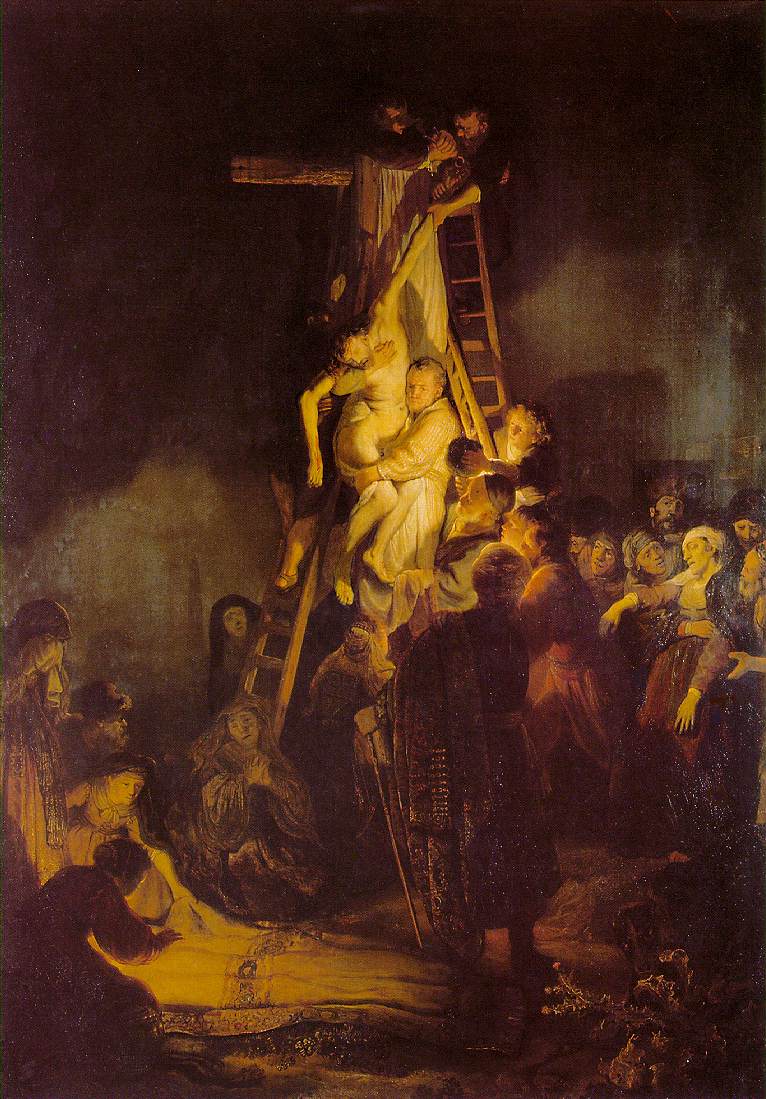
The Lord Jesus, when He died on the Cross, shed His Blood, thus
giving His sinless life to atone for our sin and to satisfy the righteousness
and holiness of God. To do so was the prerogative of the Son of God alone. No
man could have a share in that. The Scripture has never told us that we shed our
blood with Christ. In His atoning work before God He acted alone; no other could
have a part. But the Lord did not die only to shed His Blood: He died that
we might die. He died as our Representative. In His death He
included you and me.
We often use the terms `substitution' and `identification' to
describe these two aspects of the death of Christ. Now many a time the use of
the word `identification' is good. But identification would suggest that the
thing begins from our side: that I try to identify myself with the Lord. I agree
that the word is true, but it should be used later on. It is better to begin
with the fact that the Lord included me in His death. It is the `inclusive'
death of the Lord which puts me in a position to identify myself, not that I
identify myself in order to be included. It is God's inclusion of me in Christ
that matters. It is something God has done. For that reason those two New
Testament words "in Christ" are always very dear to my heart.
The death of the Lord Jesus is inclusive. The resurrection of the
Lord Jesus is alike inclusive. We have looked at the first chapter of I
Corinthians to establish the fact that we are "in Christ Jesus". Now we will go
to the end of the same letter to see something more of what this means.
1 Corinthians 15:45
The first man was named Adam, and
the Scriptures tell us that he was a living person. But Jesus, who may be
called the last Adam, is a life-giving spirit.
1 Corinthians 15:46
We see that the one with a
spiritual body did not come first. He came after the one, (Adam), who had a
physical body.
1 Corinthians 15:47
The first man, (Adam), was made
from the dust of the earth, but the second man, (Jesus), came from heaven.
Two remarkable names or titles are used of the Lord
Jesus. He is spoken of there as "the last Adam" and He is spoken of too as "the
second man". Scripture does not refer to Him as the second Adam but as "the last
Adam"; nor does it refer to Him as the last Man, but as "the second man". The
distinction is to be noted, for it enshrines a truth of great value.
As the last Adam, Christ is the sum total of humanity; as the
second Man He is the Head of a new race. So we have here two unions, the one
relating to His death and the other to His resurrection. In the first place His
union with the race as "the last Adam" began historically at Bethlehem and ended
at the cross and the tomb. In it He gathered up into Himself all that was in
Adam and took it to judgment and death. In the second place our union with Him
as "the second man" begins in resurrection and ends in eternity -- which is to
say, it never ends -- for, having in His death done away with the first man in
whom God's purpose was frustrated, He rose again as Head of a new race of men,
in whom that purpose shall be fully realized.
When therefore the Lord Jesus was crucified on the cross, He was
crucified as the last Adam. All that was in the first Adam was gathered up and
done away in Him. We were included there. The First
Adam brought Sin to the human race and the First Man brought death to the human
race. The Last Adam wiped out the power of
Sin over the human race
and the Second Man brings new life to the new human race.
It is in His resurrection that He stands forth as the second Man, and there too
we are included.
Romans 6:5
If we shared in Jesus' death by being
baptized, we will also be raised to life with Him.
We died in Him as the last Adam; we
live in Him as the second Man.
The Cross is thus the power of God
which translates us from Adam to Christ.
(The author uses `the Cross'
here and throughout these studies in a special sense. Most readers will be
familiar with the current use of the expression `the Cross' to signify,
firstly, the entire redemptive work accomplished historically in the death,
burial, resurrection and ascension of the Lord Jesus Himself
Philippians 2:8
Jesus Christ was humble and obeyed
God and died on the cross.
Philippians 2:9
Then God gave Jesus the highest
place and honored His name above all others.
and secondly, in a wider sense, the
union of believers with Him therein through grace
Romans 6:4
When we were baptized, we died and were
buried with Jesus Christ. We were baptized, so that we would live a new
life, as Christ was raised to life by the glory of God the Father.
Ephesians 2:4
But God was merciful and loving.
Ephesians 2:5
We were dead because of our sins, but
God loved us so much that he made us alive with Jesus Christ, and God's
wonderful kindness is what saves you.
Ephesians 2:6
God raised us from death to life with
Christ Jesus, and he has given us a place beside Christ in heaven.
Clearly in that use of the term the
operation of `the Blood' in relation to forgiveness of sins (as dealt with in
Chapter 1 of this book) is, from God's viewpoint, included (with all that
follows in these studies) as a part of the work of the Cross. In this and the
following chapters, however, the author is compelled, for lack of an
alternative term, to use `the Cross' in a more particular and limited
doctrinal sense in order to draw a helpful distinction, namely, that between
substitution and identification, as being, from the human angle, two separate
aspects of the doctrine of redemption. Thus the name of the whole is of
necessity used for one of its parts. The reader should bear this in mind in
what follows.)
Our old history ends with the Cross; our new history begins with
the resurrection.
II Corinthians 5:17
Anyone in Jesus Christ is a new
person. The past is forgotten, and everything is new.
The Cross terminates the first creation, and out of death there is
brought a new creation in Christ, the second Man. If we are `in Adam' all that
is in Adam necessarily devolves upon us; it becomes ours involuntarily, for we
have to do nothing to get it. There is no need to make up our minds to lose our
temper or to commit some other sin; it comes to us freely and despite ourselves.
In a similar way, if we are `in Christ' all that is in Christ comes to us by
free grace, without effort on our part but on the ground of simple faith.
But to say that all we need comes to us in Jesus Christ by free grace,
though true enough, may seem unpractical. How does it work out in practice? How
does it become real in our experience?
As we study Romans 6 - 8 we discover that the conditions of living the normal
Christian life are fourfold. They are: (a) Knowing, (b) Reckoning, (c)
Presenting ourselves to God, and (d) Walking in the Spirit, and they are set
forth in that order. If we would live that life we shall have to take all four
of these steps; not one nor two nor three, but all four. As we study each of
them we shall trust the Lord by His Holy Spirit to illumine our understanding;
and we shall seek His help now to take the first big step forward.
A. Our Death With Jesus Christ is A Historic Fact
Romans 6:1
What should we say? Should we keep on
sinning, so that God's wonderful kindness will show up even better?
Romans 6:2
No, we should not! If we are dead to sin,
how can we go on sinning?
Romans 6:3
Don't you know that all who share in
Christ Jesus by being baptized also share in his death?
Romans 6:4
When we were baptized, we died and were
buried with Christ. We were baptized, so that we would live a new life, as
Christ was raised to life by the glory of God the Father.
Romans 6:5
If we shared in Jesus' death by being
baptized, we will be raised to life with him.
Romans 6:6
We know that the persons we used to be
were nailed to the cross with Jesus. This was done, so that our sinful bodies
would no longer be the slaves of sin.
Romans 6:7
We know that sin doesn't have power over
dead people.
Romans 6:8
As surely as we died with Jesus Christ, we
believe we will also live with him.
Romans 6:9
We know that death no longer has any power
over Jesus Christ. He died and was raised to life, never again to die.
Romans 6:10
When Jesus Christ died, he died for sin
once and for all. But now he is alive, and he lives only for God.
Romans 6:11
In the same way, you must think of
yourselves as dead to the power of sin. But Christ Jesus has given life to
you, and you live for God.
These verses make clear that
the death of the Lord Jesus is representative and inclusive. In His death we all
died. None of us can progress spiritually without seeing this. Just as we cannot
have justification if we have not seen Him bearing our sins on the Cross,
so we cannot have sanctification if we have not seen Him bearing us on
the Cross. Not only have our sins been laid on Him but we ourselves have been
put into Him.
How did you receive forgiveness? You realized that the Lord Jesus
died as your Substitute and bore your sins upon Himself, and that His Blood was
shed to cleanse away your defilement. When you saw your sins all taken away on
the Cross what did you do? Did you say, `Lord Jesus, please come and die for my
sins'? No, you did not pray at all; you only thanked the Lord You did not
beseech Him to come and die for you, for you realized that He had already done
it.
But what is true of your forgiveness is also true of your
deliverance. The work is done. There is no need to pray but only to praise. God
has put us all in Christ, so that when Christ was crucified we were crucified
also. Thus there is no need to pray: `I am a very wicked person; Lord, please
crucify me'. That is all wrong. You did not pray about your sins; why pray now
about yourself? Your sins were dealt with by His Blood, and you were dealt with
by His Cross. It is an accomplished fact. All that is left for you to do is to
praise the Lord that when Christ died you died also; you died in Him. Praise Him
for it and live in the light of it.
Psalms 106:12
Then your people trusted you and sang
your praises.
Do you believe in the death of Christ? Of course you do. Well,
the same Scripture that says He died for us says also that we died with Him.
Look at it again:
Romans 5:8
But God showed how much he loved us by
having Jesus Christ die for us, even though we were sinful.
That is the first statement, and that is clear enough; but
is this any less clear?
Romans 6:6
We know that the persons we used to be
were nailed to the cross with Jesus. This was done, so that our sinful bodies
would no longer be the slaves of sin.
Romans 6:7
We know that sin doesn't have power over
dead people.
Romans 6:8
As surely as we died with Jesus Christ, we
believe we will also live with Him.
When are we crucified with Him? What is the date of our old man's
crucifixion? Is it tomorrow? Yesterday? Today? In order to answer this it may
help us if for a moment I turn Paul's statement round and say, `Christ was
crucified with (i.e. at the same time as) our old man'. Some of you came
here in twos. You traveled to this place together. You might say, My friend came
here with me', but you might just as truly say, `I came here with my friend'.
Had one of you come three days ago and the other only today you could not
possibly say that; but having come together you can make either statement with
equal truth, because both are statements of fact. So also in historic fact we
can say, reverently but with equal accuracy, `I was crucified when Christ was
crucified' or `Christ was crucified when I was crucified', for they are not two
historical events, but one. My crucifixion was "with him". 3 Has Christ been crucified? Then
can I be otherwise? And if He was crucified nearly two thousand years ago, and I
with Him, can my crucifixion be said to take place tomorrow? Can His be past and
mine be present or future? Praise the Lord, when He died in my stead, but He
bore me with Him to the Cross, so that when He died I died. And if I believe in
the death of the Lord Jesus, then I can believe in my own death just as surely
as I believe in His.
Why do you believe that the Lord Jesus died? What is your ground
for that belief? Is it that you feel He has died? No, you have never felt
it. You believe it because the Word of God tells you so. When the Lord was
crucified, two thieves were crucified at the same time. You do not doubt that
they were crucified with Him, either, because the Scripture says so quite
plainly.
You believe in the death of the Lord Jesus and you believe in the
death of the thieves with Him. Now what about your own death? Your crucifixion
is more intimate than theirs. They were crucified at the same time as the Lord
but on different crosses, whereas you were crucified on the self same cross as
He, for you were in Him when He died. How can you know? You can know for the one
sufficient reason that God has said so. It does not depend on your feelings. If
you feel that Christ has died, He has died; and if you do not feel that he died,
He has died. If you feel that you have died, you have died; and if you do not
feel that you have died, you have nevertheless just as surely died. These are
Divine facts. That Christ has died is a fact, that the two thieves have died is
a fact, and that you have died is a fact also. Let me tell you, You have
died! You are done with! You are ruled out! The self you loathe is on the
Cross in Christ.
Romans 6:6
Could it be any clearer? Our old way of
life was nailed to the Cross with Jesus Christ, a decisive end to that
sin-miserable life--no longer at sin's desire.
This is the Gospel (good news) for Christians.
Our crucifixion can never be made effective by will or by effort,
but only be accepting what the Lord Jesus did on the Cross. Our eyes must be
opened to see the finished work of Calvary. Some of you, prior to your
salvation, may have tried to save yourselves. You read the Bible, prayed, went
to Church, gave alms. Then one day your eyes were opened and you saw that a full
salvation had already been provided for you on the Cross. You just accepted that
and thanked God, and peace and joy flowed into your heart. Now salvation and
sanctification are on exactly the same basis. You receive deliverance from sin
in the same way as you receive forgiveness of sins.
For God's way of deliverance is altogether different from man's
way. Man's way is to try to suppress sin by seeking to overcome it; God's way is
to remove the sinner. Many Christians mourn over their weakness, thinking that
if only they were stronger all would be well. The idea that, because failure to
lead a holy life is due to our impotence, something more is therefore demanded
of us, leads naturally to this false conception of the way of deliverance. If we
are preoccupied with the power of sin and with our inability to meet it, then we
naturally conclude that to gain the victory over sin we must have more power.
`If only I were stronger', we say, `I could overcome my violent outbursts of
temper', and so we plead with the Lord to strengthen us that we may exercise
more self-control.
But this is altogether wrong; this is not Christianity. God's
means of delivering us from sin is not by making us stronger and stronger, but
by making us weaker and weaker. That is surely rather a peculiar way of victory,
you say; but it is the Divine way. God sets us free from the dominion of sin,
not by strengthening our old man but by crucifying him; not by helping him to do
anything but by removing him from the scene of action.
For years, maybe, you have tried fruitlessly to exercise control
over yourself, and perhaps this is still your experience; but when once you see
the truth you will recognize that you are indeed powerless to do anything, but
that in setting you aside altogether God has done it all. Such a revelation
brings human self-effort to an end.
B. The First Step: "Knowing This...(Bible
FAITH)"
The normal Christian life must begin with a very definite
`knowing', which is not just knowing something about the truth nor understanding
some important doctrine. It is not intellectual knowledge at all, but an opening
of the eyes of the heart to see what we have in Christ.
How do you know your sins are forgiven? Is it because your
pastor told you so? No, you just know it. If I ask you how you know, you
simply answer, `I know it!' Such knowledge comes by Divine revelation. It comes
from the Lord Himself. Of course the fact of forgiveness of sins is in the
Bible, but for the written Word of God to become a living Word from God to you
He had to give you
Ephesians 1:17
I ask the glorious Father and God of
our Lord Jesus Christ to give you his Holy Spirit. The Holy Spirit will make
you wise and let you understand what it means to know God.
What you needed was to know Christ in that way, and it is
always so. So there comes a time, in regard to any new apprehension of Christ,
when you know it in your own heart, you `see' it in your spirit. A light has
shined into your inner being and you are wholly persuaded of the fact. What is
true of the forgiveness of your sins is no less true of your deliverance from
sin. When once the light of God dawns upon your heart you see yourself in
Christ. It is not now because someone has told you, and not merely because
Romans 6 says
so. It is something more even than that. You know it because God has revealed it
to you by His Spirit. You may not feel it; you may not understand it; but you
know it, for you have seen it. Once you have seen yourself in Christ, nothing
can shake your assurance of that blessed fact.
If you ask a number of believers who have entered upon the
normal Christian life how they came by their experience, some will say in this
way and some will say in that. Each stresses his own particular way of entering
in and produces Scripture to support his experience; and unhappily many
Christians are using their special experiences and their special scriptures to
fight other Christians. The fact of the matter is that, while Christians may
enter into the deeper life by different ways, we need not regard the experiences
or doctrines they stress as mutually exclusive, but rather complementary. One
thing is certain, that any true experience of value in the sight of God must
have been reached by way of a new discovery of the meaning of the Person and
work of the Lord Jesus. That is a crucial test and a safe one.
And here in our passage Paul makes everything
depend upon such a discovery.
Romans 6:6
We know that the persons we used to be
were nailed to the cross with Jesus. This was done, so that our sinful bodies
would no longer be the slaves of sin.
C. Divine Revelation Essential To Knowledge
So our first step is to seek from God a knowledge that comes by
revelation -- a revelation, that is to say, not of ourselves but of the finished
work of the Lord Jesus Christ on the Cross. When Hudson Taylor, the founder of
the China Inland Mission, entered into the normal Christian life it was thus
that he did so. You remember how he tells of his long-standing problem of how to
live `in Christ', how to draw the sap out of the Vine into himself. For he knew
that he must have the life of Christ flowing out through him and yet felt that
he had not got it, and he saw clearly enough that his need was to be found in
Christ. `I knew', he said, writing to his sister from Chinkiang in 1869, `that
if only I could abide in Christ, all would be well, but I could not.'
The more he tried to get in the more he found himself slipping
out, so to speak, until one day light dawned, revelation came and he saw. `Here,
I feel, is the secret: not asking how I am to get sap out of the Vine
into myself, but remembering that Jesus is the Vine -- the root,
stem, branches, twigs, leaves, flowers, fruit, all indeed.'
Then, in words of a friend that had helped him: `I have not got
to make myself a branch. The Lord Jesus tells me I am a branch. I
am part of Him and I have just to believe it and act upon it. I have seen
it long enough in the Bible, but I believe it now as a living
reality.'
It was as though something which had indeed been true all the
time had now suddenly become true in a new way to him personally, and he writes
to his sister again: `I do not know how far I may be able to make myself
intelligible about it, for there is nothing new or strange or wonderful -- and
yet, all is new! In a word, "whereas once I was blind, now I see"... I am dead
and buried with Christ -- aye, and risen too and ascended... God reckons me so,
and tells me to reckon myself so. He knows best... Oh, the joy of seeing this
truth -- I do pray that the eyes of your understanding may be enlightened, that
you may know and enjoy the riches freely given us in Christ.'
Oh, it is a great thing to see that we are in Christ! Think of
the bewilderment of trying to get into a room in which you already are! Think of
the absurdity of asking to be put in! If we recognize the fact that we
are in, we make no effort to enter. If we had more revelation we should
have fewer prayers and more praises. Much of our praying for ourselves is just
because we are blind to what God has done.
I remember one day in Shanghai I was talking with a brother who
was very exercised concerning his spiritual state. He said, `So many are living
beautiful, saintly lives. I am ashamed of myself. I call myself a Christian and
yet when I compare myself with others I feel I am not one at all. I want to know
this crucified life, this resurrection life, but I do not know it and see no way
of getting there.' Another brother was with us, and the two of us had been
talking for two hours or so, trying to get the man to see that he could not have
anything apart from Christ, but without success. Said our friend, `the best
thing a man can do is to pray.' `But if God has already given you everything,
what do you need to pray for?' we asked. `He hasn't', the man replied, `for I am
still losing my temper, still failing constantly; so I must pray more.' `Well',
we said, `do you get what you pray for?' `I am sorry to say that I do not get
anything', he replied. We tried to point out that, just as he had done nothing
for his justification, so he need do nothing for his sanctification.
Just then a third brother, much used of the Lord, came in and
joined us. There was a thermos flask on the table, and this brother picked it up
and said, `What is this?' `A thermos flask.' `Well, you just imagine for a
moment that this thermos flask can pray, and that it starts praying something
like this: "Lord, I want very much to be a thermos flask. Wilt Thou make me to
be a thermos flask? Lord, give me grace to become a thermos flask. Do please
make me one!" What will you say?' `I do not think even a thermos flask would be
so silly,' our friend replied. `It would be nonsense to pray like that; it
is a thermos flask!' Then my brother said, `You are doing the same thing.
God in times past has already included you in Christ. When He died, you died;
when He lived, you lived. Now today you cannot say, "I want to die; I want to be
crucified; I want to have resurrection life." The Lord simply looks at you and
says, "You are dead! You have new life!" All your praying is just
as absurd as that of the thermos flask. You do not need to pray to the Lord for
anything; you merely need your eyes opened to see that He has done it all.'
That is the point. We need not work to die, we need not wait to
die, we are dead. We only need to recognize what the Lord has already
done and to praise Him for it. Light dawned for that man. With tears in his eyes
he said, `Lord, I praise Thee that Thou hast already included me in Christ. All
that is His is mine!' Revelation had come and faith had something to lay hold
of; and if you could have met that brother later on, what a change you would
have found!
D. The Cross Goes To The Root Of Our Problem
Let me remind you again of the fundamental nature of that which
the Lord has done on the Cross. I feel I cannot press this point too much for we
must see it. Suppose, for the sake of illustration, that the government
of your country should wish to deal drastically with the question of strong
drink and should decide that the whole country was to go `dry', how could the
decision be carried into effect? How could we help? If we were to search every
shop and house throughout the land and smash all the bottles of wine or beer or
brandy we came across, would that meet the case? Surely not. We might thereby
rid the land of every drop of alcoholic liquor it contains, but behind those
bottles of strong drink are the factories that produce them, and if we only deal
with the bottles and leave the factories untouched, production will still
continue and there is no permanent solution of the problem. The drink-producing
factories, the breweries and distilleries throughout the land, must be closed
down if the drink question is to be permanently settled.
We are the factory; our actions are the products. The Blood of
the Lord Jesus dealt with the question of the products, namely, our sins. So the
question of what we have done is settled, but would God have stopped there? What
about the question of what we are? Our sins were produced by us. They have been
dealt with, but how are we going to be dealt with? Do you believe the
Lord would cleanse away all our sins and then leave us to get rid of the
sin-producing factory? Do you believe He would put away the goods produced but
leave us to deal with the source of production?
To ask this question is but to answer it. Of course He has not
done half the work and left the other half undone. No, He has done away with the
goods and also made a clean sweep of the factory that produces the goods.
The finished work of Christ really has gone to the root of our
problem and dealt with it. There are no half measures with God. "Knowing this,"
says Paul, "That our old man was crucified with him, that the body of sin might
be done away, that so we should no longer be in bondage to sin" (Rom. 6:6).
"Knowing this"! Yes, but do you know it? "Or are you ignorant?" (Rom. 6:3).
May the Lord graciously open our eyes.
We now come to a matter on which there has been some confusion of
thought among the Lord's children. It concerns what follows this knowledge. Note
again first of all the wording of
Romans 6:6
We know that the persons we used to be
were nailed to the cross with Jesus. This was done, so that our sinful bodies
would no longer be the slaves of sin.
The tense of the verb
is most precious for it puts the event right back there in the past. It is
final, once-for-all. The thing has been done and cannot be undone. Our old man
has been crucified once and for ever, and he can never be un-crucified. This is
what we need to know.
Then, when we know this, what follows? Look again at our passage.
The next command
Romans 6:11
In the same way, you must think of
yourselves as dead to the power of sin. But Christ Jesus has given life to
you, and you live for God.
This, clearly, is the
natural sequel to Romans 6:6.
Read them together: `Knowing that our old man was crucified, ... reckon
ye yourselves to be dead'. That is the order. When we know that our old man has
been crucified with Christ, then the next step is to reckon it so.
Unfortunately, in presenting the truth of our union with Christ
the emphasis has too often been placed upon this second matter of reckoning
ourselves to be dead, as though that were the starting point, whereas it should
rather be upon knowing ourselves to be dead. God's Word makes it clear
that `knowing' is to precede `reckoning'. "Knowing this... reckon." The sequence
is most important. Our reckoning must be based on knowledge of divinely revealed
fact, for otherwise faith has no foundation on which to rest. When we know, then
we reckon spontaneously.
So in teaching this matter we should not over-emphasize reckoning.
People are always trying to reckon without knowing. They have not first had a
Spirit-given revelation of the fact; yet they try to reckon and soon they get
into all sorts of difficulties. When temptation comes they begin to reckon
furiously: `I am dead; I am dead; I am dead!' but in the very act of reckoning
they lose their temper. Then they say, `It doesn't work. Romans
6:11 is no good.' And we have to admit that Romans
6:11
is no good without Romans 6:6. So it comes
to this, that unless we know for a fact that we are dead in Jesus Christ,
the more we reckon the more intense will the struggle become, and the issue will
be sure defeat.
For years after my conversion I had been taught to reckon. I
reckoned from 1920 until 1927. The more I reckoned that I was dead to sin, the
more alive I clearly was. I simply could not believe myself dead and I could not
produce the death. Whenever I sought help from others I was told to read
Romans
6:11, and the more I read Romans
6:11 and tried to reckon, the further away death was: I could not get at it.
I fully appreciated the teaching that I must reckon, but I could not make out
why nothing resulted from it. I have to confess that for months I was troubled.
I said to the Lord, `If this is not clear, if I cannot be brought to see this
which is so very fundamental, I will cease to do anything. I will not preach any
more; I will not go out to serve Thee any more; I want first of all to get
thoroughly clear here.' For months I was seeking, and at times I fasted, but
nothing came through.
I remember one morning -- that morning was a real morning and one
I can never forget -- I was upstairs sitting at my desk reading the Word and
praying, and I said, `Lord, open my eyes!' And then in a flash I saw it. I saw
my oneness with Christ. I saw that I was in Him, and that when He died I died. I
saw that the question of my death was a matter of the past and not of the
future, and that I was just as truly dead as He was because I was in Him when He
died. The whole thing had dawned upon me. I was carried away with such joy at
this great discovery that I jumped from my chair and cried, `Praise the Lord, I
am dead!' I ran downstairs and met one of the brothers helping in the kitchen
and I laid hold of him. `Brother', I said, `do you know that I have died?' I
must admit he looked puzzled. `What do you mean?' he said, so I went on: `Do you
not know that Christ has died? Do you not know that I died with Him? Do you not
know that my death is no less truly a fact than His?' Oh it was so real to me! I
longed to go through the streets of Shanghai shouting the news of my discovery.
From that day to this I have never for one moment doubted the finality of that
word: "I have been crucified with Jesus Christ".
I do not mean to say that we need not work that out. Yes, there is
an outworking of the death which we are going to see presently, but this, first
of all, is the basis of it. I have been crucified: it has been done.
What, then, is the secret of reckoning? To put it in one word, it
is revelation. We need revelation from God Himself
Matthew 16:17
Jesus told him: Simon, son of Jonah,
you are blessed! You didn't discover this on your own. It was shown to you by
my Father in heaven.
Ephesians 1:17
I ask the glorious Father and God of
our Lord Jesus Christ to give you his Spirit. The Spirit will make you wise
and let you understand what it means to know God.
Ephesians 1:18
My prayer is that light will flood
your hearts and that you will understand the hope that was given to you when
God chose you. Then you will discover the glorious blessings that will be
yours together with all of God's people.
We need to have our eyes opened to the fact of our union with
Christ, and that is something more than knowing it as a doctrine. Such
revelation is no vague, indefinite thing. Most of us can remember the day when
we saw clearly that Christ died for us, and we ought to be equally clear as to
the time when we saw that we died with Christ. It should be nothing hazy, but
very definite, for it is with this as basis that we shall go on. It is not that
I reckon myself to be dead, and therefore I will be dead. It is that, because I
am dead -- because I see now what God has done with me in Christ --
therefore I reckon myself to be dead. That is the right kind of
reckoning. It is not reckoning toward death but from death.
A. The Second Step: "Even So Reckon...(Account
For)"
What does reckoning mean? `Reckoning' in Greek means doing
accounts book-keeping. Accounting is the only thing in the world we human beings
can do correctly. An artist paints a landscape. Can he do it with perfect
accuracy? Can the historian vouch for the absolute accuracy of any record, or
the map-maker for the perfect correctness of any map? They can make, at best,
fair approximations. Even in everyday speech, when we try to tell some incident
with the best intention to be honest and truthful, we cannot speak with complete
accuracy. It is mostly a case of exaggeration or understatement, of one word too
much or too little. What then can a man do that is utterly reliable? Arithmetic!
There is no scope for error there. One chair plus one chair equals two chairs.
That is true in London and it is true in Cape Town. If you travel west to New
York or east to Singapore it is still the same. All the world over and for all
time, one plus one equals two. One plus one is two in heaven and earth and
hell.
Why does God say we are to reckon ourselves dead? Because we
are dead. Let us keep to the analogy of accounting. Suppose I have
fifteen shillings in my pocket, what do I enter in my account-book? Can I enter
fourteen shillings and sixpence or fifteen shillings and sixpence? No, I must
enter in my account-book that which is in fact in my pocket. Accounting is the
reckoning of facts, not fancies. Even so, it is because I am really dead that
God tells me to account it so. God could not ask me to put down in my
account-book what was not true. He could not ask me to reckon that I am dead if
I am still alive. For such mental gymnastics the word `reckoning' would be
inappropriate; we might rather speak of `mis-reckoning'!
Reckoning is not a form of make-believe. It does not mean that,
having found that I have only twelve shillings in my pocket, I hope that by
entering fifteen shillings incorrectly in my account-book such `reckoning' will
somehow remedy the deficiency. It won't. If I have only twelve shillings, yet
try to reckon to myself: `I have fifteen shillings; I have fifteen shillings; I
have fifteen shillings', do you think that the mental effort involved will in
any way affect the sum that is in my pocket? Not a bit of it! Reckoning will not
make twelve shillings into fifteen shillings, nor will it make what is untrue
true. But if, on the other hand, it is a fact that I have fifteen shillings in
my pocket, then with great ease and assurance I can enter fifteen shillings in
my account-book. God tells us to reckon ourselves dead, not that by the process
of reckoning we may become dead, but because we are dead. He never told us to
reckon what was not a fact.
Having said, then, that revelation leads spontaneously to
reckoning, we must not lose sight of the fact that we are presented with a
command: "Reckon ye..." There is a definite attitude to be taken. God asks us to
do the account; to put down `I have died' and then to abide by it. Why? Because
it is a fact. When the Lord Jesus was on the cross, I was there in Him.
Therefore I reckon it to be true. I reckon and declare that I have died in Him.
Paul said, "Reckon ye also yourselves to be dead unto sin, but alive unto God."
How is this possible? "In Christ Jesus." Never forget that it is always and only
true in Christ. If you look at yourself you will think death is not
there, but it is a question of faith not in yourself but in Him. You look to the
Lord, and know what He has done. `Lord, I believe in Thee. I reckon upon
the fact in Thee.' Stand there all the day.
B. The Reckoning Of Faith
The first four-and-a-half chapters of Romans speak of faith and
faith and faith. We are justified by faith in Him
Romans 3:28
We see that people are acceptable to God
because they have faith, and not because they obey the Law.
Romans 5:1
By faith we have been made acceptable to
God. And now, because of our Lord Jesus Christ, we live at peace with God.
Righteousness, the forgiveness of our sins, and peace with God are all ours by
faith, and without faith in the finished work of Jesus Christ none can possess
them. But in the second section of Romans we do not find the same repeated
mention of faith, and it might at first appear that the emphasis is therefore
different. It is not really so, however, for where the words `faith' and
`believe' drop out the work `reckon' takes their place. Reckoning and faith are
here practically the same thing.
What is faith? Faith is my acceptance of God's fact. It always
has its foundations in the past. What relates to the future is hope rather than
faith, although faith often has its object or goal in the future, as in
Hebrews 11.
Perhaps for this reason the word chosen here is `reckon'. It is a word that
relates only to the past -- to what we look back to as settled, and not
forward to as yet to be. This is the kind of faith described
Mark 11:24
Everything you ask for in prayer will be
yours, if you only have faith.
The statement there is that, if you
believe that you already have received your requests (that is, of course,
in Christ), then `you shall have them'. To believe that you may get
something, or that you can get it, or even that you will get it,
is not faith in the sense meant here. This is faith -- to believe that you have
already got it. Only that which relates to the past is faith in this sense.
Those who say `God can' or `God may' or `God must' or `God will' do not
necessarily believe at all. Faith always says, `God has done it'.
When, therefore, do I have faith in regard to my crucifixion?
Not when I say God can, or will, or must crucify me, but when with joy I say,
`Praise God, in Christ I am crucified!'
In Romans 3 we
see the Lord Jesus bearing our sins and dying as our Substitute that we might be
forgiven. In Romans 6 we
see ourselves included in the death whereby He secured our deliverance. When the
first fact was revealed to us we believed on Him for our justification. God
tells us to reckon upon the second fact for our deliverance. So that, for
practical purposes, `reckoning' in the second section of Romans takes the place
of `faith' in the first section. The emphasis is not different. The normal
Christian life is lived progressively, as it is entered initially, by faith in
Divine fact: in Christ and His Cross.
C. Temptation And Failure, The Challenge
of Faith
For us, then, the two greatest facts in history are these:
that all our sins are dealt with by the Blood, and that we ourselves are dealt
with by the Cross. But what now of the matter of temptation? What is to be our
attitude when, after we have seen and believed these facts, we discover the old
desires rising up again? Worse still, what if we fall once more into known sin?
What if we lose our temper, or worse? Is the whole position set forth above
proved thereby to be false?
Now remember, one of the Devil's main objects is always to
make us doubt the Divine facts.
Genesis 3:3
except the tree in the middle of the
garden. He told us not to eat fruit from that tree or even to touch it. If we
do, we will die."
Genesis 3:4
"No, you won't!" the snake replied.
After we have seen, by revelation of the Spirit of God, that we are indeed dead
with Christ, and have reckoned it so, he will come and say: `There is something
moving inside. What about it? Can you call this death?' When that happens, what
will be our answer? The crucial test is just here. Are you going to believe the
tangible facts of the natural realm which are clearly before your eyes, or the
intangible facts of the spiritual realm which are neither seen nor
scientifically proved?
Now we must be careful. It is important for us to recall again
what are facts stated in God' Word for faith to lay hold of and what are not.
How does God state that deliverance is effected? Well, in the first place, we
are not told that sin as a principle in us is rooted out or removed. To reckon
on that will be to miscalculate altogether and find ourselves in the false
position of the man we considered earlier, who tried to put down the twelve
shillings in his pocket as fifteen shillings in his account-book. No, sin is not
eradicated. It is very much there, and, given the opportunity, will overpower us
and cause us to commit sins again, whether consciously or unconsciously. That is
why we shall always need to know the operation of the precious Blood.
But whereas we know that, in dealing with sins committed,
God's method is direct, to blot them out of remembrance by means of the Blood,
when we come to the principle of sin and the matter of deliverance from its
power, we find instead that God deals with this indirectly. He does not remove
the sin but the sinner. Our old man was crucified with Him, and because of this
the body, which before had been a vehicle of sin, is unemployed
Romans 6:6
We know that the persons we used to be
were nailed to the cross with Jesus. This was done, so that our sinful bodies
would no longer be the slaves of sin.
Sin, the old master, is still
about, but the slave who served him has been put to death and so is out of reach
and his members are unemployed. The gambler's hand is unemployed, the liar's
tongue is unemployed, and these members are now available to be used instead "as
instruments of righteousness unto God"
Romans 6:13
Make every part of your body a servant
that pleases God.
Thus we can say that `deliverance from sin' is a more
scriptural idea than `victory over sin'. The expressions "freed from sin" and
"dead unto sin" in Romans 6:7
and 11 imply
deliverance from a power that is still very present and very real -- not from
something that no longer exists. Sin is still there, but we are knowing
deliverance from its power in increasing measure day by day.
This deliverance is so real that John can boldly write:
1 John 3:9
God's children cannot keep on being
sinful. His life-giving power lives in them and makes them his children, so
that they cannot keep on sinning.
which is, however, a statement that, wrongly understood, may easily
mislead us. By it John is not telling us that sin is now no longer in our
history and that we shall not again commit sin. He is saying that to sin is not
in the nature of that which is born of God. The life of Christ has been planted
in us by new birth and its nature is not to commit sin. But there is a great
difference between the nature and the history of a thing, and there is a great
difference between the nature of the life within us and our history. To
illustrate this (though the illustration is an inadequate one) we might say that
wood `cannot' sink, for it is not its nature to do so; but of course in history
it will do so if a hand hold it under water. The history is a fact, just as sins
in our history are historic facts; but the nature is a fact also, and so is the
new nature that we have received in Christ. What is `in Christ' cannot sin; what
is in Adam can sin and will do so whenever Satan is given a chance to exert his
power.
So it is a question of our choice of which facts we will count
upon and live by: the tangible facts of daily experience or the mightier fact
that we are now `in Christ'. The power of His resurrection is on our side, and
the whole might of God is at work in our salvation
Romans 1:16
I am proud of the good news! It is God's
powerful way of saving all people who have faith, whether they are Jews or
Gentiles.
but the matter still rests upon our making real in history what is
true in Divine fact.
"Now faith is the assurance of things hoped for, the proving
of things not seen"
Hebrews 11:1
Faith insures what we hope for and is
proof of what we cannot see.
and "the things which are not seen are eternal"
II Corinthians 4:18
Things that are seen don't last
forever, but the things that are not seen are eternal. That's why we keep our
minds on the things that cannot be seen.
I think we all know that Hebrews
11:1 is the only definition of faith in the New Testament, or indeed in the
Scriptures. It is important that we should really understand that definition.
You are familiar with the common English translation of these words, describing
faith as "the substance of things hoped for" However, the word in the Greek has
in it the sense of an action and not just of some thing, a `substance', and I
confess I have personally spent a number of years trying to find a correct word
to translate this. "Faith is the substantiating of
things hoped for". That is much better. It implies the making of them real in
experience.
Hebrews 11:1 :
(ASV)
Now faith is assurance of
things hoped for, a
conviction of things not seen.
(BBE)
Now faith is the substance of things hoped for,
and the sign that the things not seen are true.
(CEV)
Faith makes us sure of what we hope for and gives
us proof of what we cannot see.
(GNB)
To have faith is to be sure of the things we hope
for, to be certain of the things we cannot see.
(GW)
Faith assures us of things we expect and convinces
us of the existence of things we cannot see.
(KJV+)
Now1161
faith4102 is2076
the substance5287 of
things hoped for,1679
the evidence1650 of
things4229 not3756
seen.991
(KJVA)
Now faith is the substance of things hoped for,
the evidence of things not seen.
(LITV)
Now faith is
the essence of
things being hoped, the evidence of things not having been seen.
(MKJV)
Now faith is
the substance of
things hoped for, the evidence of things not seen.
(MSG)
The fundamental fact of existence is that this
trust in God, this faith, is the firm foundation under everything that makes
life worth living. It's our handle on what we can't see.
(WEB)
Now faith is assurance of things hoped for, proof
of things not seen.
How do we `substantiate' something? We are doing so every day.
We cannot live in the world without doing so. Do you know the difference between
substance and `substantiating'? A substance is an object, something before me.
`Substantiating' means that I have a certain power or faculty that makes that
substance to be real to me. Let us take a simple illustration. By means of our
senses we can take things of the world of nature and transfer them into our
consciousness so that we can appreciate them. Sight and hearing, for example,
are two of my faculties which substantiate to me the world of light and sound.
We have colors: red, yellow, green, blue, violet; and these colors are real
things. But if I shut my eyes, then to me the color is no longer real; it is
simply nothing -- to me. It is not only that the color is there, but I
have the power to `substantiate' it. I have the power to make that color true
to me and to give it reality in my consciousness. That is the meaning of
`substantiating'.
If I am blind I cannot distinguish color, or if I lack the
faculty of hearing I cannot enjoy music. Yet music and color are in fact
real things, and their reality is unaffected by whether or not I am able
to appreciate them. Now we are considering here the things which, though they
are not seen, are eternal and therefore real. Of course we cannot substantiate
Divine things with any of our natural senses; but there is one faculty which can
substantiate the "things hoped for", the things of Christ, and that is faith.
Faith makes the real things to become real in my experience. Faith
`substantiates' to me the things of Christ. Hundreds of thousands of
people are reading
Romans 6:6
We know that the persons we used to be
were nailed to the cross with Jesus. This was done, so that our sinful bodies
would no longer be the slaves of sin.
To faith it is true; to doubt, or to mere
mental assent apart from spiritual illumination, it is not true.
Let us remember again that we are dealing here not with
promises but with facts. The promises of God are revealed to us by His Spirit
that we may lay hold of them; but facts are facts and they remain facts whether
we believe them or not. If we do not believe the facts of the Cross they still
remain as real as ever, but they are valueless to us. It does not need faith to
make these things real in themselves, but faith can `substantiate' them and make
them real in our experience.
Whatever contradicts the truth of God's Word we are to regard
as the Devil's lie, not because it may not be in itself a very real fact to our
senses but because God has stated a greater fact before which the other must
eventually yield. I once had an experience which (though not applicable in
detail to the present matter) illustrates this principle. Some years ago I was
ill. For six nights I had high fever and could find no sleep. Then at length God
gave me from the Scripture a personal word of healing, and because of this I
expected all symptoms of sickness to vanish at once. Instead of that, not a wink
of sleep could I get, and I was not only sleepless but more restless than ever.
My temperature rose higher, my pulse beat faster and my head ached more severely
than before. The enemy asked, `Where is God's promise? Where is your faith? What
about all your prayers?' So I was tempted to thrash the whole matter out in
prayer again, but was rebuked, and this Scripture came to mind:
John 17:17
Your word is the Truth and let this Truth
make them completely yours.
If God' Word is truth, I thought, then what are these symptoms? They
must all be lies! So I declared to the enemy, `This sleeplessness is a lie, this
headache is a lie, this fever is a lie, this high pulse is a lie. In view of
what God has said to me, all these symptoms of sickness are just your lies, and
God's Word to me is truth.' In five minutes I was asleep, and I awoke the
following morning perfectly well.
Now of course in a particular personal matter such as the
above it might be quite possible for me to deceive myself as to what God had
said, but of the fact of the Cross there can never be any such question. We
must believe God, no matter how convincing Satan's arguments appear.
A skillful liar lies not only in word but in gesture and
deed; he can as easily pass a bad coin as tell an untruth. The Devil is a
skillful liar, and we cannot expect him to stop at words in his lying. He will
resort to lying signs and feelings and experiences in his attempts to shake us
from our faith in God's Word. Let me make it clear that I do not deny the
reality of the `flesh'. Indeed we shall have a good deal more to say about this
further on in our study. But I am speaking here of our being moved from a
revealed position in Christ. As soon as we have accepted our death with Christ
as a fact, Satan will do his best to demonstrate convincingly by the evidence of
our day-to-day experience that we are not dead at all but very much alive. So we
must choose. Will we believe Satan's lie or God's truth? Are we going to be
governed by appearances or by what God says?
I am Mr. Nee. I know that I am Mr. Nee. It is a fact upon
which I can confidently count. It is of course possible that I might lose my
memory and forget that I am Mr. Nee, or I might dream that I am some other
person. But whether I feel like it or not, when I am sleeping I am Mr. Nee and
when I am awake I am Mr. Nee; when I remember it I am Mr. Nee and when I forget
it I am still Mr. Nee.
Now of course, were I to pretend to be someone else, things
would be much more difficult. If I were to try and pose as Miss K. I should have
to keep saying to myself all the time, `You are Miss K.; now be sure to remember
that you are Miss K.,' and despite much reckoning the likelihood would be that
when I was off my guard and someone called, `Mr. Nee!' I should be caught out
and should answer to my own name. Fact would triumph over fiction, and all my
reckoning would break down at that crucial moment. But I am Mr. Nee and
therefore I have no difficulty whatever in reckoning myself to be Mr. Nee. It is
a fact which nothing I experience or fail to experience can alter.
So also, whether I feel it or not, I am dead with Christ. How
can I be sure? Because Christ has died; and since
II Corinthians 5:14
We are ruled by Jesus Christ's
love for us and we are certain that if one person (Jesus) died for everyone
else, then all of us have died.
Whether my experience proves it or seems to disprove it, the fact
remains unchanged. While I stand upon that fact Satan cannot prevail against me.
Remember that his attack is always upon our assurance. If he can get us to doubt
God's Word, then his object is secured and he has us in his power; but if we
rest unshaken in the assurance of God's stated fact, assured that He cannot do
injustice to His work or His Word, then it does not matter what tactics Satan
adopts, we can well afford to laugh at him. If anyone should try to persuade me
that I am not Mr. Nee, I could well afford to do the same.
II Corinthians 5:7
But we live by Faith, not by what
we see.
You probably know the illustration of Fact, Faith and Experience
walking along the top of a wall. Fact walked steadily on, turning neither to
right nor left and never looking behind. Faith followed and all went well so
long as he kept his eyes focused upon Fact; but as soon as he became concerned
about Experience and turned to see how he was getting on, he lost his
balance and tumbled off the wall, and poor old Experience fell down after
him.
All temptation is primarily to look within; to take our eyes
off the Lord and to take account of appearances. Faith is always meeting a
mountain, a mountain of evidence that seems to contradict God's Word, a mountain
of apparent contradiction in the realm of tangible fact -- of failures in deed,
as well as in the realm of feeling and suggestion -- and either faith or the
mountain has to go. They cannot both stand. but the trouble is that many a time
the mountain stays and faith goes. That must not be. If we resort to our senses
to discover the truth, we shall find Satan's lies are often enough true to our
experience; but if we refuse to accept as binding anything that contradicts
God's Word and maintain an attitude of faith in Him alone, we shall find instead
that Satan's lies begin to dissolve and that our experience is coming
progressively to tally with that Word.
It is our occupation with Christ that has this result,
for it means that He becomes progressively real to us on concrete issues. In a
given situation we see Him as real holiness, real resurrection
life -- for us. What we see in Him objectively now operates in us subjectively
-- but really -- to manifest Him in us in that situation. That is the
mark of maturity. That is what Paul means by his words
Galatians 4:19
I am in terrible pain until Jesus
Christ is seen living in you.
Faith is `substantiating' God's facts; and faith is always the `substantiating'
of eternal fact -- of something eternally true.
The verb
katargeo translated
`destroyed' in
Romans 6:6
We know that the persons we used to be
were nailed to the cross with Jesus. This was done, so that our sinful
bodies would no longer be the slaves of sin.
does not mean `annihilated', but `put out of operation', `made
ineffective'. It is from the Creek root argos, `inactive', `not working',
`unprofitable', which is the word translated `idle' in
Matthew 20:6
Finally, about five in the afternoon
the man went back and found some others standing there. He asked them, "Why
have you been standing here all day long doing
nothing?"
of the unemployed laborers in the market place.
D. Abiding In Him
Now although we have already spent long on this matter, there
is a further thing that may help to make it clearer to us. the Scriptures
declare that we are "dead indeed", but nowhere do they say that we are dead
in ourselves. We shall look in vain to find death within; that is just
the place where it is not to be found. We are dead not in ourselves but in
Christ. We were crucified with Him because we were in Him.
We are familiar with the words of the Lord Jesus,
John 15:4
Stay joined to me, and I will stay joined
to you. Just as a branch cannot produce fruit unless it stays joined to the
vine, you cannot produce fruit unless you stay joined to me.
Let us consider them for a moment. First they remind us once again
that we have never to struggle to get into Christ. We are not told to get there,
for we are told to stay there where we have been placed. It was God's own
act that put us in Christ, and we are to abide in Him.
But further, this verse lays down for us a Divine principle,
which is that God has done the work in Christ and not in us as individuals. The
all-inclusive death and the all-inclusive resurrection of God's Son were
accomplished fully and finally apart from us in the first place. It is the
history of Christ which is to become the experience apart from Him. The
Scriptures tell us that we were crucified "with Him", that we were quickened,
raised, and set by God in the heavens "in Him", and that we are complete "in
Him"
Romans 6:6
We know that the persons we used to be
were nailed to the cross with Jesus. This was done, so that our sinful bodies
would no longer be the slaves of sin.
Ephesians 2:5
We were dead because of our sins,
but God loved us so much that he made us alive with Jesus Christ, and God's
wonderful kindness is what saves you.
Ephesians 2:6
God raised us from death to life with
Christ Jesus, and he has given us a place beside Jesus Christ in heaven.
Colossians 2:10
And you are fully grown because you
belong to Jesus Christ, who is over every power and authority.
It is not just something that is still to be effected in us (though
it is that, of course). It is something that has already been effected,
in association with Him.
In the Scriptures we find that no Christian experience exists
as such. What God has done in His gracious purpose is to include us in
Christ. In dealing with Christ God has dealt with the Christian; in dealing with
the Head He has dealt with all the members. It is altogether wrong for us to
think that we can experience anything of the spiritual life in ourselves merely,
and apart from Him. God does not intend that we should acquire something
exclusively personal in our experience, and He is not willing to effect anything
like that for you and me. All the spiritual experience of the Christian is
already true in Christ. It has already been experienced by Christ. What we
call `our' experience is only our entering into His history and
His experience.
It would be odd if one branch of a vine tried to bear grapes
with a reddish skin, and another branch tried to bear grapes with a green skin,
and yet another branch grapes with a very dark purple skin, each branch trying
to produce something of its own without reference to the vine. It is impossible,
unthinkable. The character of the branches is determined by the vine. Yet
certain Christians are seeking experiences as experiences. They think of
crucifixion as something, of resurrections as something, of ascension as
something, and they never stop to think that the whole is related to a Person.
No, only as the Lord opens our eyes to see the Person do we have any true
experience. Every true spiritual experience means that we have discovered a
certain fact in Christ and have entered into that; anything that is not from Him
in this way is an experience that is going to evaporate very soon. `I have
discovered that in Christ; then, Praise the Lord, it is mine! I possess
it, Lord, because it is in Thee.' Oh it is a great thing to know the facts of
Christ as the foundation for our experience.
So God's basic principle in leading us on experimentally is not
to give us something. It is not to bring us through something, and as a result
to put something into us which we can call `our experience'. It is not
that God effects something within us so that we can say, `I died with
Christ last March' or `I was raised from the dead on January 1st, 1937,' or
even, `Last Wednesday I asked for a definite experience and I have got it'. No,
that is not the way. I do not seek experiences in themselves as in this
present year of grace. Time must not be allowed to dominate my thinking
here.
Then, some will say, what about the crises so many of us have
passed through? True, some of us have passed through real crises in our lives.
For instance George Muller could say, bowing himself down to the ground, `There
was a day when George Muller died'. How about that? Well, I am not questioning
the reality of the spiritual experiences we go through nor the importance of
crises to which God brings us in our walk with Him; indeed, I have already
stressed the need for us to be quite as definite ourselves about such crisis in
our own lives. But the point is that God does not give individuals individual
experiences. All that they have is only an entering into what God has already
done. It is the `realizing' in time of eternal things. The history
of Christ becomes our experience and our spiritual history; we do not have a
separate history from His. The entire work regarding us is not done in us here
but in Christ. He does no separate work in individuals apart from what He has
done there. Even eternal life is not given to us as individuals: the life is in
the Son, and "he that hath the Son hath the life". God has done all in His Son,
and He has included us in Him; we are incorporated into Christ.
Now the point of all this is that there is a very real
practical value in the stand of faith that says, `God has put me in Christ, and
therefore all that is true of Him is true of me. I will abide in Him.' Satan is
always trying to get us out, to keep us out, to convince us that we are out, and
by temptations, failures, suffering, trial, to make us feel acutely that we are
outside of Christ. Our first thought is that, if we were in Christ, we should
not be in this state, and therefore, judging by the feelings we now have, we
must be out of Him; and so we begin to pray, `Lord, put me into Christ'. No!
God's injunction is to "abide" in Christ, and that is the way of deliverance.
But how is it so? Because it opens the way for God to take a hand in our lives
and to work the thing out in us. It makes room for the operation of His superior
power -- the power of resurrection
Romans 6:4
When we were baptized, we died and were
buried with Jesus Christ. We were baptized, so that we would live a new life,
as Christ was raised to life by the glory of God the Father.
Romans 6:5
If we shared in Jesus' death by being
baptized, we will be raised to life with him.
Romans 6:6
We know that the persons we used to be
were nailed to the cross with Jesus. This was done, so that our sinful bodies
would no longer be the slaves of sin.
Romans 6:7
We know that sin doesn't have power over
dead people.
Romans 6:8
As surely as we died with Jesus Christ, we
believe we will also live with him.
Romans 6:9
We know that death no longer has any power
over Jesus Christ. He died and was raised to life, never again to die.
Romans 6:10
When Jesus Christ died, he died for sin
once and for all. But now he is alive, and he lives only for God.
-- so that the facts of Jesus Christ do progressively become
the facts of our daily experience, and where before "sin reigned"
Romans 5:21
Sin ruled by means of death. But God's
kindness now rules, and God has accepted us because of Jesus Christ our Lord.
This means that we will have eternal life.
we make now the joyful discovery that we are truly "no
longer... in bondage to sin"
Romans 6:6
We know that the persons we used to be
were nailed to the cross with Jesus. This was done, so that our sinful bodies
would no longer be the slaves of sin.
As we stand steadfastly on the ground of what Christ is, we
find that all that is true of Him is becoming experimentally true in us. If
instead we come onto the ground of what we are in ourselves we will find that
all that is true of the old nature remains true of us. If we get there in
faith we have everything; if we return back here we find nothing. So
often we go to the wrong place to find the death of self. It is in Christ. We
have only to look within to find we are very much alive to sin; but when we look
over there to the Lord, God sees to it that death works here but that "newness
of life" is ours also. We are "alive unto God" (Rom.
6:4,11).
"Abide in me, and I in you." This is a double sentence: a
command coupled with a promise. That is to say, there is an objective and a
subjective side to God's working, and the subjective side depends upon the
objective; the "I in you" is the outcome of our abiding in Him. We need to guard
against being over-anxious about the subjective side of things, and so becoming
turned in upon ourselves. We need to dwell upon the objective -- "abide in me"
-- and to let God take care of the subjective. And this He has undertaken to
do.
I have illustrated this from the electric light. You are in a
room and it is growing dark. You would like to have the light on in order to
read. There is a reading-lamp on the table beside you. What do you do? Do you
watch it intently to see if the light will come on? Do you take a cloth and
polish the bulb? No, you get up and cross over to the other side of the room
where the switch is on the wall and you turn the current on. You turn your
attention to the source of power and when you have taken the necessary action
there the light comes on here.
So in our walk with the Lord our attention must be fixed on
Christ. "Abide in me, and I in you" is the Divine order. Faith in the objective
facts make those facts true subjectively. As the apostle Paul puts it,
II Corinthians 3:18
So our faces are not covered.
They show the bright glory of the Lord, as the Lord's Spirit makes us more and
more like our glorious Lord.
The same principle holds good in the matter of
fruitfulness of life:
John 15:5
I am the vine, and you are the branches. If
you stay joined to me, and I stay joined to you, then you will produce lots of
fruit. But you cannot do anything without me.
We do not try to produce fruit or concentrate upon the fruit
produced. Our business is to look away to Him. As we do so He undertakes to
fulfill His Word in us.
How do we abide? `Of God are ye in Christ Jesus.' It was the
work of God to put you there and He has done it. Now stay there! Do not
be moved back onto your own ground. Never look at yourself as though you were
not in Christ. Look at Christ and see yourself in Him. Abide in Him. Rest
in the fact that God has put you in His Son, and live in the expectation that He
will complete His work in you. It is for Him to make good the glorious promise
that
Romans 6:14
Don't let sin keep ruling your lives for
you are ruled by God's kindness and not by the Law.
The kingdom of this world is not this kingdom of God. God had in His
heart a world-system - a universe of His creating -- which should be headed up
in Christ His Son
Colossians 1:16
Everything was created by Jesus,
everything in heaven and on earth, everything seen and unseen, including all
forces and powers, and all rulers and authorities. All things were created by
God's Son, and everything was made for him.
Colossians 1:17
God's Son was before all else, and by
him everything is held together.
But Satan, working through man's flesh, has set up instead a
rival system known in Scripture as "this world" -- a system in which we are
involved and which he himself dominates. He has in fact become "the prince of
this world"
John 12:31
This world's people are now being judged,
and the ruler of this world is already being thrown out!
A. The Two Creations
Thus, in Satan's hands, the first creation has become the old
creation, and God's primary concern is now no longer with that but with a second
and new creation. He is bringing in a new creation, a new kingdom and a new
world, and nothing of the old creation, the old kingdom or the old world can be
transferred to the new. It is a question now of these two rival realms, and of
which realm we belong to.
The apostle Paul, of course, leaves us in no doubt as to which of
these two realms is now in fact ours. He tells us that God, in redemption,
"delivered us out of the power of darkness, and translated us into the kingdom
of the Son of his love"
Colossians 1:12
I pray that you will be grateful to
God for letting you have part in what He has promised His people in the
Kingdom of Light.
Colossians 1:13
God rescued us from the dark power of
Satan and brought us into the Kingdom of his dear Son,
But in order to bring us into His new kingdom, God must do
something new in us. He must make of us new creatures. Unless we are created
anew we can never fit into the new realm. "That which is born of the flesh is
flesh"; and, "flesh and blood cannot inherit the kingdom of God; neither doth
corruption inherit incorruption"
John 3:6
Humans give life to their children but only
God's Spirit can change you into a child of God.
1 Corinthians 15:50
My friends, I want you to know
that our bodies of flesh and blood will decay. This means that they cannot
share in God's kingdom, which lasts forever.
However educated, however cultured, however improved it be, flesh is
still flesh. Our fitness for the new kingdom is determined by the creation to
which we belong. Do we belong to the old creation or the new? Are we born of the
flesh or of the Spirit? Our ultimate suitability for the new realm hinges on the
question of origin. The question is not `good' or bad?' but `flesh or Spirit?'
"That which is born of the flesh is flesh", and it will never be anything
else. That which is of the old creation can never pass over into the new.
Once we really understand what God is seeking, namely, something
altogether new for Himself, then we shall see clearly that we can never bring
any contribution from the old realm into that new thing. God wanted to have us
for Himself, but He could not bring us as we were into that which He had
purposed; so He first did away with us by the Cross of Christ, and then by
resurrection provided a new life for us.
II Corinthians 5:17
Anyone who belongs to Jesus
Christ is a new person. The past is forgotten, and everything is new.
Being now new creatures with a new nature and a new set of faculties,
we can enter the new kingdom and the new world.
The Cross was the means God used to bring to an end `the old
things' by setting aside altogether our `old man', and the resurrection was the
means He employed to impart to us all that was necessary for our life in that
new world. "We were buried therefore with him through baptism into death: that
like as Christ was raised from the dead through the glory of the Father, so we
also might walk in newness of life"
Romans 6:4
When we were baptized, we died and were
buried with Jesus Christ. We were baptized, so that we would live a new life,
as Jesus Christ was raised to life by the glory of God the Father.
The greatest negative in the universe is the Cross, for with it
God wiped out everything that was not of Himself: the greatest positive in the
universe is the resurrection, for through it God brought into being all He will
have in the new sphere. So the resurrection stands at the threshold of the new
creation. It is a blessed thing to see that the Cross ends all that belongs to
the first regime, and that the resurrection introduces all that pertains to the
second. Everything that had its beginning before resurrection must be wiped out.
Resurrection is God's new starting-point.
We have now two worlds before us, the old and the new. In the old,
Satan has absolute dominion. You may be a good man in the old creation, but as
long as you belong to the old you are under sentence of death, because nothing
of the old can go over to the new. The Cross is God's declaration that all that
is of the old creation must die. Nothing of the first Adam can pass beyond the
Cross; it all ends there. The sooner we see that, the better, for it is by the
Cross that God has made a way of escape for us from that old creation. God
gathered up in the Person of His Son all that was of Adam and crucified Him; so
in Him all that was of Adam was done away. Then God made, as it were, a
proclamation throughout the universe saying: `Through the Cross I have set aside
all that is not of Me; you who belong to the old creation are all included in
that; you too have been crucified with Christ!' None of us can escape that
verdict.
This brings us to the subject of baptism.
Romans 6:3
Don't you know that all who share in
Christ Jesus by being baptized also share in his death?
Romans 6:4
When we were baptized, we died and were
buried with Jesus Christ. We were baptized, so that we would live a new life,
as Christ was raised to life by the glory of God the Father.
What is the significance of these words?
Baptism in Scripture is associated with salvation.
Mark 16:16
Anyone who believes upon me and is
baptized will be saved. But anyone who refuses to believe in me will be
condemned.
We cannot speak scripturally of `baptismal regeneration' but we may
speak of `baptismal salvation'. What is salvation? It relates not to our sins
nor to the power of sin, but to the cosmos or world-system. We are
involved in Satan's world-system. To be saved is to make our exit from his
world-system into God's
In the Cross of our Lord Jesus Christ, says Paul,
Galatians 6:14
But I will never brag about anything
except the cross of our Lord Jesus Christ. Because of his cross, the world is
dead as far as I am concerned, and I am dead as far as the world is concerned.
This is the figure developed by Peter when he writes of the
eight souls who were "saved through water"
1Peter 3:20
They had disobeyed God while Noah was
building the boat, but God had been patient with them. Eight people went into
that boat and were brought safely through the flood.
Entering into the ark, Noah and those with him stepped by faith out
of that old corrupt world into a new one. It was not so much that they were
personally not drowned, but that they were out of that corrupt system.
That is salvation.
Then Peter goes on: "Which also after a true likeness (mg. `in
the antitype') doth now save you, even baptism"
1Peter 3:21
Those flood waters were like baptism that
now saves you. But baptism is more than just washing your body.
It means turning to God with a clear conscience, because
Jesus Christ was raised from death.
In other words, by that aspect of the Cross which is
figured in baptism you are delivered from this present evil world, and, by your
baptism in water, you confirm this. It is baptism "into his death", ending one
creation; but it is also baptism "into Christ Jesus", having in view a new one
Romans 6:3
Don't you know that all who share in
Christ Jesus by being baptized also share in his death?
You go down into the water and your world, in figure, goes down with you. you
come up in Jesus Christ, but your world is drowned.
"Believe on the Lord Jesus, and you shall be saved", said Paul at
Philippi, and
Acts 16:31
They replied, "Have faith in the Lord
Jesus and you will be saved! This is also true for everyone who lives in your
home."
Acts 16:32
Then Paul and Silas told him and everyone
else in his house about the Lord.
Acts 16:33
While it was still night, the jailer took
them to a place where he could wash their cuts and bruises. Then he and
everyone in his home were baptized.
Acts 16:34
They were very glad that they had put
their faith in God. After this, the jailer took Paul and Silas to his home and
gave them something to eat.
In doing so, he and those with him testified before God, His
people and the spiritual powers that they were indeed saved from a world under
judgment. As a result, we read, they rejoiced greatly, "having believed in
God".
Thus it is clear that baptism is no mere question of a cup of
water, nor of a baptistery of water. It is a tremendous thing, relating as it
does both to the death and to the resurrection of our Lord; and having in view
two worlds. Anyone who has worked in a pagan country knows what tremendous
issues are raised by baptism.
B. Burial Means An End
Peter goes on now to describe baptism in the passage just quoted
as "the answer of a good conscience toward God"
1Peter 3:21
Those flood waters were like baptism that
now saves you. But baptism is more than just washing your body. It means
turning to God with a clear conscience, because Jesus Christ was raised from
death.
Now we cannot answer without being spoken to . If God had said
nothing we should have no need to answer. But He has spoken; He has spoken to us
by the Cross. By it He has told of His judgment of us, of the world, of the old
creation and of the old kingdom. The Cross is not only Christ's personally -- an
`individual' Cross. It is an all inclusive Cross, a `corporate' Cross, a Cross
that includes you and me. God has put us all into His Son, and crucified us in
Him. In the last Adam He has wiped out all that was of the first Adam.
Now what is my answer to God's verdict on the old creation? I
answer by asking for baptism. Why? In
Romans 6:4
When we were baptized, we died and were
buried with Jesus Christ. We were baptized, so that we would live a new life,
as Jesus Christ was raised to life by the glory of God the Father.
Paul explains that baptism means burial: "We were buried therefore with him
through baptism". Baptism is of course connected with both death and
resurrection, though in itself it is neither death nor resurrection: it is
burial. But who qualifies for burial? Only the dead! So if I ask for baptism I
proclaim myself dead and fit only for the grave.
Alas, some have been taught to look on burial as a means
to death; they try to die by getting themselves buried! Let me say emphatically
that, unless our eyes have been opened by God to see that we have died in Christ
and been buried with Him, we have no right to be baptized. The reason we step
down into the water is that we have recognized that in God's sight we have
already died. It is to that that we testify. God's question is clear and
simple. `Christ has died, and I have included you there. Now, what are you going
to say to that?' What is my answer? `Lord, I believe You have done the
crucifying. I say Yes to the death and to the burial to which You have committed
me.' He has consigned me to death and the grave; by my request for baptism I
give public assent to that fact.
In China a woman lost her husband, but, becoming deranged by her
loss, she flatly refused to have him buried. Day after day for a fortnight he
lay in the house. `No', she said, `he is not dead; I talk with him every night.'
She was unwilling to have him buried because, poor woman, she did not believe
him to be dead. When are we willing to bury our dear ones? Only when we are
absolutely sure that they have passed away. While there is the tiniest hope that
they are alive we will never bury them. So when will I ask for baptism? When I
see that God's way is perfect and that I deserved to die, and when I truly
believe that God has already crucified me. Once I am fully persuaded that,
before God, I am quite dead, then I apply for baptism. I say, `Praise God, I am
dead! Lord, You have slain me; now get me buried!'
In China we have two emergency Services, a `Red Cross' and a
`Blue Cross' The first deals with those who are wounded in battle but are still
alive, to bring them succor and healing; the second deals with those who are
already dead in famine, flood or war, to give them burial. God's dealings with
us in the Cross of Christ are more drastic than those of the `Red Cross'. He
does not set out to patch up the old creation. By Him even the still living are
condemned to death and to burial, that they may be raised again to new life. God
has done the work of crucifixion so that now we are counted among the dead; but
we must accept this and submit to the work of the `Blue Cross', by sealing that
death with `burial'.
There is an old world and a new world, and between the two there
is a tomb. God has already crucified me, but I must consent to be consigned to
the tomb. My baptism confirms God's sentence, passed upon me in the Cross of His
Son. It affirms that I am cut off from the old world and belong now to the new.
So baptism is no small thing. It means for me a definite conscious break with
the old way of life. This is the meaning of
Romans 6:2
No, we should not! If we are dead to sin,
how can we go on sinning?
Romans 6:3
Don't you know that all who share in Christ Jesus by being baptized also share
in His death?
"We who died to sin, how shall we any longer live therein?" Paul says, in
effect, `If you would continue in the old world, why be baptized? You should
never have been baptized if you meant to live on in the old realm'. When once we
see this, we clear the ground for the new creation by our assent to the burial
of the old.
In
Romans 6:5
If we shared in Jesus' death by being
baptized, we will be raised to life with him
still writing to those who "were baptized" (verse 3),
Paul speaks of our being "united with him by the likeness of his death". For by
baptism we acknowledge in a future that God has wrought an intimate union
between ourselves and Christ in this matter of death and resurrection. One day I
was seeking to emphasize this truth to a Christian brother. We happened to be
drinking tea together, so I took a lump of sugar and stirred it into my tea. A
couple of minutes later I asked, `Can you tell me where the sugar is now, and
where the tea?' `No', he said, `you have put them together and the one has
become lost in the other; they cannot now be separated.' It was a simple
illustration, but it helped him to see the intimacy and the finality of our
union with Christ in death. It is God that has put us there, and God's acts
cannot be reversed.
What, in fact does this union imply? The real meaning behind
baptism is that in the Cross we were `baptized' into the historic death of
Christ, so that His death became ours. Our death and His became then so
closely identified that it is impossible to divide between them. It is to this
historic `baptism' -- this God-wrought union with Him -- that we assent when we
go down into the water. Our public testimony in baptism today is our admission
that the death of Christ two thousand years ago was a mighty all-inclusive
death, mighty enough and all-inclusive enough to carry away in it and bring to
an end everything in us that is not of God.
C. Resurrection Unto Newness Of Life
Romans 6:3
Don't you know that all who share in
Christ Jesus by being baptized also share in his death?
Romans 6:4
When we were baptized, we died and were
buried with Jesus Christ. We were baptized, so that we would live a new life,
as Jesus Christ was raised to life by the glory of God the Father.
Romans 6:5
If we shared in Jesus' death by being
baptized, we will be raised to new life with him.
Romans 6:6
We know that the persons we used to be
were nailed to the cross with Jesus. This was done, so that our sinful bodies
would no longer be the slaves of sin.
Romans 6:7
We know that sin doesn't have power over
dead people.
Romans 6:8
As surely as we died with Jesus Christ, we
believe we will also live with him.
Romans 6:9
We know that death no longer has any power
over Jesus Christ. He died and was raised to life, never again to die.
Romans 6:10
When Jesus Christ died, he died for sin
once and for all. But now he is alive, and he lives only for God.
Romans 6:11
In the same way, you must think of
yourselves as dead to the power of sin. But Christ Jesus has given life to
you, and you live for God.
Romans 6:12
Don't let sin rule your body. After all,
your body is bound to die, so don't obey its desires
Romans 6:13
or let any part of it become a slave of
evil. Give yourselves to God, as people who have been raised from death to
life. Make every part of your body a slave that pleases God.
Romans 6:14
Don't let sin keep ruling your lives. You
are ruled by God's kindness and not by the Law.
Now with resurrection the figure is different because something
new is introduced. I am "baptized into his death", but I do not enter in quite
the same way into His resurrection, for, Praise the Lord! His resurrection
enters into me, imparting to me a new life. In the death of the Lord the
emphasis is solely upon `I in Christ'. With the resurrection, while the same
thing is true, there is now a new emphasis upon `Christ in me'. How is it
possible for Christ to communicate His resurrection life to me? How do I receive
this new life? Paul suggests, I think, a very good illustration with these very
same words: "united with him". For the word `united' `planted together')
may carry in the Greek the sense of `grafted' and it gives us a very
beautiful picture of the life of Christ which is imparted to us through
resurrection.
In Fukien I once visited a man who owned an orchard of
long-ien trees. He had three or four
acres of land and about three hundred fruit trees. I inquired if his trees had
been grafted or if they were of the original native stock. `Do you think', he
replied, `that I would waste my land growing un grafted trees? What value could I
ever expect from the old stock?
So I asked him to explain the process of grafting, which he
gladly did. `When a tree has grown to a certain height', he said, `I lop off the
top and graft on to it.' Pointing to a special tree he asked, `Do you see that
tree? I call it the father tree, because all the grafts for the other trees are
taken from that one. If the other trees were just left to follow the course of
nature, their fruit would be only about the size of a raspberry, and would
consist mainly of thick skin and seeds. This tree, from which the grafts for all
the others are taken, bears a luscious fruit the size of a plum, with very thin
skin and a tiny seed; and of course all the grafted trees bear fruit like it.'
`How does it happen?' I asked. `I simply take a little of the nature of the one
tree and transfer it to the other', he explained. `I make a cleavage in the poor
tree and insert a slip from the good one. Then I bind it up and leave it to
grow.' `But how can it grow?' I asked. `I don't know', he said, `but it does
grow.'
Then he showed me a tree bearing miserably poor fruit from the
old stock below the graft, and rich juicy fruit from the new stock above the
graft. `I have left the old shoots with their useless fruit on them to show the
difference', he said. `From it you can understand the value of grafting. You can
appreciate, can you not, why I grow only grafted trees?'
How can one tree bear the fruit of another? How can a poor tree
bear good fruit? Only by grafting. Only by our implanting into it the life of a
good tree. But if a man can graft a branch of one tree into another, cannot God
take of the life of His Son and, so to speak, graft it into us?
A Chinese woman burned her arm badly and was taken to hospital.
In order to prevent serious contracture due to scarring it was found necessary
to graft some new skin over the injured area, but the doctor attempted in vain
to graft a piece of the woman's own skin onto the arm. Owing to her age and
ill-nourishment the skin graft was too poor and would not `take'. Then a foreign
nurse offered a piece of skin and the operation was carried out successfully.
The new skin knit with the old, and the woman left the hospital with her arm
perfectly healed; but there remained a patch of white foreign skin on her yellow
arm to tell the tale of the past. You ask how the skin of another grew on that
woman's arm? I do not know how it grew, but I know that it did grow.
If an earthly surgeon can take a piece of skin from one human
body and graft it on another, cannot the Divine Surgeon implant the life of His
Son into me? I do not know how it is done.
John 3:8
Only God's Spirit gives new life. The Spirit
is like the wind that blows wherever it wants to. You can hear the wind, but you
don't know where it comes from or where it is going.
We cannot tell how God has done His work in us, but it is done. We can
do nothing and need do nothing to bring it about, for by the resurrection God
has already done it.
God has done everything. There is only one fruitful life in the
world and that has been grafted into millions of other lives. We call this the
`new birth'. New birth is the reception of a life which I did not possess
before. It is not that my natural life has been changed at all; it is that
another life, a life altogether new, altogether Divine, has become my life.
God has cut off the old creation by the Cross of His Son in
order to bring in a new creation in Christ by resurrection. He has shut the door
to that old kingdom of darkness and translated me into the kingdom of His dear
Son. My glorying is in the fact that it has been done -- that, through the Cross
of our Lord Jesus Christ , that old world has " been crucified unto me,
and I unto the world"
Galatians 6:14
But I will never brag about anything
except the cross of our Lord Jesus Christ. Because of his cross, the world is
dead as far as I am concerned, and I am dead as far as the world is concerned.
My baptism is my public testimony to that fact. By it, as by
my oral witness, my "confession is made unto salvation"
Romans 10:10
God will accept you and save you, if you
truly believe this and tell it to others.
Our study has now brought us to the point where we are able to
consider the true nature of consecration.
Romans 6:12
Don't let sin rule your body. After all,
your body is bound to die, so don't obey its desires
Romans 6:13
or let any part of it become a slave of
evil. Give yourselves to God, as people who have been raised from death to
life. Make every part of your body a slave that pleases God.
Romans 6:14
Don't let sin keep ruling your lives. You
are ruled by God's kindness and not by the Law.
Romans 6:15
What does all this mean? Does it mean we
are free to sin, because we are ruled by God's wonderful kindness and not by
the Law? Certainly not!
Romans 6:16
Don't you know that you are slaves of
anyone you obey? You can be slaves of sin and die, or you can be obedient
slaves of God and be acceptable to him.
Romans 6:17
You used to be slaves of sin. But I thank
God that with all your heart you obeyed the teaching you received from me.
Romans 6:18
Now you are set free from sin and are
slaves who please God.
Romans 6:19
I am using these everyday examples,
because in some ways you are still weak. You used to let the different parts
of your body be slaves of your evil thoughts. But now you must make every part
of your body serve God, so that you will belong completely to him.
Many have taken this word "present" to imply consecration without
looking carefully into its content. Of course that is what it does mean, but not
in the sense in which we so often understand it. It is not the consecration of
our `old man' with his instincts and resources -- our natural wisdom, strength
and other gifts -- to the Lord for Him to use.
This will be at once clear from Romans 6:13.
Note there the clause "as alive from the dead". Paul says: "Present yourselves
unto God, as alive from the dead". This defines for us the point at which
consecration begins. For what is here referred to is not the consecration of
anything belonging to the old creation, but only of that which has passed
through death to resurrection. The `presenting' spoken of is the outcome of my
knowing my old man to be crucified. Knowing, reckoning, presenting to God: that
is the Divine order.
When I really know I am crucified with Him, then spontaneously I
reckon myself dead (Romans 6:6
and 6:11); and when I know that I am raised with Him from the dead, then
likewise I reckon myself "alive unto God in Christ Jesus" (Romans 6:9
and 6:11), for both the death and the resurrection side of the Cross are to be
accepted by faith. When this point is reached, giving myself to Him follows. In
resurrection He is the source of my life -- indeed He is my life; so I
cannot but present everything to Him, for all is His, not mine. But without
passing through death I have nothing to consecrate, nor is there anything God
can accept, for He has condemned all that is of the old creation to the Cross.
Death has cut off all that cannot be consecrated to Him, and resurrection
alone has made consecration possible. Presenting myself to God means that
henceforth I consider my whole life as now belonging to the Lord.
A. The Third Step: "Present Yourselves..."
Let us observe that this `presenting' relates to the members of my
body -- that body which, as we say earlier, is now unemployed in respect to sin.
"Present yourselves... and your members", says Paul, and again: "Present your
members" (Romans
6:13,19). God requires of me that I now regard all my members, all my
faculties, as belonging wholly to Him.
It is a great thing when I discover I am no longer my own but His.
If the ten shillings in my pocket belong to me, then I have full authority over
them. But if they belong to another who has committed them to me in trust, then
I cannot buy what I please with them, and I dare not lose them. Real Christian
life begins with knowing this. How many of us know that, because Christ is
risen, we are therefore alive "unto God" and not unto ourselves? How many
of us dare not use our time or money or talents as we would, because we realize
they are the Lord's not ours? How many of us have such a strong sense that we
belong to Another that we dare not squander a shilling of our money, or an hour
of our time, or any of our mental or physical powers?
On one occasion a Chinese brother was traveling by train and found
himself in a carriage together with three non-Christians who wished to play
cards in order to while away the time. Lacking a fourth to complete the game,
they invited this brother to join them. `I am sorry to disappoint you', he said,
`but I cannot join your game for I have not brought my hands with me.' `Whatever
do you mean?' they asked in blank astonishment. `This pair of hands does not
belong to me', he said, and then there followed the explanation of the transfer
of ownership that had taken place in his life. That brother regarded the members
of his body as belonging entirely to the Lord. That is true holiness.
Romans 6:19
I am using these everyday examples, because
in some ways you are still weak. You used to let the different parts of your
body be slaves of your evil thoughts. But now you must make every part of your
body serve God, so that you will belong completely to him.
Make it a definite act. "Present yourselves to God."
B. Separated Unto The Lord
What is holiness? Many people think we become holy by the
eradication of something evil within. No, we become holy by being separated unto
God. In Old Testament times, it was when a man was chosen by God to be
altogether His that he was publicly anointed with oil and was then said to be
`sanctified'. Thereafter he was regarded as set apart to God. In the same
manner even animals or material things -- a lamb, or the gold of the temple --
could be sanctified, not by the eradication of anything evil in them, but by
being thus reserved exclusively to the Lord. "Holiness' in the Hebrew sense
meant something thus set apart, and all true holiness is holiness "to the Lord"
Exodus 28:36
On a narrow strip of pure gold engrave
the words: "Dedicated to the LORD."
I give myself over wholly to Christ: that is holiness.
Presenting myself to God implies a recognition that I am
altogether His. This giving of myself is a definite thing, just as definite as
reckoning. There must be a day in my life when I pass out of my own hands into
His, and from that day forward I belong to Him and no longer to myself. That
does not mean that I consecrate myself to be a preacher or a missionary. Alas,
many people are missionaries not because they have truly consecrated themselves
to God but because, in the sense of which we are speaking, they have not
consecrated themselves to Him. They have `consecrated' (as they would put it)
something altogether different, namely, their own un-crucified natural faculties
to the doing of His work; but that is not true consecration. Then to what are we
to be consecrated? Not to Christian work, but to the will of God to be and do
whatever He wants.
David had many mighty men. Some were generals and others were
gatekeepers, according as the king assigned them their task. We must be willing
to be either generals or gatekeepers, allotted to our parts just as God wills
and not as we choose. If you are a Christian, then God has marked out a pathway
for you -- a `course' as Paul calls it
II Timothy 4:7
I have fought well. I have finished
the race, and I have been faithful.
Not only Paul's path but the path of every Christian has been clearly
marked out by God, and it is of supreme importance that each one should know and
walk in the God-appointed course. `Lord, I give myself to Thee with this desire
alone, to know and walk in the path Thou hast ordained.' That is true giving. If
at the close of a life we can say with Paul: "I have finished my course", then
we are blessed indeed. There is nothing more tragic than to come to the end of
life and know we have been on the wrong course. We have only one life to live
down here and we are free to do as we please with it, but if we seek our own
pleasure our life will never glorify God. A devoted Christian once said in my
hearing, `I want nothing for myself; I want everything for God.' Do you want
anything apart from God, or does all your desire center in His will? Can you
truly say that the will of God is "good and acceptable and perfect" to
you?
Romans 12:2
Don't be like the people of this world,
but let God change the way you think. Then you will know how to do everything
that is good and pleasing to him.
For it is our wills that are in question here. That strong
self-assertive will of mine must go to the Cross, and I must give myself over
wholly to the Lord. We cannot expect a tailor to make us a coat if we do not
give him any cloth, nor a builder to build us a house if we let him have no
building material; and in just the same way we cannot expect the Lord to live
out His life in us if we do not give Him our lives in which to live. Without
reservations, without controversy, we must give ourselves to Him to do as He
pleases with us.
Romans 6:13
or let any part of it become a slave of
evil. Give yourselves to God, as people who have been raised from death to
life. Make every part of your body a servant that pleases God.
C. Servant Or Slave?
If we give ourselves unreservedly to God, many adjustments may
have to be made: in family, or business, or church relationships, or in the
matter of our personal views. God will not let anything of ourselves remain. His
finger will touch, point by point, everything that is not of Him, and He will
say: `This must go'. Are you willing? It is foolish to resist God, and always
wise to submit to Him. We admit that many of us still have controversies with
the Lord. He wants something, while we want something else. Many things we dare
not look into, dare not pray about, dare not even think about, lest we lose our
peace. We can evade the issue in that way, but to do so will bring us out of the
will of God. It is always an easy matter to get out of His will, but it is a
blessed thing just to hand ourselves over to Him and let Him have His way with
us.
How good it is to have the consciousness that we belong to the
Lord and are not our own! There is nothing more precious in the world. It is
that which brings the awareness of His continual presence, and the reason is
obvious. I must first have the sense of God's possession of me before I can have
the sense of His presence with me. When once His ownership is established, then
I dare do nothing in my own interests, for I am His exclusive property.
Romans 6:16
Don't you know that you are slaves of
anyone you obey? You can be slaves of sin and die, or you can be obedient
slaves of God and be acceptable to him.
The word here rendered `servant' really signifies a bondservant, a
slave. This word is used several times in the second half of
Romans 6. What
is the difference between a servant and a slave? A servant may serve another,
but the ownership does not pass to that other. If he likes his master he can
serve him, but if he does not like him he can give in his notice and seek
another master. Not so is it with the slave. He is not only the servant of
another but he is the possession of another. How did I become the slave of the
Lord? On His part He bought me, and on my part I presented myself to Him. By
right of redemption I am God's property, but if I would be His slave I must
willingly give myself to Him, for He will never compel me to do so.
The trouble about many Christians today is that they have an
insufficient idea of what God is asking of them. How glibly they say: `Lord, I
am willing for anything.' Do you know that God is asking of you your very life?
There are cherished ideals, strong wills, precious relationships, much-loved
work, that will have to go; so do not give yourself to God unless you mean it.
God will take you seriously, even if you did not mean it seriously.
When the Galilean boy brought his bread to the Lord, what did the
Lord do with it? He broke it. God will always break what is offered to Him. He
breaks what He takes, but after breaking it He blesses and uses it to meet the
needs of others. After you give yourself to the Lord, He begins to break what
was offered to Him. Everything seems to go wrong, and you protest and find fault
with the ways of God. But to stay there is to be no more than just a broken
vessel -- no good for the world because you have gone too far for the world to
use you, and no good for God either because you have not gone far enough for Him
to use you. You are out of gear with the world, and you have a controversy with
God. This is the tragedy of many a Christian.
My giving of myself to the Lord must be an initial fundamental
act. Then day by day I must go on giving to Him, not finding fault with His use
of me but accepting with praise even what the flesh revolts against.
I am the Lord's and now no longer reckon myself to be my own but
acknowledge in everything His ownership and authority. That it the attitude God
requires, and to maintain it is true consecration. I do not consecrate myself to
be a missionary or a preacher; I consecrate myself to God to do His will where I
am, be it in school, office or kitchen, counting whatever He ordains for me to
be the very best, for nothing but good can come to those who are wholly His.
May we always be possessed by the consciousness that we are not
our own.
We have spoken of the need of revelation, of faith and of
consecration, if we are to live the normal Christian life. But unless we see the
end God has in view we shall never clearly understand why these steps are
necessary to lead us to that end. Before therefore we consider further the
question of inward experience, let us first look at the great Divine goal before
us.
What is God's purpose in creation and what is His purpose in
redemption? It may be summed up in two phrases, one from each of our two
sections of Romans. It is: "The glory of God"
Romans 3:23
All of us have sinned and fallen short of
God's glory.
and "The glory of the children of God"
Romans 8:21
that creation would be set free from
decay and would share in the glorious freedom of his children.
In Romans
3:23 we read: "All have sinned, and fall short of the glory of God". God's
purpose for man was glory, but sin thwarted that purpose by causing man to miss
God's glory. When we think of sin we instinctively think of the judgment it
brings; we invariably associate it with condemnation and hell. Man's thought is
always of the punishment that will come to him if he sins, but God's thought is
always of the glory man will miss if he sins. The result of sin is that we
forfeit God's glory: the result of redemption is that we are qualified again for
glory. God's purpose in redemption is glory, glory, glory.
A. Firstborn Among Many Brethren
This consideration takes us forward into
Romans 8:16
God's Spirit makes us sure that we are
his children.
Romans 8:17
His Spirit lets us know that together
with Jesus Christ we will be given what God has promised. We will also share
in the glory of Jesus Christ, because we have suffered with Him.
Romans 8:18
I am sure that what we are suffering now
cannot compare with the glory that will be shown to us.
and again in
Romans 8:29
and he has always known who his chosen
ones would be. He had decided to let them become like his own Son, so that his
Son would be the first of many children.
Romans 8:30
God then accepted the people he had
already decided to choose, and he has shared his glory with them.
Paul says: "We are children of God: and if children, then heirs;
heirs of God, and joint-heirs with Christ; if so be that we suffer with him,
that we may be also glorified with him. For I reckon that the sufferings of this
present time are not worthy to be compared with the glory which shall be
revealed to us" (Romans
8:16-18); and again: "Whom he foreknew, he also foreordained to be conformed
to the image of his Son, that he might be the firstborn among many brethren: and
whom he foreordained, them he also called: and whom he called, them he also
justified: and whom he justified, them he also glorified" (Romans
8:29,30). What was God's objective? It was that His Son Jesus Christ might
be the firstborn among many brethren, all of whom should be conformed to His
image. How did God realize that objective? "Whom he justified, them he also
glorified." God's purpose, then, in creation and redemption was to make Christ
the firstborn Son among many glorified sons. That may perhaps at first convey
very little to many of us, but let us look into it more carefully.
In
John 1:14
The Word became human flesh and lived here
with us. We saw his true glory, the glory of the only Son of the Father. From
him all the kindness and all the truth of God have come down to us.
we are told that the Lord Jesus was God's only begotten Son: "the Word
became flesh, and dwelt among us (and we beheld his glory, glory as of the only
begotten from the Father)". That He was God's only begotten Son signifies that
God had no other Son but this one. He was with the Father from all eternity.
But, we are told, God was not satisfied that Christ should remain the only
begotten Son; He wanted also to make Him His first begotten. How could an only
begotten Son become a first begotten? The answer is simple: by the Father having
more children. If you have but one son then his is the only begotten, but if
thereafter you have other children then the only begotten becomes the first
begotten.
The Divine purpose in creation and redemption was that God should
have many children. He wanted us, and could not be satisfied without us.
Some time ago I called to see Mr. George Cutting, the writer of the well-known
tract Safety, Certainty and Enjoyment. When I was ushered into the
presence of this old saint of ninety-three years, he took my hand in his and in
a quiet, deliberate way he said: `Brother, do you know, I cannot do without Him?
And do you know, He cannot do without me?' Though I was with him for over an
hour, his great age and physical frailty made any sustained conversation
impossible. But what remains in my memory of that interview was his frequent
repetition of these two questions: `Brother, do you know, I cannot do without
Him? And do you know, He cannot do without me?'
In reading the story of the prodigal son most people are impressed
with all the troubles the prodigal meets; they are occupied in thinking what a
bad time he is having. But that is not the point of the parable. "My son... was
lost, and is found" -- there is the heart of the story. It is not a question of
what the son suffers but of what the Father loses. He is the sufferer;
He is the loser. A sheep is lost: whose is the loss? The shepherd's. A
coin is lost: whose is the loss? The woman's. A son is lost: whose is the loss?
The Father's. That is the lesson of Luke chapter
15.
The Lord Jesus was the only begotten Son, and as the only begotten
He had no brothers. But the Father sent the Son in order that the only begotten
might also be the first begotten, and the beloved Son have many brethren. There
you have the whole story of the Incarnation and the Cross; and there you have at
the last the purpose of God fulfilled in
Hebrews 2:10
Everything belongs to God, and all
things were created by his power. So God did the right thing when he made
Jesus perfect by suffering, as Jesus led many of God's children to be saved
and to share in His glory.
In Romans
8:29 we read of "many brethren"; in Hebrews
2:10 of "many sons". From the point of view of the Lord Jesus it is
"brethren"; from the point of view of God the Father it is "sons". Both words in
this context convey the idea of maturity. God is seeking full-grown sons; but He
does not stop even there. For He does not want His sons to live in a barn or a
garage or a field; He wants them in His home; He wants them to share His glory.
That is the explanation of
Romans 8:30
God then accepted the people he had
already decided to choose, and he has shared his glory with them.
Son-Ship -- the full
expression of His Son -- is God's goal in the many sons. How could He bring that
about? By justifying them and then by glorifying them. In His dealings with them
God will never stop short of that goal. He set Himself to have sons, and to have
those sons, mature and responsible, with Him in glory. He made provision for the
whole of Heaven to be peopled with glorified sons. That was His purpose in
redemption.
B. The Grain Of Wheat
But how could God's only begotten Son become His first begotten?
The method is explained in
John 12:24
I tell you for certain that a grain of
wheat that falls on the ground will never be more than one grain unless it
dies. But if it dies, it will produce lots of wheat.
Who was that grain? It was the Lord Jesus. In the whole universe God had
only one `grain of wheat'; He had no second grain. God put His one grain of
wheat into the ground and it died, and in resurrection the only begotten grain
became the first begotten grain, and from the one grain there have sprung many
grains.
In respect of His divinity the Lord Jesus remains uniquely "the
only begotten Son of God". Yet there is a sense in which, from the resurrection
onward through all eternity, He is also the first begotten, and His life from
that time is found in many brethren. For we who are born of the Spirit are made
thereby "partakers of the divine nature"
II Peter 1:4
God made great and marvelous promises,
so that his nature would become part of us. Then we could escape our evil
desires and the corrupt influences of this world.
though not, mark you, as of ourselves but only, as we shall see in a
moment, in dependence upon God and by virtue of our being `in Christ'. We have
"received the spirit of adoption, whereby we cry, Abba, Father. The Spirit
himself bears witness with our spirit, that we are children of God" (Rom.
8:5,16). It was by way of the Incarnation and the Cross that the Lord Jesus
made this possible. Therein was the Father-heart of God satisfied, for in the
Son's obedience unto death the Father has secured His many sons.
The first and the twentieth chapters of John are in this respect
most precious. In the beginning of his Gospel John tells us that Jesus was "the
only begotten from the Father". At the end of his Gospel he tells us how, after
the Lord Jesus died and rose again, He said to Mary Magdalene,
John 20:17
Jesus told her, "Don't hold on to me! I
have not yet gone to the Father. But tell my disciples that I am going to the
one who is my Father and my God, as well as your Father and your God."
In this Gospel the Lord had spoken often of "the Father" or
of "my Father". Now, in resurrection, He adds, "...and your Father". It is the
eldest Son, the first begotten, speaking. By His death and resurrection many
brethren have been brought into God's family, and so, in the same verse He uses
this very name for them: "My brethren".
Hebrews 2:11
Jesus and the people he makes holy all
belong to the same family. That is why he isn't ashamed to call them his
brothers and sisters.
C. The Choice That Confronted Adam
God planted a great number of trees in the garden of Eden, but
"in the midst of the garden" -- that is, in a place of special prominence -- He
planted two trees, the tree of life and the tree of the knowledge of good and
evil. Adam was created innocent; he had no knowledge of good and evil. Think of
a grown man, say thirty years old, who has no sense of right or wrong, no power
to differentiate between the two! Would you not say such a man was undeveloped?
Well, that is exactly what Adam was. And God brings him into the garden and says
to him, in effect, `Now the garden is full of trees, full of fruits, and of the
fruit of every tree you may eat freely. But in the very midst of the garden is
one tree called "the tree of the knowledge of good and evil"; you must not eat
of that, for in the day that you do so you will surely die. But remember,
the name of the other tree close by is Life.' What, then, is the meaning
of these two trees? Adam was, so to speak, created morally neutral -- neither
sinful nor holy, but innocent -- and God put those two trees there so that he
might exercise free choice. He could choose the tree of life, or he could choose
the tree of the knowledge of good and evil.
Now the knowledge of good and evil, though forbidden to Adam, is
not wrong in itself. Without it however Adam is in a sense limited in that he
cannot decide for himself on moral issues. Judgment of right and wrong
resides not in him but in God, and Adam's only course when faced with any
question is to refer it to Jehovah God. Thus you have a life in the garden which
is totally dependent on God. These two trees, then, typify two deep principles;
they represent two planes of life, the Divine and the human. The "tree of life"
is God Himself, for God is life. He is the highest form of life, and He is also
the source and goal of life. And the fruit: what is that? It is our Lord Jesus
Christ. You cannot eat the tree but you can eat the fruit. No one is able to
receive God as God, but we can receive the Lord Jesus. The fruit is the edible
part, the receivable part of the tree. So -- may I say it reverently? -- the
Lord Jesus is really God in a receivable form. God in Christ we can receive.
If Adam should take of the tree of life, he would partake of the
life of God and thus become a `son' of God, in the sense of having in him a life
that derived from God. There you would have God's life in union with man: a race
of men having the life of God in them and living in constant dependence upon
God for that life. If on the other hand Adam should turn the other way and
take the fruit of the tree of the knowledge of good and evil, then he would
develop his own manhood along natural lines apart from God. Reaching a peak of
attainment as a self-sufficient being, he would have the power in himself to
form independent judgment, but he would have no life from God.
So this was the alternative that lay before him. Choosing the
way of the Spirit, the way of obedience, he could become a `son' of God, living
in dependence upon God for his life; or, taking the natural course, he could put
the finishing touch to himself, as it were, by becoming a self-dependent being,
judging and acting apart from God. The history of humanity is the outcome of the
choice he made.
D. Adam's Choice - The Reason For The Cross
Adam chose the
tree of the knowledge of good and evil and thereby took up independent ground.
In doing so he became (as man is now in his own eyes) a `fully developed' man.
He could command a knowledge; he could decide for himself; he could go on or
stop. From then on he was "wise"
Genesis 3:6
The woman stared at the fruit. It looked
beautiful and tasty. She wanted the wisdom that it would
give her, and she ate some of the fruit. Her husband was there with
her, so she gave some to him, and he ate it too.
But the consequence for his was death rather than life, because the
choice he had made involved complicity with Satan and brought him therefore
under the judgment of God. That is why access to the tree of life had thereafter
to be forbidden to him.
Two planes of life had been set before Adam: that of Divine life
in dependence upon God, and that of human life with its `independent' resources.
Adam's choice of the latter was sin, because thereby he allied himself with
Satan to thwart the eternal purpose of God. He did so by choosing to develop his
manhood -- to become perhaps a very fine man, even by his standards a `perfect'
man -- apart from God. But the end was death, because he had not in him the
Divine life necessary to realize God's purpose in his being, but had chosen to
become instead an `independent' agent of the Enemy. Thus in Adam we all become
sinners, equally dominated by Satan, equally subject to the law of sin and
death, and equally deserving of the wrath of God.
From this we see the Divine reason for the death and resurrection
of the Lord Jesus. We see too the Divine reason for true consecration -- for
reckoning ourselves to be dead unto sin but alive unto God in Christ Jesus, and
for presenting ourselves unto Him as alive from the dead. We must all go to the
Cross, because what is in us by nature is a self-life, subject to the law
of sin. Adam chose a self-life rather than a Divine life; so God had to gather
up all that was in Adam and do away with it. Our `old man' has been crucified.
God has put us all in Christ and crucified Him as the last Adam, and thus all
that is of Adam has passed away.
Then Christ arose in new form; with a body still, but `in the
Spirit', no longer `in the flesh'. "The last Adam became a life-giving spirit"
1 Corinthians 15:45
The first man was named Adam, and
the Scriptures tell us that he was a living person. But Jesus, who may be
called the last Adam, is a life-giving spirit.
The Lord Jesus now has a resurrected body, a spiritual body, a
glorious body, and since He is no longer in the flesh He can now be received by
all. "He that eats my flesh, he also shall live because of me", said Jesus
John 6:57
The living Father sent me, and I have life
because of him. Now everyone who eats my flesh will live because of me.
. The Jews revolted at the thought of eating His flesh and
drinking His blood, but of course they could not receive Him then because He was
still literally in the flesh. Now that He is in the Spirit every one of us can
receive Him, and it is by partaking of His resurrection life that we are
constituted children of God. "As many as received him, to them gave he the right
to become children of God... which were born... of God."
John 1:12
But Some people accepted Him and placed
their faith in Him and He gave them the right to be the children of God.
John 1:13
They were not God's children by nature or
because of any human desires. God himself was the one who made them his
children.
God is not out to reform our life. It is not His thought to bring
it to a certain stage of refinement, for it is on a totally wrong plane. On that
plane He cannot now bring man to glory. He must have a new man; one born
anew, born of God. Regeneration and justification go together.
E. He That Hath The Son Hath The Life
There are various planes of life. Human life lies between the life
of the lower animals and the life of God. We cannot bridge the gulf that divides
us from the plane above or the plane below, and the distance that separates us
from the life of God is vastly greater than that which separates us from the
life of the lower animals.
In China one day I called on a Christian leader who was sick in
bed, and whom, for the sake of this story, I shall call `Mr. Wong' (though that
was not his real name). He was a very learned man, a Doctor of Philosophy, and
one esteemed throughout the whole of china for his high moral principles, and he
had long been engaged in Christian work. But he did not believe in the need for
regeneration; he only proclaimed a social gospel.
When I called on Mr. Wong his pet dog was by his bedside, and
after speaking with him of the things of God and of the nature of His work in
us, I pointed to the dog and inquired his name. He told me he was called Fido.
`Is Fido his Christian name or his surname?' I asked (using the common Chinese
terms for `personal name' and `family name'). `Oh, that is just his name', he
said. `Do you mean that is just his Christian name? Can I call him Fido Wong?' I
continued. `Certainly not!' came the emphatic reply. `But he lives in your
family', I protested, `Why don't you call him Fido Wong?' Then, indicating his
two daughters, I asked `Are your daughters not called Miss Wong?' `Yes!' `Well
then, why cannot I call your dog Master Wong?' The Doctor laughed, and I went
on: `Do you see what I am getting at? Your daughters were born into your family
and they bear your name because you have communicated your life to them. Your
dog may be an intelligent dog, a well-behaved dog, and altogether a most
remarkable dog; but the question is not, Is he a good or a bad dog? It is
merely, Is he a dog? He does not need to be bad to be disqualified from being a
member of your family; he only needs to be a dog. The same principle applies to
you in your relationship to God. The question is not whether you are a bad man
or a good man, more or less, but simply, Are you a man? If your life is on a
lower plane than that of God's life, then you cannot belong to the Divine
family. Throughout your life your aim in preaching has been to turn bad men into
good men; but men as such, whether good or bad, can have no vital
relationship with God. Our only hope as men is to receive the Son of God, and
when we do so His life in us will constitute us sons of God.' The Doctor saw the
truth, and that day he became a member of God's family by receiving the Son of
God into his heart.
What we today possess in Christ is more than Adam lost. Adam was
only a developed man. He remained on that plane, and never possessed the
life of God. But we who receive the Son of God not only receive the forgiveness
of sins; we receive also the Divine life which was represented in the garden by
the tree of life. By the new birth we receive something Adam never had; we
possess what he missed.
F. They Are All Of One
God wants sons who shall be joint-heirs with Christ in glory.
That is His goal; but how can He bring that about? Turn now to
Hebrews 2:10
Everything belongs to God, and all
things were created by His power. So God did the right thing when he made
Jesus perfect by suffering, as Jesus led many of God's children to be saved
and to share in his glory.
Hebrews 2:11
Jesus and the people he makes holy all
belong to the same family. That is why he isn't ashamed to call them his
brothers and sisters.
There are two parties mentioned here, namely, "many sons" and
"the author of their salvation", or, in different terms, "he that sanctifies"
and "they that are sanctified". But these two parties are said to be "all of
one". The Lord Jesus as Man derived His life from God, and (in another sense,
but just as truly) we derive our new life from God. He was "begotten... of the
Holy Ghost"
Matthew 1:20
While Joseph was thinking about this, an
angel from the Lord came to him in a dream. The angel said, "Joseph, the baby
that Mary will have is from the Holy Spirit. Go ahead and marry her.
and we were "born of... the spirit", "born... of God"
John 3:5
Jesus answered: I tell you for certain that
before you can get into God's kingdom, you must be born not only by water, but
by the Spirit.
John 1:13
They were not God's children by nature or
because of any human desires. God himself was the one who made them his
children.
So, God says, we are
all of One. "Of" in the Greek means "out of". The first begotten Son and the
many sons are all (though in different senses) "out of" the one Source of life.
Do you realize that we have the same life today that God has? The life which He
has in Heaven is the life which He has imparted to us here on the earth. That is
the precious "gift of God"
Romans 6:23
Sin pays off with death. But God's gift
is eternal life given by Jesus Christ our Lord.
It is for that reason that we can live a life of holiness, for it is
not our own life that has been changed, but the life of God that has been
imparted to us.
Do you notice that, in this consideration of the eternal purpose,
the whole question of sin ultimately goes out? It no longer has a place. Sin
came in with Adam, and even when it has been dealt with, as it has to be, we are
only brought back to the point where Adam was. But in relating us again to the
Divine purpose -- in, as it were, restoring to us access to the tree of life --
redemption has given us far more than Adam ever had. It has made us partakers of
the very life of God Himself.
We have spoken of the eternal purpose of God as the motive and
explanation of all His dealings with us. Now, before we return to our study of
the phases of Christian experience as set forth in Romans, we must digress yet
again in order to consider something which lies at the heart of all our
experience as the vitalizing power of effective life and service. I refer to the
personal presence and ministry of the Holy Spirit of God.
And here, too, let us take as our starting-point two verses from
Romans, one from each of our sections.
Romans 5:5
that will never disappoint us. All of this
happens because God has given us the Holy Spirit, who fills our hearts with
his love.
Romans 8:9
You are no longer ruled by your desires,
but by God's Spirit, who lives in you. People who don't have the Spirit of
Christ in them don't belong to him.
God does not give His gifts at random, nor dispense them in any
arbitrary fashion. They are given freely to all, but they are given on a
definite basis.
Ephesians 1:3
Praise the God and Father of our Lord
Jesus Christ for the spiritual blessings that Jesus Christ has brought us from
heaven!
but if those blessings which are ours in Jesus Christ are to become ours in
experience, we must know on what ground we can appropriate them.
In considering the gift of the Holy Spirit it is helpful to think
of this in two aspects, as the Spirit outpoured and the Spirit indwelling, and
our purpose now is to understand on what basis this twofold gift of the Holy
Spirit becomes ours. I have no doubt that we are right in distinguishing thus
between the outward and the inward manifestations of His working, and that as we
go on we shall find the distinction helpful. Moreover, when we compare them, we
cannot but come to the conclusion that the inward activity of the Holy Spirit is
the more precious. But to say this is not for one moment to imply that His
outward activity is not also precious, for God only gives good gifts to His
children. Unfortunately we are apt to esteem our privileges lightly because of
their sheer abundance. The Old Testament saints, who were not as favored as we
are, could appreciate more readily than we do the preciousness of this gift of
the outpoured Spirit. In their day it was a gift given only to the select few --
chiefly to priests, judges, kings and prophets -- whereas now it is the portion
of every child of God. Think! we who are mere nonentities can have the same
Spirit resting upon us as rested upon Moses the friend of God, upon David the
beloved king, and upon Elijah the mighty prophet. By receiving the gift of the
outpoured Holy Spirit we join the ranks of God's chosen servants of the Old
Testament dispensation. Once we see the value of this gift of God, and realize
too our deep need of it, we shall immediately ask, How can I receive the Holy
Spirit in this way to equip me with spiritual gifts and to empower me for
service? Upon what basis has the Spirit been given?
A. The Spirit Outpoured
Acts 2:32
All of us can tell you that God has raised
Jesus to New Life!
Acts 2:33
Jesus was taken up to sit at the right side
of God, and he was given the Holy Spirit, just as the Father had promised.
Jesus is also the one who has given the Spirit to us, and that is what you are
now seeing and hearing.
Acts 2:34
David didn't go up to heaven. So he wasn't
talking about himself when he said, "The Lord told my Lord to sit at his right
side,
Acts 2:35
until he made my Lord's enemies into a
footstool for him."
Acts 2:36
Everyone in Israel should then know for
certain that God has made Jesus both Lord and Christ, even though you put him
to death on a cross.
(32) This Jesus did God raise up, whereof we all are
witnesses. (33) Being therefore by the right hand of God exalted, and having
received of the Father the promise of the Holy Ghost, he hath poured forth this,
which ye see and hear. (34) For David ascended not into the heavens: but he says himself, The Lord said unto my Lord, sit thou on my right hand, (35) Till
I make your enemies the footstool of thy feet.(36) Let all the house of Israel
therefore know assuredly, that God hath made him both Lord and Christ, this
Jesus whom ye crucified."
Let us for the moment set verses
34 and 35 aside and consider verses 33
and 36 together. The former are a quotation from
Psalms 110:1
The LORD said to my Lord, "Sit at my
right side, until I make your enemies into a footstool for you."
Psalms 110:2
The LORD will let your power reach out
from Zion, and you will rule over your enemies.
and are really a parenthesis, so we shall get the force of Peter's
argument better if we ignore them for the time being. In verse 33
Peter states that the Lord Jesus was exalted "at the right hand of God" (mg.).
What was the result? He "received of the Father the promise of the Holy Ghost".
And what followed? Pentecost! The result of His exaltation was -- "this, which
ye see and hear".
What, then, was the basis upon which the Spirit was first given
to the Lord Jesus to be poured out upon His people? It was His exaltation to
Heaven. This passage makes it absolutely clear that the Holy Spirit was poured
out because the Lord Jesus was exalted. The outpouring of the Spirit has no
relation to your merits or mine, but only to the merits of the Lord Jesus. The
question of what we are does not come into consideration at all here, but
only what He is. He is glorified; therefore the Spirit is poured out.
Because the Lord Jesus died on the Cross, I have received
forgiveness of sins; because the Lord Jesus rose from the dead, I have received
new life; because the Lord Jesus has been exalted to the right hand of the
Father, I have received the outpoured Spirit. All is because of Him; nothing is
because of me. Remission of sins is not based on human merit, but on the Lord's
crucifixion; regeneration is not based on human merit, but on the Lord's
resurrection; and the endowment with the Holy Spirit is not based on human
merit, but on the Lord's exaltation. The Holy Spirit has not been poured out on
you or me to prove how great we are, but to prove the greatness of the Son of
God.
Now look at verse
36. There is a word here which demands our careful attention: the word
`therefore'. How is this word generally used? Not to introduce a statement, but
to follow a statement that has already been made. Its use always implies that
something has been mentioned before. Now what has preceded this particular
`therefore'? With what is it connected? It cannot reasonably be connected with
either verse 34
or verse
35, but it quite obviously relates back to verse
33. Peter has just referred to the outpouring of the Spirit upon the
disciples "which ye see and hear", and he says: "Let all the house of Israel
therefore know assuredly, that God hath made him both Lord and Christ,
this Jesus whom ye crucified". Peter says, in effect, to his audience: `This
outpouring of the Spirit, which you have witnessed with your own eyes and ears,
proves that Jesus of Nazareth whom ye crucified is now both Lord and Christ'.
The Holy Spirit was poured out on earth to prove what had taken place in Heaven
-- the exaltation of Jesus of Nazareth to the right hand of God. The purpose of
Pentecost is to prove the Lordship of Jesus Christ.
There was a young man named Joseph, who was dearly loved of his
father. One day news reached the father of the death of his son, and for years
Jacob lamented Joseph's loss. But Joseph was not in the grave; he was in a place
of glory and power. After Jacob had been mourning the death of his son for
years, it was suddenly reported to him that Joseph was alive and in a high
position in Egypt. At first Jacob could not take it in. It was too good to be
true. But ultimately he was persuaded that the story of Joseph's exaltation was
really a fact. How did he come to believe in it? He went out, and saw the
chariots that Joseph had sent from Egypt.
What do the chariots represent here? They surely typify here the
Holy Spirit, sent both to be the evidence that God's Son is in glory and to
convey us there. How do we know that Jesus of Nazareth, who was crucified by
wicked men nearly two thousand years ago, did not just die a martyr's death but
is at the Father's right hand in glory? How can we know for a surety that He is
Lord of lords and King of kings? We can know it beyond dispute because He has
poured out His Spirit upon us. Hallelujah! Jesus is Lord! Jesus is
Christ! Jesus of Nazareth is both Lord and Christ!
The exaltation of the Lord Jesus is the basis on which the Spirit
has been given. Is it possible then that the Lord has been glorified and
you have not received the Spirit? On what basis did you receive
forgiveness of sins? Was it because you prayed so earnestly, or because you read
your Bible from cover to cover, or because of your regular attendance at Church?
Was it because of your merits at all? No! A thousand times, No! On what ground
then were your sins forgiven? "Apart from shedding of blood there is no
remission"
Hebrews 9:22
The Law says that almost everything must
be sprinkled with blood, and no sins can be forgiven unless blood is offered.
The sole ground of forgiveness is the shedding of blood; and since
the precious Blood has been shed, your sins have been forgiven.
Now the principle on which we receive the endowment of the Holy
Spirit is the very same as that on which we receive forgiveness of sins. The
Lord has been crucified, therefore our sins have been forgiven; the Lord has
been glorified, therefore the Spirit has been poured out upon us. Is it possible
that the Son of God shed His Blood and that your sins, dear child of God, have
not been forgiven? Never! Then is it possible that the Son of God has been
glorified and you have not received the Spirit? Never!
Some of you may say: I agree with all this, but I have no
experience of it. Am I to sit down smugly and say I have everything, when I know
perfectly well I have nothing? No, we must never rest content with objective
facts alone. We need subjective experience also; but that experience will only
come as we rest upon Divine facts. God's facts are the basis of our
experience.
Let us go back again to the question of justification. How were
you justified? Not by doing anything at all, but by accepting the fact that the
Lord had done everything. Endowment with the Holy Spirit becomes yours in
exactly the same way as justification, not by your doing anything yourself, but
by your putting your faith in what the Lord has already done.
If we lack the experience, we must ask God for a revelation of
the eternal fact of the baptism of the Holy Spirit as the gift of the exalted
Lord to His Church. Once we see that, effort will cease, and prayer will give
place to praise. It was a revelation of what the Lord had done for the world
that brought to an end our efforts to secure forgiveness of sins, and it is a
revelation of what the Lord has done for His Church that will bring to an end
our efforts to secure the baptism of the Holy Spirit. We work because we have
not seen the work of Christ. But when once we have seen that, faith will spring
up in our hearts, and as we believe, experience will follow.
Some time ago a young man, who had only been a Christian for
five weeks and who had formerly been violently opposed to the gospel, attended a
series of meetings which I was addressing in Shanghai. At the close of one in
which I was speaking along the above lines, he went home and began to pray
earnestly, `Lord, I do want the power of the Holy Spirit. Seeing Thou hast now
been glorified, wilt Thou not now pour out Thy Spirit upon me?' Then he
corrected himself: `Oh no, Lord, that's all wrong!' and began to pray again:
`Lord Jesus, we are in a life-partnership, Thou and I, and the Father has
promised us two things -- glory for Thee, and the Spirit for me. Thou, Lord,
hast received the glory; therefore it is unthinkable that I have not received
the Spirit. Lord, I praise Thee! Thou hast already received the glory, and I
have already received the Spirit.' From that day the power of the Spirit was
consciously upon him.
B. Faith Is Again The Key
As for forgiveness, so equally for the coming upon us of the
Holy Spirit, the whole question is one of faith. As soon as we see the Lord
Jesus on the Cross, we know our sins are forgiven; and as soon as we see the
Lord Jesus on the Throne, we know the Holy Spirit has been poured out upon us.
The basis upon which we receive the endowment of the Holy Spirit is not our
praying and fasting and waiting, but the exaltation of Christ. Those who
emphasize tarrying and hold `tarrying meetings' only mislead us, for the gift is
not for the `favored few' but for all, because it is not given on the ground of
what we are at all, but of what Christ is. The Spirit has been poured out to
prove His goodness and greatness, not ours. Christ has been crucified,
therefore we have been forgiven: Christ has been glorified, therefore we have
been endued with power from on high. It is all because of Him.
Suppose an unbeliever expresses the desire to be saved, and you
explain to him the way of salvation and pray with him. Suppose then he prays
after this fashion: `Lord Jesus, I believe Thou hast died for me, and that Thou
canst blot out all my sins. I truly believe Thou wilt forgive me.' Have you any
confidence that that man is saved? When will you rest assured that he has really
been born again? Not when he prays: `Lord, I believe Thou wilt forgive my
sins', but when he says: `Lord, I praise Thee that Thou hast forgiven my
sins. Thou hast died for me; therefore my sins are blotted out'
You believe a person is saved when prayer turns to praise -- when he ceases to
ask the Lord to forgive him, but praises Him that He has already done so because
the Blood of the Lamb has already been shed.
In the same way, you can pray and wait for years and never
experience the Spirit's power; but when you cease to plead with the Lord to pour
out His Spirit upon you, and when instead you trustfully praise Him that the
Spirit has been poured out because the Lord Jesus has been
glorified, you will find that your problem is solved. Praise God! no single
child of His need agonize, nor even wait, for the Spirit to be given. Jesus is
not going to be made Lord; He is Lord. Therefore I am not going
to receive the Spirit; I have received the Spirit. It is all a
question of the faith which comes by revelation. When our eyes are opened to see
that the Spirit has already been poured out because Jesus has already been
glorified, then prayer turns to praise in our hearts.
All spiritual blessings are given on a definite basis. God's
gifts are freely given, but there are conditions which must be fulfilled on our
part before the reception of them is possible. There is a passage in God's Word
which makes the conditions of the outpoured Spirit perfectly clear:
Acts 2:38
Peter said, "Turn back to God! Be baptized
in the name of Jesus Christ, so that your sins will be forgiven. Then you will
be given the Holy Spirit.
Acts 2:39
This promise is for you and your children.
It is for everyone our Lord God will choose, no matter where they live."
Four things are mentioned in this passage: Repentance, Baptism,
Forgiveness, and the Holy Spirit. The first two are conditions, the second two
are gifts. What are the conditions to be fulfilled if we are to have forgiveness
of sins? According to the Word they are two: repentance and baptism.
I. The first condition is repentance, which means a change of mind.
Formerly I thought sin a pleasant thing, but now I have changed my mind about
it; formerly I thought the world an attractive place, but now I know better;
formerly I regarded it a miserable business to be a Christian, but now I think
differently. Once I thought certain things delightful, now I think them vile;
once I thought other things utterly worthless, now I think them most precious.
That is a change of mind, and that is repentance. No life can be truly changed
apart from such a change of mind.
II. The second condition is baptism. Baptism is an outward
expression of an inward faith. When in my heart I truly believe that I have died
with Jesus Christ, have been buried and have risen with Him, then I ask for baptism. I
thereby declare publicly what I believe privately. Baptism is faith in
action.
III. Here then are two divinely appointed conditions of forgiveness
-- repentance, and faith publicly expressed. Have you repented? Have you
testified publicly to your union with your Lord? Then have you received
remission of sins and the gift of the Holy Ghost? You say you have only received
the first gift, not the second. But, my friend, God offered you two things if
you fulfilled two conditions! Why have you only taken one? What are you doing
about the second?
Suppose I went into a book-shop, selected a two-volume book,
priced at ten shillings, and, having put down a ten-shilling note, walked out of
the shop, carelessly leaving one volume on the counter. When I reached home and
discovered the oversight, what do you think I should do? I should go straight
back to the shop to get the forgotten book, but I should not dream of paying
anything for it. I should simply explain to the shopkeeper that both volumes
were duly paid for, and ask him if he would therefore kindly let me have the
second one; and without any further payment I should march happily out of the
shop with my possession under my arm. Would you not do the same under the same
circumstances?
But you are under the same circumstances. If you have
fulfilled the conditions you are entitled to two gifts, not just one. You have
already taken the one; why not just come and take the other now? Say to the
Lord, `Lord, I have complied with the conditions for receiving remission of sins
and the gift of the Holy Ghost, but I have foolishly only taken the former. Now
I have come back to take the gift of the Holy Ghost, and I praise Thee for
it.'
C. The Diversity Of The Experience
But you ask: `How shall I know that the Holy Spirit is come
upon me?' I cannot tell how you will know, but you will know. No
description has been given us of the personal sensations and emotions of the
disciples at Pentecost. We do not know exactly how they felt, but we do know
that their feelings and behavior were somewhat abnormal, because people seeing
them said they were intoxicated. When the Holy Spirit falls upon God's people
there will be some things which the world cannot account for. There will be
supernatural accompaniments of some kind, though it be no more than an
overwhelming sense of the Divine Presence. We cannot and we must not stipulate
what particular form such outward expressions will take in any given case, but
one thing is sure, that each one upon whom the Spirit of God falls will know
it.
When the Holy Spirit came upon the disciples at Pentecost there
was something quite extraordinary about their behavior, and Peter offered an
explanation from God's Word to all who witnessed it. This, in substance, is what
he said: `When the Holy Spirit falls upon believers, some will prophesy, some
will dream dreams, and others will see visions. This is what God has stated
through the prophet Joel.' But did Peter prophesy? Well, hardly in the sense in
which Joel meant it. Did the hundred and twenty prophesy or see visions? We are
not told that they did. Did they dream dreams? How could they, for were they not
all wide awake? Well then, what did Peter mean by using a quotation that seems
scarcely to fit the case at all? In the passage quoted
Joel 2:28
Later, I will give my Spirit to everyone.
Your sons and daughters will prophesy. Your old men will have dreams, and your
young men will see visions.
Joel 2:29
In those days I will even give my Spirit to
my servants, both men and women.
prophesy, dreams and visions are said to accompany the outpouring
of the Spirit, yet these evidences were apparently lacking at Pentecost.
On the other hand, Joel's prophecy said not a word about "a
sound as of the rushing of a mighty wind", nor about "tongues parting asunder
like as of fire" as accompaniments of the Spirit's outpouring; yet these were
manifest in that upper room. And where in Joel do we find mention of speaking in
other tongues? And yet the disciples at Pentecost did so.
What did Peter mean? Imagine him quoting God's Word to show
that the experience of Pentecost was the outpouring of the Spirit spoken of by
Joel, without a single one of the evidences mentioned by Joel being found at
Pentecost. What the Book mentioned the disciples lacked, and what the disciples
had the Book did not mention! It looks as though Peter's quotation of the Book
disproves his point rather than proving it. What is the explanation of this
mystery?
Let us recall that Peter was himself speaking under the control
of the Holy Spirit. The Book of the Acts was written by the Spirit's
inspiration, and not one word was spoken at random. There is no misfit, but a
perfect harmony. Note carefully that Peter did not say: `What you see and hear
fulfills what was spoken by the prophet Joel'. What he said was: "This is that
which hath been spoken by the prophet Joel"
Acts 2:16
But this is what God had the prophet Joel
say,
It was not a case of fulfillment, but of an experience of the same
order. "This is that" means that `this which you see and hear is of the same
order as that which is foretold'. When it is a case of fulfillment, each
experience is reduplicated and prophecy is prophecy, dreams are dreams, and
visions are visions; but when Peter says "This is that", it is not a question of
the one being a replica of the other, but of the one belonging to the same
category as the other. "This" amounts to the same thing as "that"; "this" is the
equivalent of "that"; "this is that". What is being emphasized by the
Holy Spirit through Peter is the diversity of the experience. The outward
evidences may be many and varied, and we have to admit that occasionally they
are strange; but the Spirit is one, and He is Lord.
1 Corinthians 12:4
There are different kinds of
spiritual gifts, but they all come from the same Spirit.
1 Corinthians 12:5
There are different ways to serve
the same Lord,
1 Corinthians 12:6
and we can each do different
things. Yet the same God works in all of us and helps us in everything we do.
What happened to R.A. Torrey when the Holy Spirit came upon him
after he had been a minister for years? Let him tell it in his own words: `I
recall the exact spot where I was kneeling in prayer in my study... It was very
quiet moment, one of the most quiet moments I ever knew... Then God simply said
to me, not in any audible voice, but in my heart. "It's yours. Now go and
preach." He had already said it to me in His Word in
1 John 5:14
We are certain that God will hear our
prayers when we ask for what pleases Him.
1 John 5:15
And if we know that God listens when we
pray, we are sure that our prayers have already been answered.
but I did not then know my Bible as I know it now, and God had
pity on my ignorance and said it directly to my soul... I went and preached, and
I have been a new minister from that day to this... Some time after this
experience (I do not recall just how long after), while sitting in my room one
day... suddenly... I found myself shouting (I was not brought up to shout and I
am not of a shouting temperament, but I shouted like the loudest shouting
Methodist), "Glory to God, glory to God, glory to God", and I could not stop.
... But that was not when I was baptized with the Holy Spirit. I was baptized
with the Holy Spirit when I took Him by simple faith in The Word of God.'
The outward manifestations in Torrey's case were not the same
as those described by Joel or by Peter, but "this is that". It is not a
facsimile, yet it is the same thing.
And how did D.L. Moody feel and act when the Spirit came upon
him?
`I was crying all the time that God would fill me with His
Spirit. Well, one day, in the city of New York -- oh, what a day! -- I cannot
describe it, I seldom refer to it; it is almost too sacred an experience to
name. Paul had an experience of which he never spoke for fourteen years. I can
only say that God revealed Himself to me, and I had such an experience of His
love that I had to ask Him to stay His hand. I went preaching again. The sermons
were not different; I did not present any new truths; and yet hundreds were
converted. I would not now be placed back where I was before that blessed
experience if you should give me all the world - it would be as the small dust
of the balance.'
The outward manifestation that accompanied Moody's experience
did not tally exactly with Joel's description, or Peter's, or Torrey's, but who
could doubt that "this" which Moody experienced was "that" experienced by the
disciples at Pentecost? It was not the same in manifestation, but it was the
very same in essence.
And what was the experience of the great Charles Finney when
the power of the Holy Ghost came upon him?
`I received a mighty baptism of the Holy Ghost without any
expectation of it, without ever having the thought in my mind that there was any
such thing for me, without any recollection that I had ever heard the thing
mentioned by any person in the world, the Holy Spirit descended upon me in a
manner that seemed to go through me body and soul. No words can express the
wonderful love that was shed abroad in my heart. I wept aloud with joy and
love.'
Finney's experience was not a duplicate of Pentecost, nor of
Torrey's experience, nor of Moody's; but "this" certainly was "that".
When the Holy Spirit is poured out upon God's people their
experiences will differ widely. Some will receive new vision, others will know a
new liberty in soul-winning, others will proclaim the Word of God with power,
and yet others will be filled with heavenly joy or overflowing praise. "This...
and this... and this... is that!" Let us praise the Lord for every new
experience that relates to the exaltation of Christ and of which it can truly be
said that "this" is an evidence of "that". There is nothing stereotyped about
God's dealings with His children. Therefore we must not by our prejudices and
preconceptions make a water-tight compartment for the working of His Spirit,
either in our own lives or in the lives of others. This applies equally to those
who require some particular manifestation (such as `speaking with tongues') as
evidence that the spirit has come upon them and to those who deny that any
manifestation is given at all. We must leave God free to work as He wills, and
to give what evidence He pleases of the work He does. He is Lord, and it is not
for us to legislate for Him.
Let us rejoice that Jesus is on the throne, and let us praise
Him that, since He has been glorified, the Spirit has been poured out upon us
all. As we accept the Divine fact in all the simplicity of faith, we shall know
it with such assurance in our own experience that we shall dare to proclaim with
confidence -- "This is that!"
-- The Holy Spirit, who He is and what He
does, by R.A. Torrey, D.D., pp. 198-9.
-- The Life of Dwight L. Moody, by
his son, W.R. Moody, p. 149
-- Autobiography of Charles E. Finney,
chapter 2
D. The Spirit's Indwelling
We move on now to the second aspect of the gift of the Holy
Spirit, which, as we shall see in our next chapter, is more particularly the
subject of Romans 8. It is that which we have
spoken of as the Spirit indwelling.
Romans 8:9
You are no longer ruled by your desires,
but by God's Spirit, who lives in you. People who don't have the Spirit of
Jesus Christ in them don't belong to him.
If the Spirit outpoured, so with the Spirit indwelling, if we are to
know in experience that which is ours in fact, our first need is of Divine
revelation. When we see Jesus Christ as Lord objectively -- that is, as exalted to the
throne in Heaven -- then we shall experience the power of the Spirit upon us.
When we see Christ as Lord subjectively -- that is, as effective Ruler within
our lives -- then we shall know the power of the Spirit within us.
A revelation of the indwelling Spirit was the remedy Paul
offered the Corinthian Christians for their un-spirituality. It is important to
note that the Christians in Corinth had become preoccupied with the visible
signs of the Holy Spirit's outpouring and were making much of `tongues' and
miracles, while at the same time their lives were full of contradictions and
were a reproach to the Lord's Name. They had quite evidently received the Holy
Spirit and yet they remained spiritually immature; and the remedy God offered
them for this is the remedy He offers His Church today for the same
complaint.
In his letter to them Paul wrote:
1 Corinthians 3:16
All of you surely know that you
are God's temple and that his Holy Spirit lives within you.
For others he prayed for enlightenment of heart,
Ephesians 1:18
My prayer is that light will flood
your hearts and that you will understand the hope that was given to you when
God chose you. Then you will discover the glorious blessings that will be
yours together with all of God's people.
A knowledge of Divine facts was the need of the Christians then, and
it is no less the need of Christians today. We need the `opening of the eyes of
our understanding' that we may know that God Himself through the Holy Spirit has
taken up His abode in our hearts. God is present in the person of the Spirit,
and Christ is present in the person of the Spirit too. Thus if the Holy Spirit
dwells in our hearts we have the Father and the Son dwelling within. That is no
mere theory or doctrine, but a blessed reality. We may perhaps have realized
that the Spirit is actually within our hearts, but have we realized that He is a
Person? Have we understood that to have the Spirit within us it to have the
living God within?
To many Christians the Holy Spirit is quite unreal. They regard
Him as a mere influence -- and influence for good, no doubt, but just an
influence for all that. In their thinking, conscience and the Spirit are more or
less identified as some `thing' within them that brings them to book when they
are bad and tries to show them how to be good. The trouble with the Corinthian
Christians was not that they lacked the indwelling Spirit but that they lacked
the knowledge of His presence. They failed to realize the greatness of the One
who had come to make His abode in their hearts; so Paul wrote to them: "Know ye
not that ye are a temple of God, and that the Spirit of God dwells within you?"
Yes, that was the remedy for their un-spirituality -- just to know who He really
was who dwelt within.
E. The Treasure In The Vessel
Do you know, my friends, that the Spirit within you is very God?
Oh that our eyes were opened to see the greatness of God's gift! Oh that we
might realize the vastness of the resources secreted in our own hearts! I could
shout with joy as I think, `The Spirit who dwells within me is no mere
influence, but a living Person; He is very God. The infinite God is within my
heart!' I am at a loss to convey to you the blessedness of this discovery, that
the Holy Spirit dwelling within my heart is a Person. I can only repeat: `He is
a Person!' and repeat it again: `He is a Person!' and repeat it yet again: `He
is a Person!' Oh, my friends, I would fain repeat it to you a hundred times --
The Spirit of God within me is a Person! I am only an earthen vessel, but
in that earthen vessel I carry a treasure of unspeakable worth, even the Lord of
glory.
All the worry and fret of God's children would end if their eyes
were opened to see the greatness of the treasure hid in their hearts. Do you
know, there are resources enough in your own heart to meet the demand of every
circumstance in which you will ever find yourself? Do you know there is power
enough there to move the city in which you live? Do you know there is power
enough to shake the universe? Let me tell you once more -- I say it with the
utmost reverence: You who have been born again of the Spirit of God -- you carry
God in your heart!
All the flippancy of the children of God would cease too if they
realized the greatness of the treasure deposited within them. If you have only
ten shillings in your pocket you can march gaily along the street, talking
lightly as you go, and swinging your stick in the air. It matters little if you
lose your money, for there is not much at stake. But if you carry a thousand
pounds in your pocket, the position is vastly different, and your whole
demeanor will be different too. There will be great gladness in your heart, but
no careless jaunting along the road; and once in a while you will slacken your
pace and, slipping your hand into your pocket, you will quietly finger your
treasure again, and then with joyful solemnity continue on your way.
In Old Testament times there were hundreds of tents in the camp
of Israel, but there was one tent quite different from all the rest. In the
common tents you could do just as you pleased -- eat or fast, work or rest, be
joyful or sober, noisy or silent. But that other tent was a tent that commanded
reverence and awe. You might move in and out of the common tents talking noisily
and laughing gaily, but as soon as you neared that special tent you
instinctively walked more quietly, and when you stood right before it you bowed
your head in solemn silence. No one could touch it with impunity. If man or
beast dared to do so, death was the sure penalty. What was so very special about
it? It was the temple of the living God. There was little unusual about
the tent itself, for it was outwardly of very ordinary material, but the great
God had chosen to make it His abode.
Do you realize what happened at your conversion? God came into
your heart and made it His temple. In Old Testament days God dwelt in a temple
made of stone; today He dwells in a temple composed of living believers. When we
really see that God has made our hearts His dwelling place, what a deep
reverence will come over our lives! All lightness, all frivolity will end, and
all self-pleasing too, when we know that we are the temple of God and
that the Spirit of God dwells within us. Has it really come to you that wherever
you go you carry with you the Holy Spirit of God? You do not just carry your
Bible with you, or even much good teaching about God, but God Himself.
The reason why many Christians do not experience the power of the
Spirit, though He actually dwells in their hearts, is that they lack reverence.
And they lack reverence because they have not had their eyes opened to the fact
of His presence. The fact is there, but they have not seen it. Why is it that
some Christians are living victorious lives while others live in a state of
constant defeat? The difference is not accounted for by the presence or absence
of the Spirit (for He dwells in the heart of every child of God) but by this,
that some recognize His indwelling and others do not. True revelation of the
fact of the Spirit's indwelling will revolutionize the life of any
Christian.
F. The Absolute Lordship Of Christ
1 Corinthians 6:19
You surely know that your body is
a temple where the Holy Spirit lives. The Spirit is in you and is a gift from
God. You are no longer your own.
1 Corinthians 6:20
God paid a great price for you. So
use your body to honor God.
This verses take us another stage further, for, when once we have
made the discovery of the fact that we are the dwelling place of God, then a
full surrender of ourselves to God must follow. When we see that we are the
temple of God we shall immediately recognize that we are not our own.
Consecration will follow revelation. The difference between victorious
Christians and defeated ones is not that some have the Spirit while others have
not, but that some know His indwelling and others do not, and that
consequently some recognize the Divine ownership of their lives while others are
still their own masters.
Revelation is the first step to holiness, and consecration is
the second. A day must come in our lives, as definite as the day of our
conversion, when we give up all right to ourselves and submit to the absolute
Lordship of Jesus Christ. There may be a practical issue raised by God to test
the reality of our consecration, but whether that be so or not, there must be a
day when, without reservation, we surrender everything to Him -- ourselves, our
families, our possessions, our business and our time. All we are and have
becomes His, to be held henceforth entirely at His disposal. >From that
day we are no longer our own masters, but only stewards. Not until the Lordship
of Jesus Christ is a settled thing in our hearts can the Spirit really operate
effectively in us. He cannot direct our lives effectually until all control of
them is committed to Him. If we do not give Him absolute authority in our lives,
He can be present, but He cannot be powerful. The power of the Spirit is
stayed.
Are you living for the Lord or for yourself? Perhaps that is too
general a question, so let me be more specific. Is there anything God is asking
of you that you are withholding from Him? Is there any point of contention
between you and Him? Not till every controversy is settled and the Holy Spirit
is given full sway can He reproduce the life of Christ in the heart of any
believer.
An American friend, now with the Lord, whose name we will call
Paul, cherished the hope from his early youth that one day he would be called
`Dr. Paul'. When he was quite a little chap he began to dream of the day when he
would enter the university, and he imagined himself first studying for his M.A.
degree and then for his Ph.D. Then at length the glad day would arrive when all
would greet him as `Dr. Paul'.
The Lord saved him and called him to preach, and before long he
became pastor of a large congregation. By that time he had his degree and was
studying for his doctorate, but, despite splendid progress in his studies and a
good measure of success as a pastor, he was a very dissatisfied man. He was a
Christian, but his life was not Christ-like; he had the Spirit of God within
him, but he did not enjoy the Spirit's presence or experience His power. He
thought to himself, `I am a preacher of the Gospel and the pastor of a church. I
tell my people they should love the Word of God, but I do not really love it
myself. I exhort them to pray, but I myself have little inclination to pray. I
tell them to live a holy life, but my own life is not holy. I warn them not to
love the world, and, though outwardly I shun it, yet in my heart I myself still
love it dearly.' In his distress he cried to the Lord to cause him to know the
power of the indwelling Spirit, but though he prayed and prayed for months, no
answer came. Then he fasted and besought the Lord to show him any hindrance
there might be in his life. That answer was not long in coming, and it was this:
`I long that you should know the power of My Spirit, but your heart is set on
something that I do not wish you to have. You have yielded to me all but one
thing, and that one thing you are holding to yourself -- your Ph.D.' Well, to
you or me it might be of little consequence whether we were addressed as plain
`Mr. Paul' or as `Dr. Paul', but to him it was his very life. He had dreamed of
it from childhood and labored for it all through his youth, and now the thing he
prized above all was almost within his grasp. In two short months it would be
his.
So he reasoned with the Lord in this wise: `Is there any harm
for me to be a Doctor of Philosophy? Will it not bring much more glory to Thy
Name to have a Dr. Paul preaching the Gospel than a plain Mr. Paul?' But God
does not change His mind, and all Mr. Paul's sound reasoning did not alter the
Lord's word to him. Every time he prayed about the matter he got the same
answer. Then, reasoning having failed, he resorted to bargaining with the Lord.
He promised to go here or there, to do this or that, if only the Lord would
allow him to have his doctor's degree; but still the Lord did not change His
mind. And all the while Mr. Paul was becoming more and more hungry to know the
fullness of the Spirit. This state of affairs continued to within two days of
his final examination.
It was Saturday, and Mr. Paul settled down to prepare his sermon
for the following day, but, study as he would, he could get no message. The
ambition of a lifetime was just within reach of realization, but God made it
clear that he must choose between the power he could sway through a doctor's
degree and the power of God's Spirit swaying his life. That evening he yielded.
`Lord', he said, `I am willing to be plain Mr. Paul all my days, but I want to
know the power of the Holy Ghost in my life.'
He rose from his knees and wrote a letter to his examiners,
asking to be excused from the examination on the Monday, and giving his reason.
Then he retired, very happy, but not conscious of any unusual experience. Next
morning he told his congregation that for the first time in six years he had no
sermon to preach, and explained how it came about. The Lord blessed that
testimony more abundantly than any of his well-prepared sermons, and from that
time God blessed and owned him in an altogether new way. From that day
he knew separation from the world, no longer as an outward thing but as a deep
inward reality, and in daily experience he knew the blessedness of the Spirit's
presence and power.
God is waiting for a settlement of all our controversies with
Him. With Mr. Paul it was a question of his doctor's degree, but with us it may
be something quite different. Our absolute surrender of ourselves to the Lord
generally hinges upon some one particular thing, and God is after that one
thing. He must have it, for He must have our all. I was greatly impressed by
something a great national leader wrote in his autobiography: `I want nothing
for myself; I want everything for my country.' If a man can be willing that his
country should have everything and he himself nothing, cannot we say to our God:
`Lord, I want nothing for myself; I want all for Thee. I will what You
will, and I want to have nothing outside Thy will.' Not until we
take the place of a servant can He take His place as Lord. He is not calling us
to devote ourselves to His cause: He is asking us to yield ourselves to His
will. Are you willing for anything He wills?
Another friend of mine, like my friend Mr. Paul, had a
controversy with the Lord. before his conversion he fell in love, and as soon as
he was saved he sought to win the one he loved to the Lord, but she would have
nothing to do with spiritual things. the Lord made it clear to him that his
relations with that girl must be broken of, but he was deeply devoted to her, so
he evaded the issue and continued to serve the Lord and to win souls for Him.
But he became conscious of his need for holiness, and that consciousness marked
the beginning of dark days for him. He asked for the Spirit's fullness that he
might have power to live a holy life, but the Lord seemed continually to ignore
his request.
One morning he had to preach in another city and he spoke from
Psalms 73:25
In heaven I have only you, and on this
earth you are all I want.
On his return home he went to a prayer meeting, and there a
sister read out the very same verse from which, unknown to her, he had just
preached, and followed it with the question: `Can we truly say: "There is none
upon earth that I desire beside thee"?' There was power in that word. It struck
right home to his heart and he had to admit to himself that he could not
truthfully say that he desired no one in Heaven or earth apart from his Lord. He
saw, there and then, that for him everything hinged upon his willingness to give
up the girl he loved.
For some it might not have involved much, but for him it was
everything. So he began to reason with the Lord: `Lord I will go to Tibet and
work for Thee there if I may marry that girl'. But the Lord seemed to care a
great deal more about his relationship with that girl than about his going to
Tibet, and no amount of reasoning on his part availed to effect any change of
emphasis on the part of the Lord. The controversy went on for several months,
and when again the young man pleaded for the fullness of the Spirit, the Lord
still pointed to the same thing. But that day the Lord triumphed, and that young
man looked up to Him and said: `Lord, I can truly say now, "Whom have I in
heaven but thee? And there is none upon earth that I desire beside thee".' And
that was the beginning of a new life for him.
A forgiven sinner is quite different from an ordinary sinner,
and a consecrated Christian is quite different from an ordinary Christian. May
the Lord bring us to a definite issue regarding the question of His Lordship. If
we do yield wholly to Him and claim the power of the indwelling Spirit, we need
wait for no special feelings or supernatural manifestations, but can simply look
up and praise Him that something has already happened. We can confidently thank
Him that the glory of God has already filled His temple. "Know ye not that ye
are the temple of God, and that the Spirit of God dwells within you?" "Know ye not
that your body is a temple of the Holy Ghost which is in you, which ye have from
God?"
We must return now to our study of Romans. We broke off at the end
of chapter 6 in order to consider two related subjects, namely, God's eternal
purpose, which is the motive and goal of our walk with Him, and the Holy Spirit,
who supplies the power and resource to bring us to that goal. We come now to
Romans 7, a
chapter which many have felt to be almost superfluous. Perhaps indeed it would
be so if Christians really saw that the old creation has been ruled out by the
Cross of Christ, and an entirely new creation brought in by His resurrection. If
we have come to the point where we really `know' that, and `reckon' on that, and
`present ourselves' on the basis of that, then perhaps we have no need of
Romans 7.
Others have felt that the chapter is in the wrong place. They
would have put it between the fifth and sixth chapters. After
Romans 6 all
is so perfect, so straightforward; and then comes breakdown and the cry, "O
wretched man that I am!" Could anything be more of an anticlimax? And so some
have argued that Paul is speaking here of his unregenerate experience. Well, we
must admit that some of what he describes here is not a Christian
experience, but none the less many Christians do experience it. What then is the
teaching of this chapter?
Romans 6 deals
with freedom from sin. Romans 7 deals
with freedom from the Law. In chapter 6 Paul has told us how we could be
delivered from sin, and we concluded that this was all that was required.
Chapter 7 now
teaches that deliverance from sin is not enough, but that we also need to know
deliverance from the Law. If we are not fully emancipated from the Law we can
never know full emancipation from sin. But what is the difference between
deliverance from sin and deliverance from the Law? We all see the value of the
former, but where is the need for the latter? Well, to appreciate this we must
first understand what the Law is and what it does.
A. The Flesh And Man's Breakdown
Romans 7 has a new lesson to teach
us. It is found in the discovery that
Romans 7:5
When we thought only of ourselves, the Law
made us have sinful desires. It made every part of our bodies into slaves who
are doomed to die.
and that
Romans 7:18
I know that my selfish desires won't let
me do anything that is good. Even when I want to do right, I cannot.
This goes beyond the question of sin, for it relates also
the matter of pleasing God. We are dealing here not with sin in its forms but
with man in his carnal state. The latter includes the former but it takes us a
stage further, for it leads to the discovery that in this realm too we are
totally impotent, and that
Romans 8:8
If we follow our selfish desires, we
cannot please God.
How then is this discovery made? It is made with the help of the Law.
Now let us retrace our steps for a minute and attempt to
describe what is probably the experience of many. Many a Christian is truly
saved and yet bound by sin. It is not that he is necessarily living under the
power of sin all the time, but that there are certain particular sins hampering
him continually so that he hears the full Gospel message, that the Lord Jesus
not only died to cleanse away our sins, but that when He died He included us
sinners in His death; so that not only were our sins dealt with, but we
ourselves were dealt with too. The man's eyes are opened and he knows he
has been crucified with Christ. Two things follow that revelation. In the first
place he reckons that he has died and risen with the Lord, and in the
second place, recognizing the Lord's claim upon him, he presents himself
to God as alive from the dead. He sees that he has no more right over himself.
This is the commencement of a beautiful Christian life, full of praise to the
Lord.
But then he begins to reason as follows: `I have died with
Christ and am raised with Him, and I have given myself over to Him for ever; now
I must do something for Him, since He has done so much for me. I want to please
Him and do His will.' So, after the step of consecration, he seeks to discover
the will of God, and sets out to obey Him. Then he makes a strange discovery. He
thought he could do the will of God and he thought he loved it, but gradually he
finds he does not always like it. At times he even finds a distinct reluctance
to do it, and often when he tries to do it he finds he cannot. Then he begins to
question his experience. He asks himself: `Did I really know? Yes! Did I really
reckon? Yes! Did I really give myself to Him? Yes! Have I taken back my
consecration? No! Then whatever is the matter now?' The more this man tries to
do the will of God the more he fails. Ultimately he comes to the conclusion that
he never really loved God's will at all, so he prays for the desire and the
power to do it. He confesses his disobedience and promises never to disobey
again. But he has barely got up from his knees before he has fallen once more;
before he reaches the point of victory he is conscious of defeat. Then he says
to himself: `Perhaps my last decision was not definite enough. This time I will
be absolutely definite.' So he brings all his will-power to bear on the
situation, only to find greater defeat than ever awaiting him the next time a
choice has to be made. Then at last he echoes the words of Paul:
Romans 7:18
I know that my selfish desires won't let
me do anything that is good. Even when I want to do right, I cannot.
Romans 7:19
Instead of doing what I know is right, I
do wrong.
B. What The Law Teaches
Many Christians are suddenly launched into the experience of
Romans 7 and
they do not know why. They fancy Romans 6 is
quite enough. Having grasped that, they think there can be no more question of
failure, and then to their utmost surprise they suddenly find themselves in
Romans 7. What
is the explanation?
First let us be quite clear that the death with Christ
described in Romans 6 is
fully adequate to cover all our need. It is the explanation of that death, with
all that follows from it, that is incomplete in Romans 6. We
are as yet still in ignorance of the truth set forth in Romans 7
and is
given to us to explain and make real the statement in
Romans 6:14
Don't let sin keep ruling your lives. You
are ruled by God's kindness and not by the Law.
The trouble is that we do not yet know deliverance from law.
What, then, is the meaning of law?
Grace means that God does something for me; law means that I do
something for God. God has certain holy and righteous demands which He places
upon me: that is law. Now if law means that God requires something of me for
their fulfillment, then deliverance from law means that He no longer requires
that from me, but Himself provides it. Law implies that God requires me to do
something for Him; deliverance from law implies that He exempts me from doing
it, and that in grace He does it Himself. I (where `I' is the `carnal'
man of
Romans 7:14
We know that the Law is spiritual. But I
am merely a human, and I have been sold as a slave to sin.
that is deliverance from law. The trouble in
Romans 7 is
that man in the flesh tried to do something for God. As soon as you try to
please God in that way, then you place yourself under law, and the experience of
Romans 7
begins to be yours.
As we seek to understand this, let it be settled at the outset
that the fault does not lie with the Law. Paul says,
Romans 7:12
Still, the Law and its commands are holy
and correct and good.
No, there is nothing wrong with the Law, but there is something
decidedly wrong with me. The demands of the Law are righteous, but the person
upon whom the demands are made is unrighteous. The trouble is not that the Law's
demands are unjust, but that I am unable to meet them. It may be all right for
the Government to require payment of 100 shillings but it will be all wrong if I
have only ten shillings with which to meet the demand!
I am a man
Romans 7:14
..... and I have been sold as a slave to
sin.
Sin has dominion over me. As long as you leave me alone I seem to be
rather a fine type of man. It is when you ask me to do something that my
sinfulness comes to light.
If you have a very clumsy servant and he just sits still and
does nothing, then his clumsiness does not appear. If he does nothing all day he
will be of little use to you, it is true, but at least he will do no damage that
way. But if you say to him: `Now come along, don't idle away your time; get up
and do something', then immediately the trouble begins. He knocks the chair over
as he gets up, stumbles over a footstool a few paces further on, then smashes
some precious dish as soon as he handles it. If you make no demands upon him his
clumsiness is never noticed, but as soon as you ask him to do anything his
awkwardness is seen at once. The demands were all right, but the man was all
wrong. He was as clumsy a man when he was sitting still as when he was working,
but it was your demands that made manifest the clumsiness that was all the time
in his make-up, whether he was active or inactive.
We are all sinners by nature. If God asks nothing of us, all
seems to go well, but as soon as He demands something of us the occasion is
provided for a grand display of our sinfulness. The Law makes our weakness
manifest. While you let me sit still I appear to be all right, but when you ask
me to do anything I am sure to spoil that thing, and if you trust me with a
second thing I will as surely spoil it too. When a holy law is applied to a
sinful man, then his sinfulness comes out in full display.
God knows who I am; He knows that from head to foot I am full
of sin; He knows that I am weakness incarnate; that I can do nothing. The
trouble is that I do not know it. I admit that all men are sinners and
that therefore I am a sinner; but I imagine that I am not such a hopeless sinner
as some. God must bring us all to the place where we see that we are utterly
weak and helpless. While we say so, we do not wholly believe it, and God has to
do something to convince us of the fact. Had it not been for the Law we should
never have known how weak we are. Paul had reached that point. He makes this
clear when he says in
Romans 7:7
Does this mean that the Law is sinful?
Certainly not! But if it had not been for the Law, I would not have known what
sin is really like. For example, I would not have known what it means to want
something that belongs to someone else, unless the Law had told me not to do
that.
Whatever might be his experience
with the rest of the Law, it was the tenth commandment, which literally
translated is: "You shall not desire..." that found him out. There his total
failure and incapacity stared him in the face!
The more we try to keep the Law the more our weakness is
manifest and the deeper we get into Romans 7,
until it is clearly demonstrated to us that we are hopelessly weak. God knew it
all along but we did not, and so God had to bring us through painful experiences
to a recognition of the fact. We need to have our weakness proved to ourselves
beyond dispute. That is why God gave us the Law.
So we can say, reverently, that God never gave us the Law to
keep; He gave us the Law to break! He well knew that we could not keep it. We
are so bad that He asks no favour and makes no demands. Never has any man
succeeded in making himself acceptable to God by means of the Law. Nowhere in
the New Testament are men of faith told that they are to keep the Law; but it
does say that the Law was given so that there should be transgression.
Romans 5:20
The Law came, so that the full power of
sin could be seen. Yet where sin was powerful, God's kindness was even more
powerful.
The Law was given to make us law-breakers! No doubt I am
a sinner in Adam;
Romans 7:7
Does this mean that the Law is sinful?
Certainly not! But if it had not been for the Law, I would not have known what
sin is really like. For example, I would not have known what it means to want
something that belongs to someone else, unless the Law had told me not to do
that.
Romans 7:8
It was sin that used this command as a way
of making me have all kinds of desires. But without the Law, sin is dead.
Romans 7:9
Before I knew about the Law, I was alive.
But as soon as I heard that command, sin came to life,
. The Law is that which exposes our true nature. Alas, we are so
conceited, and think ourselves so strong, that God has to give us something to
test us and prove how weak we are. At last we see it and confess: `I am a sinner
through and through, and I can of myself do nothing whatever to please God.'
No, the Law was not given in the expectation that we would
keep it. It was given in the full knowledge that we would break it; and when we
have broken it so completely that we are convinced of our utter need, then the
Law has served its purpose. It has been our schoolmaster to bring us to Christ,
that He Himself may fulfill it in us
Galatians 3:24
In fact, the Law was our teacher. It
was supposed to teach us until we had faith and were acceptable to God.
C. Christ The End Of The Law
In Romans 6 we
saw how God delivered us from sin; in Romans 7 we
see how He delivers us from the Law. In chapter 6 we
were shown the way of deliverance from sin in the picture of a master and his
slave; in chapter 7 we
are shown the way of deliverance from the Law in the picture of two husbands and
a wife. The relation between sin and the sinner is that of master to slave; the
relation between the Law and the sinner is that of husband to wife.
Notice first that in the picture in
Romans 7:1
My friends, you surely understand enough
about law to know that laws only have power over people who are alive.
Romans 7:2
For example, the Law says that a man's
wife must remain his wife as long as he lives. But once her husband is dead,
she is free
Romans 7:3
to marry someone else. However, if she
goes off with another man while her husband is still alive, she is said to be
unfaithful.
Romans 7:4
That is how it is with you, my friends.
You are now part of the body of Christ and are dead to the power of the Law.
You are free to belong to Christ, who was raised to life so that we could
serve God.
Paul illustrates our deliverance from the Law there is only
one woman, while there are two husbands. The woman is in a very difficult
position, for she can only be wife of one of the two, and unfortunately she is
married to the less desirable one. Let us make no mistake, the man to whom she
is married is a good man; but the trouble lies here, that the husband and wife
are totally unsuited to one another. He is a most particular man, accurate to a
degree; she on the other hand is decidedly easy-going. With him all is definite
and precise; with her all is vague and haphazard. He wants everything just so,
while she accepts things as they come. How could there be happiness in such a
home?
And then that husband is so exacting! He is always making
demands on his wife. And yet one cannot find fault with him, for as a husband he
has a right to expect something of her; and besides, all his demands are
perfectly legitimate. There is nothing wrong with the man and nothing wrong with
his demands; the trouble is that he has the wrong kind of wife to carry them
out. The two cannot get on at all; theirs are utterly incompatible natures. Thus
the poor woman is in great distress. She is fully aware that she often makes
mistakes, but living with such a husband it seems as though everything
she says and does is wrong! What hope is there for her? If only she were married
to that other Man all would be well. He is no less exacting than her husband,
but He also helps much. She would fain marry Him, but her husband is still
alive. What can she do? She is "bound by law to the husband" and unless he dies
she cannot legitimately marry that other Man.
This picture is not drawn by me but by the apostle Paul. The
first husband is the Law; the second husband is Christ; and you are the woman.
The Law requires much, but offers no help in the carrying out of its
requirements. The Lord Jesus requires just as much, yea more
Mat 5:21
You know that our ancestors were told, "Do
not murder" and "A murderer must be brought to trial."
Mat 5:22
But I promise you that if you are angry with
someone, you will have to stand trial. If you call someone a fool, you will be
taken to court. And if you say that someone is worthless, you will be in
danger of the fires of hell.
Mat 5:23
So if you are about to place your gift on
the altar and remember that someone is angry with you,
Mat 5:24
leave your gift there in front of the altar.
Make peace with that person, then come back and offer your gift to God.
Mat 5:25
Before you are dragged into court, make
friends with the person who has accused you of doing wrong. If you don't, you
will be handed over to the judge and then to the officer who will put you in
jail.
Mat 5:26
I promise you that you will not get out
until you have paid the last cent you owe.
Mat 5:27
You know the commandment which says, "Be
faithful in marriage."
Mat 5:28
But I tell you that if you look at another
woman and want her, you are already unfaithful in your thoughts.
Mat 5:29
If your right eye causes you to sin, poke it
out and throw it away. It is better to lose one part of your body, than for
your whole body to end up in hell.
Mat 5:30
If your right hand causes you to sin, chop
it off and throw it away! It is better to lose one part of your body, than for
your whole body to be thrown into hell.
Mat 5:31
You have been taught that a man who divorces
his wife must write out divorce papers for her.
Mat 5:32
But I tell you not to divorce your wife
unless she has committed some terrible sexual sin. If you divorce her, you
will cause her to be unfaithful, just as any man who marries her is guilty of
taking another man's wife.
Mat 5:33
You know that our ancestors were told,
"Don't use the Lord's name to make a promise unless you are going to keep it."
Mat 5:34
But I tell you not to swear by anything when
you make a promise! Heaven is God's throne, so don't swear by heaven.
Mat 5:35
The earth is God's footstool, so don't swear
by the earth. Jerusalem is the city of the great king, so don't swear by it.
Mat 5:36
Don't swear by your own head. You cannot
make one hair white or black.
Mat 5:37
When you make a promise, say only "Yes" or
"No." Anything else comes from the devil.
Mat 5:38
You know that you have been taught, "An eye
for an eye and a tooth for a tooth."
Mat 5:39
But I tell you not to try to get even with a
person who has done something to you. When someone slaps your right cheek,
turn and let that person slap your other cheek.
Mat 5:40
If someone sues you for your shirt, give up
your coat as well.
Mat 5:41
If a soldier forces you to carry his pack
one mile, carry it two miles.
Mat 5:42
When people ask you for something, give it
to them. When they want to borrow money, lend it to them.
Mat 5:43
You have heard people say, "Love your
neighbors and hate your enemies."
Mat 5:44
But I tell you to love your enemies and pray
for anyone who mistreats you.
Mat 5:45
Then you will be acting like your Father in
heaven. He makes the sun rise on both good and bad people. And he sends rain
for the ones who do right and for the ones who do wrong.
Mat 5:46
If you love only those people who love you,
will God reward you for that? Even tax collectors love their friends.
Mat 5:47
If you greet only your friends, what's so
great about that? Don't even unbelievers do that?
Mat 5:48
But you must always act like your Father in
heaven.
but what He requires from us He Himself carries out in us. The
Law makes demands and leaves us helpless to fulfill them; Christ makes demands,
but He Himself fulfills in us the very demands He makes. Little wonder that the
woman desires to be freed from the first husband that she may marry that other
Man! But her only hope of release is through the death of her first husband, and
he holds on to life most tenaciously. Indeed there is not the least prospect of
his passing away.
Mat 5:18
Heaven and earth may disappear. But I
promise you that not even a period or comma will ever disappear from the Law.
Everything written in it must happen.
The Law is going to continue for all eternity. If the Law will
never pass away, then how can I ever be united to Christ? How can I marry a
second husband if my first husband simply refuses to die? There is one way out.
If he will not die, I can die, and if I die the marriage
relationship is dissolved. And that is exactly God's way of deliverance from the
Law. The most important point to note in this section of Romans 7 is
the transition from verse
3 to verse 4. Verses 1 to
3 show that the husband should die, but in verse 4 we
see that in fact it is the woman who dies. The Law does not pass away. God's
righteous demands remain for ever, and if I live I must meet those demands;
but if I die the Law has lost its claim upon me. It cannot follow me beyond the
grave.
Exactly the same principle operates in our deliverance from
the Law as in our deliverance from sin. When I have died my old master, Sin,
still continues to live, but his power over his slave extends as far as the
grave and no further. He could ask me to do a hundred and one things when I was
alive, but when I am dead he calls on me in vain. I am for ever freed from his
tyranny. So it is with regard to the Law. While the woman lives she is bound to
her husband, but with her death the marriage bond is dissolved and she is
"discharged from the law of her husband". The Law may still make demands, but
for me its power to enforce them is ended.
Now the vital question arises: `How do I die?' And the
preciousness of our Lord's work comes in just here:
Romans 7:4
That is how it is with you, my friends.
You are now part of the body of Christ and are dead to the power of the Law.
You are free to belong to Christ, who was raised to life so that we could
serve God.
When Christ died His body was broken, and since God placed me
in Him
1Corinthians 1:30
You are God's children. He sent
Christ Jesus to save us and to make us wise, acceptable, and holy.
I have been broken too. When He was crucified, I was crucified with
Him.
An Old Testament illustration may help to make this clear. It
was the veil of testimony that separated the Holy Place from the Most Holy
Place, and upon it were embroidered cherubim
Exodus 26:31
Make a curtain to separate the holy
place from the most holy place. Use fine linen woven with blue, purple, and
red wool, and embroidered with figures of winged creatures. Cover four acacia
wood posts with gold and set them each on a silver stand. Then fasten gold
hooks to the posts and hang the curtain there.
2Chronicles 3:14
A curtain was made of fine linen
woven with blue, purple, and red wool, and embroidered with designs of winged
creatures.
whose faces, by analogy from
Ezekiel 1:10
Each creature had the face of a human in
front, the face of a lion on the right side, the face of a bull on the left,
and the face of an eagle in back.
Ezekiel 1:11
Two wings of each creature were spread
out and touched the wings of the creatures on either side. The other two wings
of each creature were folded against its body.
Ezekiel 1:12
Wherever the four living creatures went,
they moved together without turning their bodies, because each creature faced
straight ahead.
Ezekiel 1:13
The creatures were glowing like hot
coals, and I saw something like a flaming torch moving back and forth among
them. Lightning flashed from the torch every time its flame blazed up.
Ezekiel 1:14
The creatures themselves moved as
quickly as sparks jumping from a fire.
included that of a man as representing the human head of
the whole natural creation
Psalm 8:4
Then I ask, "Why do you care about us
humans? Why are you concerned for us weaklings?"
Psalm 8:5
You made us a little lower than you
yourself, and you have crowned us with glory and honor.
Psalm 8:6
You let us rule everything your hands have
made. And you put all of it under our power--
Psalm 8:7
the sheep and the cattle, and every wild
animal,
Psalm 8:8
the birds in the sky, the fish in the sea,
and all ocean creatures.
. In Old Testament days God dwelt within the veil and man
without. Man could look upon the veil, but not within it. That veil symbolized
our Lord's flesh, His body
Hebrews 10:20
by a new way that leads to life! And
this way takes us through the curtain that is Christ himself.
. So in the Gospels men could only look upon the outward form
of our Lord; they could not, save by Divine revelation
Mat 16:16
Simon Peter spoke up, "You are the Messiah,
the Son of the living God."
Mat 16:17
Jesus told him: Simon, son of Jonah, you
are blessed! You didn't discover this on your own. It was shown to you by my
Father in heaven.
, see the God who dwelt within. But when the Lord Jesus died,
the veil of the temple was rent from top to bottom
Mat 27:51
At once the curtain in the temple was torn
in two from top to bottom. The earth shook, and rocks split apart.
as by the hand of God, so that man could gaze right into
the Most Holy Place. Since the death of the Lord Jesus, God is no longer veiled
but seeks to reveal Himself
1Cor 2:7
We speak of God's hidden and mysterious
wisdom that God decided to use for our glory long before the world began.
1Cor 2:8
The rulers of this world didn't know
anything about this wisdom. If they had known about it, they would not have
nailed the glorious Lord to a cross.
1Cor 2:9
But it is just as the Scriptures say, "What
God has planned for people who love him is more than eyes have seen or ears
have heard. It has never even entered our minds!"
1Cor 2:10
God's Spirit has shown you everything. His
Spirit finds out everything, even what is deep in the mind of God.
But when the veil was rent asunder, what happened to the
cherubim? God rent only the veil, it is true, but the cherubim were there in the
veil and were one with it, for they were embroidered upon it. It was impossible
to rend the veil and preserve them whole. When the veil was rent the cherubim
were rent with it. And, in the sight of God, when the Lord Jesus died the whole
living creation died too.
"Wherefore, my brethren, ye also were made dead to the law
through the body of Christ." That woman's husband may be very well and strong,
but if she dies he may make as many demands upon her as he likes; it will not
affect her in the slightest. Death has set her free from all her husband's
claims. We were in the Lord Jesus when He died, and that inclusive death of His
has for ever freed us from the Law. But our Lord did not remain in the grave. On
the third day He rose again; and since we are still in Him we are risen too. The
body of the Lord Jesus speaks not only of His death but of His resurrection, for
His resurrection was a bodily resurrection. Thus "through the body of Christ" we
are not only "dead to the law' but alive unto God.
God's purpose in uniting us to Christ was not merely
negative; it was gloriously positive -
Romans 7:4
That is how it is with you, my friends.
You are now part of the body of Christ and are dead to the power of the Law.
You are free to belong to Christ, who was raised to life so that we could
serve God.
Death has dissolved the old marriage relationship, so that the woman, driven to
despair by the constant demands of her former husband, who never lifted a little
finger to help her carry them out, is now set free to marry the other Man, who
with every demand He makes becomes in her the power for its fulfillment.
And what is the issue of this new union?
Romans 7:4
That is how it is with you, my friends.
You are now part of the body of Christ and are dead to the power of the Law.
You are free to belong to Christ, who was raised to life so that we could
serve God.
.
By the body of Christ that foolish, sinful woman has died, but being united to
Him in death she is united to Him in resurrection also, and in the power of
resurrection life she brings forth fruit unto God. The risen life of the Lord in
her empowers her for all the demands God's holiness makes upon her. The Law of
God is not annulled; it is perfectly fulfilled, for the risen Lord now lives out
His life in her, and His life is always well-pleasing to the Father.
What happens when a woman marries? She no longer bears her
own name but that of her husband; and she shares not his name only but his
possessions too. "So it is when we are joined to Christ. When we belong to Him,
all that is His becomes ours, and with His infinite resources at our disposal we
are well able to meet all His demands.
D. Our End Is God's Beginning
Now that we have settled the doctrinal side of the question we
must come down to practical issues, staying a little longer with the negative
aspect and keeping the positive for our next chapter. What does it mean in
everyday life to be delivered from the Law? It means that from henceforth I am
going to try to please Him. `What a doctrine!' you exclaim. `What awful heresy!
You cannot possibly mean that!'
But remember, if I try to please God `in the flesh', then
immediately I place myself under the Law. I broke the Law; the Law pronounced
the death sentence; the sentence was executed, and now by death I -- the carnal
`I'
Romans 7:14
We know that the Law is spiritual. But I
am merely a human, and I have been sold as a slave to sin.
-- have been set free from all its claims. There is still a Law
of God, and now there is in fact a "new commandment" that is infinitely more
exacting than the old, but, Praise God! its demands are being met, for it is
Christ who now fulfills them; it is Christ who works in me what is well-pleasing
to God. "I came... to fulfill {the law}" were His words
Mat 5:17
Don't suppose that I came to do away with
the Law and the Prophets. I did not come to do away with them, but to give
them their full meaning.
Thus Paul, from the ground of resurrection, can say:
Phi 2:12
My dear friends, you always obeyed when I
was with you. Now that I am away, you should obey even more. So work with fear
and trembling to discover what it really means to be saved.
Phi 2:13
God is working in you to make you willing
and able to obey him.
It is God that works within you. Deliverance from law does
not mean that we are free from doing the will of God. It certainly does not mean
that we are going to be lawless. Very much the reverse! What it does mean
however is that we are free from doing that will as of ourselves. Being
fully persuaded that we cannot do it, we cease trying to please God from the
ground of the old man. Having at last reached the point of utter despair in
ourselves so that we cease even to try, we put our trust in the Lord to manifest
His resurrection life in us.
Let me illustrate by what I have seen in my own country. In
China some bearers can carry a load of salt weighing 120 kilos, some even 250
kilos. Now along comes a man who can carry only 120 kilos, and here is a load of
250 kilos. He knows perfectly well he cannot carry it, and if he is wise he will
say: `I won't touch it!' But the temptation to try is ingrained in human nature,
so although he cannot possibly carry it he still tries. As a youngster I used to
amuse myself watching ten or twenty of these fellows come along and try, though
every one of them knew he could not possibly manage it. In the end he must give
up and make way for the man who could.
The sooner we too give up trying the better, for if we
monopolize the task, then there is no room for the Holy Spirit. But if we say:
`I'll not do it; I'll trust Thee to do it for me', then we shall find that a
Power stronger than ourselves is carrying us through.
In 1923 I met a famous Canadian evangelist. I had said in an
address something along the above lines, and as we walked back to his home
afterwards he remarked: `The note of Romans 7 is
seldom sounded nowadays; it is good to hear it again. The day I was delivered
from the Law was a day of Heaven on earth. After being a Christian for years I
was still trying my best to please God, but the more I tried the more I failed.
I regarded God as the greatest Demander in the universe, but I found myself
impotent to fulfill the least of His demands. Suddenly one day, as I read
Romans 7,
light dawned and I saw that I had not only been delivered from sin but from the
Law as well. In my amazement I jumped up and said: "Lord, are you really making
no demands on me? Then I need do nothing more for You!"
God's requirements have not altered, but we are not the ones to
meet them. Praise God, He is the Lawgiver on the Throne, and He is the Law Keeper
in my heart. He who gave the Law, Himself keeps it. He makes the demands, but He
also meets them. My friend could well jump up and shout when he found he had
nothing to do, and all who make a like discovery can do the same. As long as we
are trying to do anything, He can do nothing. It is because of our trying that
we fail and fail and fail. God wants to demonstrate to us that we can do nothing
at all, and until that is fully recognized our disappointments and
disillusionments will never cease.
A brother who was trying to struggle into victory remarked to
me, `I do not know why I am so weak.' `The trouble with you', I said, `is that
you are weak enough not to do the will of God, but you are not weak enough to
keep out of things altogether. You are still not weak enough. When you are
reduced to utter weakness and are persuaded that you can do nothing whatever,
then God will do everything.' We all need to come to the point where we say:
`Lord, I am unable to do anything for Thee, but I trust Thee to do everything in
me.'
I was once staying in a place in China with some twenty other
brothers. There was inadequate provision for bathing in the home where we
stayed, so we went for a daily plunge in the river. On one occasion a brother
had cramp in one leg, and I suddenly saw he was sinking fast, so I motioned to
another brother, who was an expert swimmer, to hasten to his rescue. But to my
astonishment he made no move. So I grew desperate and called out: `Don't you see
the man is drowning?' and the other brothers, about as agitated as I was,
shouted vigorously too. But our good swimmer still did not move. Calm and
collected, he remained just where he was, apparently postponing the unwelcome
task. Meantime the voice of the poor drowning brother grew fainter and his
efforts feebler. In my heart I said: `I hate that man! Think of his letting a
brother drown before his very eyes and not going to the rescue!'
But when the man was actually sinking, with a few swift
strokes the swimmer was at his side, and both were safely ashore. When I got an
opportunity I aired my views. `I have never seen any Christian who loved his
life quite as much as you do', I said. `Think of the distress you would have
saved that brother if you had considered yourself a little less and him a little
more.' But the swimmer knew his business better than I did. `Had I gone
earlier', he said, `he would have clutched me so fast that both of us would have
gone under. A drowning man cannot be saved until he is utterly exhausted and
ceases to make the slightest effort to save himself.'
Do you see it? When we give up the case, then
God will take it up. He is waiting until we are at an end of our
resources and can do nothing more for ourselves. God has condemned all that is
of the old creation and consigned it to the Cross. The flesh profiteth
nothing! If we try to do anything in the flesh we are virtually
repudiating the Cross of Christ. God has declared us to be fit only for death.
When we truly believe that, then we confirm God's verdict by giving up all our
fleshly efforts to please Him. Our every effort to do His will is a denial of
His declaration in the Cross of our utter worthlessness. Our continued efforts
are a misunderstanding on the one hand of God's demands and on the other hand of
the source of supply.
We see the Law and we think that we must meet its demands, but
we need to remember that, though the Law in itself is all right, it will be all
wrong if it is applied to the wrong person. The "wretched man" of
Romans 7 tried
to meet the demands of God's law himself, and that was the cause of his
trouble. The repeated use of the little word `I' in this chapter gives the clue
to the failure.
Romans 7:19
Instead of doing what I know is right, I
do wrong.
There was a fundamental misconception in this man's mind. He thought
God was asking him to keep the Law, so of course he was trying to keep
it. But God was requiring no such thing of him. What was the result? Far from
doing what pleased God, he found himself doing what displeased Him. In his very
efforts to do the will of God he did exactly the opposite of what he knew to be
His will.
E. I Thank God!
Romans 6 deals
with "the body of sin", Romans 7 with "the body of
this death"
Romans 6:6
We know that the persons we used to be
were nailed to the cross with Jesus. This was done, so that our sinful bodies
would no longer be the slaves of sin.
Romans 7:24
What a miserable person I am. Who will
rescue me from this body that is doomed to die?
. In chapter 6 the
whole question before us is sin; in chapter 7 the
whole question before us is death. What is the difference between the body of
sin and the body of death? In regard to sin (that is, to whatever displeases
God) I have a body of sin -- a body, that is to say, which is actively engaged
in sin. But in regard to the Law of God (that is, to that which expresses the
will of God) I have a body of death. My activity in regard to sin makes my body
a body of sin; my failure in regard to all that is wicked, worldly and Satanic I
am, in my nature, wholly positive; but in regard to all that pertains to
holiness and Heaven and God I am wholly negative.
Have you discovered the truth of that in your life? It is no
good merely to discover it in Romans
6 and 7. Have you discovered that you carry the encumbrance of a lifeless
body in regard to God's will? You have no difficulty in speaking about worldly
matters, but when you try to speak for the Lord you are tongue-tied; when you
try to pray you feel sleepy; when you try to do something for the Lord you feel
unwell. You can do anything but that which is related to God's will. There is
something in this body that does not harmonize with the will of God.
What does death mean? We may illustrate from a well-known verse
in the first letter to the Corinthians:
1Corinthians 11:30
That's why many of you are sick
and weak and why a lot of others have died.
Death is weakness produced to its extremity - weakness,
sickness, death. Death means utter weakness; it means you are weak to such a
point that you can become no weaker. That I have a body of death in relation to
God's will means that I am so weak in regard to serving God, so utterly weak,
that I am reduced to a point of dire helplessness. "O wretched man that I am!
who shall deliver me out of the body of this death?" cried Paul, and it is good
when anyone cries out as he did. There is nothing more musical in the ears of
the Lord. This cry is the most spiritual and the most scriptural cry a man can
utter. He only utters it when he knows he can do nothing, and gives up making
any further resolutions. Up to this point, every time he failed he made a new
resolution and doubled and redoubled his will-power. At last he discovers there
is no use in his making up his mind any more, and he cries out in desperation:
"O wretched man that I am !" Like a man who suddenly awakes to find himself in a
burning building, his cry is now for help, for he has come to the point where he
despairs of himself.
Have you despaired of yourself, or do you hope that if you read
and pray more you will be a better Christian? Bible-reading and prayer are not
wrong, and God forbid that we should suggest that they are, but it is wrong
to trust even in them for victory. Our help is in Him who is the object of
that reading and prayer. Our trust must be in Christ alone. Happily the
"wretched man" does not merely deplore his wretchedness; he asks a fine
question, namely: "Who shall deliver me?" "Who?" Hitherto he has looked
for some thing; now his hope is in a Person. Hitherto he has looked within for a
solution to his problem; now he looks beyond himself for a Savior. He no longer
puts forth self-effort; all his expectation is now in Another.
How did we obtain forgiveness of sins? Was it by reading,
praying, almsgiving, and so on? No, we looked to the Cross, believing in what
the Lord Jesus had done; and deliverance from sin becomes ours on exactly the
same principle, nor is it otherwise with the question of pleasing God. In the
matter of forgiveness we look to Him on the Cross; in the matter of deliverance
from sin and of doing the will of God we look to Him in our hearts. For the one
we depend on what He has done; for the other we depend on what He will do in us;
but in regard to both, our dependence is on Him alone. He is the One who does it
all.
At the time when the Epistle to the Romans was written a
murderer was punished in a peculiar and terrible manner. The dead body of the
one murdered was tied to the living body of the murderer, head to head, hand to
hand, foot to foot, and the living one was bound to the dead one till death. The
murderer could go where he pleased, but wherever he went he had to carry the
corpse of that murdered man with him. Could punishment be more appalling? Yet
this is the illustration Paul now uses. It is as though he were bound to a dead
body and unable to get free. Wherever he goes he is hampered by this terrible
burden. At last he can bear it no longer and cries: "O wretched man that I am!
who shall deliver me...?" And then, in a flash of illumination, his cry of
despair changes to a song of praise. He has found the answer to his question.
Romans 7:25
Thank God! Jesus Christ will rescue me.
So with my mind I serve the Law of God, although my selfish desires make me
serve the law of sin.
We know that justification is ours through the Lord Jesus and
requires no work on our part, but we think sanctification is dependent on our
own efforts. We know we can receive forgiveness only by entire reliance on the
Lord; yet we believe we can obtain deliverance by doing something ourselves. We
fear that if we do nothing, nothing will happen. After salvation the old habit
of `doing' reasserts itself and we begin our old self-efforts again. Then God's
word comes afresh to us: "It is finished"
John 19:30
After Jesus drank the wine, he said,
"Everything is done!" He bowed his head and died.
. He has done everything on the Cross for our forgiveness and He will
do everything in us for our deliverance. In both cases He is the doer.
"It is God that works within you."
The first words of the delivered man are very precious -- "I
thank God". If someone gives you a cup of water you thank the person who gave
it, not someone else. Why did Paul say "Thank God"? Because God was the One who
did everything. Had it been Paul who did it, he would have said, "Thank Paul".
But he saw that Paul was a "wretched man" and that God alone could meet his
need; so he said, "Thank God". God wants to do all, for He must have all the
glory. If we do some of the work, then we will get some of the glory; but God
must have it all Himself, so He does all the work from beginning to end.
What we have said in this chapter might seem negative and
unpractical if we were to stop at this point, as though the Christian life were
a matter of sitting still and waiting for something to happen. Of course it is
very far from being so. All who truly live it know it to be a matter of very
positive and active faith in Christ and in an altogether new principle of life
-- the law of the Spirit of life. We are now going to look at the effects in us
of this new life principle.
Coming now to Romans 8 we
may first summarize the argument of our second section of the letter from
chapter 5:12
to chapter 8:39 in two phrases, each containing a contrast and each marking
an aspect of Christian experience. The are: Romans 5:12 to
6:23: `In Adam' and `in Christ'. Romans 7:1 to
8:39: `In the flesh' and `in the Spirit'.
We need to understand the relationship of these four things. The
former two are `objective' and set forth our position, firstly as we were
by nature and secondly as we now are by faith in the redemptive work of Christ.
The latter two are `subjective' and relate to our walk as a matter of
practical experience. Scripture makes it clear that the first two give us only a
part of the picture and that the second two are required to complete it. We
think it enough to be "in Christ", but we learn now that we must also walk "in
the Spirit"
Romans 8:9
You are no longer ruled by your desires,
but by God's Spirit, who lives in you. People who don't have the Spirit of
Christ in them don't belong to him.
The frequent occurrence of "the Spirit" in the early part of
Romans
8 serves to emphasize this further important lesson of the Christian
life.
A. The Flesh And The Spirit
The flesh is linked with Adam; the Spirit with Christ. Leaving
aside now as settled the question of whether we are in Adam or in Christ, we
must ask ourselves: Am I living in the flesh or in the Spirit?
To live in the flesh is to do something `out from' myself as in
Adam. It is to derive strength from the old natural source of life that I
inherited from him, so that I enjoy in experience all Adam's very complete
provision for sinning which all of us have found so effective. Now the same is
true of what is in Christ. To enjoy in experience what is true of me as in Him,
I must learn what it is to walk in the Spirit. It is a historic fact that in
Christ my old man was crucified, and it is a present fact that I am blessed
Ephesians 1:3
Praise the God and Father of our Lord
Jesus Christ for the spiritual blessings that Christ has brought us from
heaven!
;
but if I do not live in the Spirit, then my life may be quite a contradiction of
the fact that I am in Christ, for what is true of me in Him is not expressed in
me. I may recognize that I am in Christ, but I may also have to face the fact
that my old temper is very much in evidence.
What is the trouble? It is that I am holding the truth merely
objectively, whereas what is true objectively must be made true subjectively;
and that is brought about as I live in the Spirit.
Not only am I in Christ, but Christ is in me. And just as
physically a man cannot live and work in water but only in air, so spiritually
Christ dwells and manifests Himself not in `flesh' but in `spirit'. Therefore if
I live "after the flesh" I find that what is mine in Christ is, so to say, held
in suspense in me. Though in fact I am in Christ, yet if I live in the
flesh -- that is, in my own strength and under my own direction -- then in
experience I find to my dismay that it is what is in Adam that manifests
itself in me. If I would know in experience all that is in Christ, then I must
learn to live in the Spirit.
Living in the Spirit means that I trust the Holy Spirit to do in
me what I cannot do myself. This life is completely different from the life I
would naturally live of myself. Each time I am faced with a new demand from the
Lord, I look to Him to do in me what He requires of me. It is not a case of
trying but of trusting; not of struggling but of resting in Him. If I have a
hasty temper, impure thoughts, a quick tongue or a critical spirit, I shall not
set out with a determined effort to change myself, but, reckoning myself dead in
Christ to these things, I shall look to the Spirit of God to produce in me the
needed purity or humility or meekness. This is what it means to "stand still,
and see the salvation of the Lord, which he will work for you"
Exodus 14:13
But Moses answered, "Don't be afraid! Be
brave, and you will see the LORD save you today. These Egyptians will never
bother you again.
Some of you have no doubt had an experience something like the
following. You have been asked to go and see a friend, and you knew the friend
was not very friendly, but you trusted the Lord to see you through. You told Him
before you set out that in yourself you could not but fail, and you asked Him
for all that was needed. Then, to your surprise, you did not feel at all
irritated, though your friend was far from gracious. On your return you thought
over the experience and marveled that you kept so calm, and you wondered if you
would be just as calm next time. You were amazed at yourself and sought an
explanation. This is the explanation: the Holy Spirit carried you
through.
Unfortunately we only have this kind of experience once in while,
but it should be a constant experience. When the Holy Spirit takes things in
hand there is no need for strain on our part. It is not a case of clenching our
teeth and thinking that thus we have controlled ourselves beautifully and have
had a glorious victory. No, where there is a real victory there is no fleshly
effort. We are gloriously carried through by the Lord.
The object of temptation is always to get us to do something.
During the first three months of the Japanese war in China we lost a great many
tanks and so were unable to deal with the Japanese tanks, until the following
scheme was devised. A single shot would be fired at a Japanese tank by one of
our snipers in ambush. After a considerable lapse of time the first shot would
be followed by a second; then, after a further silence, by another shot; until
the tank driver, eager to locate the source of the disturbance, would pop his
head out to look around. The next shot, carefully aimed, would put an end to
him.
As long as he remained under cover he was perfectly safe. The
whole scheme was devised to bring him out into the open. In the same way,
Satan's temptations are not primarily to make us do something particularly
sinful, but merely to cause us to act in our own energy; and as soon as we step
out of our hiding-place to do something on that basis, he has gained the victory
over us. If we do not move, if we do not come out of the cover of Christ into
the realm of the flesh, then he cannot get us.
The Divine way of victory does not permit of our doing anything
at all -- anything, that is to say, outside of Christ. This is because as soon
as we move we run into danger, for our natural inclinations take us in the wrong
direction. Where, then, are we to look for help? Turn now to
Galatians5:17
The Spirit and your desires are enemies
of each other. They are always fighting each other and keeping you from doing
what you feel you should.
In other words, the flesh does not fight against us but against the Holy
Spirit, "for these are contrary the one to the other", and it is He, not we, who
meets and deals with the flesh. What is the result? "That ye may not do the
things that ye would."
I think we have often understood that last clause of this verse
in a wrong sense. Let us consider what it means. What `would we do' naturally?
We would move off on some course of action dictated by our own instincts and
apart from the will of God. The effect then of our refusal to act out from
ourselves is that the Holy Spirit is free to meet and deal with the flesh in us,
with the result that we shall not do what we naturally would do; that is, we
shall not act according to our natural inclinations; we shall not go off on a
course and plan of our own: but shall find instead our satisfaction in
His perfect plan. Hence we have the principle: "Walk by the Spirit, and
ye shall not fulfill the lust of the flesh"
Galatians 5:16
If you are guided by the Spirit, you
won't obey your selfish desires.
. If we live in the Spirit, if we walk by faith in the risen Christ, we
can truly `stand aside' while the Spirit gains new victories over the flesh
every day. He has been given to us to take charge of this business. Our victory
lies in hiding in Christ, and in counting in simple trust upon His Holy Spirit
to overcome in us our fleshly lusts with His own new desires. The Cross has been
given to procure salvation for us; the Spirit has been given to produce
salvation in us. Christ risen and ascended is the basis of our salvation; Christ
in our hearts by the Spirit is its power.
B. Christ Our Life
"I thank God through Jesus Christ"! That exclamation of Paul's
is fundamentally the same as his other words in
Galatians 2:20
I have died, but Christ lives in me.
And I now live by faith in the Son of God, who loved me and gave his life for
me.
which we have taken as the key to our study: "I live; and yet no longer
I, but Christ". We saw how prominent is the word `I' throughout his
argument in Romans 7,
culminating in the agonized cry: "O wretched man that I am!" Then follows
the shout of deliverance: "Thank God... Jesus Christ"! and it is clear
that the discovery Paul has made is this, that the life we live is the life
of Christ alone. We think of the Christian life as a `changed life', a
`substituted life', and Christ is our Substitute within. "I live; and yet no
longer I, but Christ lives within me." This life is not something which we
ourselves have to produce. It is Christ's own life reproduced in us.
How many Christians believe in `reproduction' in this sense, as
something more than regeneration? Regeneration means that the life of Christ is
planted in us by the Holy Spirit at our new birth. `Reproduction' goes further:
it means that new life grows and becomes manifest progressively in us, until the
very likeness of Christ begins to be reproduced in our lives. That is what Paul
means when he speaks of his travail for the Galatians "until Christ be formed in
you"
Galatians 4:19
My children, I am in terrible pain
until Jesus Christ is seen living within you.
Let me illustrate with another story. I once arrived in America
in the home of a saved couple who requested me to pray for them. I inquired the
case of their trouble. `Oh, Mr. Nee, we have been in a bad way lately', they
confessed. `We are so easily irritated by the children, and during the past few
weeks we have both lost our tempers several times a day. We are really
dishonoring the Lord. Will you ask Him to give us patience?' `That is the one
thing I cannot do', I said. `What do you mean?' they asked. `I mean that one
thing is certain', I answered, `and that is that God is not going to answer your
prayer.' At that they said in amazement, `Do you mean to tell us we have gone so
far that God is not willing to hear us when we ask Him to make us patient?' `No,
I do not mean quite that, but I would like to ask you if you have ever
prayed in this respect. You have. But did God answer? No! Do you know why?
Because you have no need of patience.' Then the eyes of the wife blazed up. She
said, `What do you mean? We do not need patience, and yet we get irritated the
whole day long! What do you mean?' `It is not patience you have need of',
I answered, `it is Christ.'
God will not give me humility or patience or holiness or love as
separate gifts of His grace. He is not a retailer dispensing grace to us in
doses, measuring out some patience to the impatient, some love to the unloving,
some meekness to the proud, in quantities that we take and work on as kind of
capital. He has given only one gift to meet all our need -- His Son Christ
Jesus, and as I look to Him to live out His life in me, He will be humble and
patient and loving and everything else I need -- in my stead. Remember the word
in the first Epistle of John:
1John 5:11
God has also said that he gave us eternal
life and that this life comes to us from his Son.
1John 5:12
And so, if we have God's Son, we have this
life. But if we don't have the Son, we don't have this life.
The life of God is not given us as a separate item; the
life of God is given us in the Son. It is
Romans 6:23
Sin pays off with death. But God's gift
is eternal life given by Jesus Christ our Lord.
. Our relationship to the Son is our relationship to the life.
It is a blessed thing to discover the difference between
Christian graces and Christ: to know the difference between meekness and Christ,
between patience and Christ, between love and Christ. Remember again what is
said in
1Corinthians 1:30
You are God's children. He sent
Christ Jesus to save us and to make us wise, acceptable, and holy.
The common conception of
sanctification is that every item of the life should be holy; but that is not
holiness, it is the fruit of holiness. Holiness is Christ. It is the Lord Jesus
being made over to us to be that. So you can put in anything there: love,
humility, power, self-control. Today there is a call for patience: He is our
patience! Tomorrow the call may be for purity: He is our purity! He is the
answer to every need. That is why Paul speaks of "the fruit of the Spirit" as
one
Galatians 5:22
God's Spirit makes us loving, happy,
peaceful, patient, kind, good, faithful,
and not of `fruits' as separate items. God has given us His Holy Spirit, and
when love is needed the fruit of the Spirit is love; when joy is needed the
fruit of the Spirit is joy. It is always true. It does not matter what your
personal deficiency, or whether it is a hundred and one different things, God
has one sufficient answer -- His Son Jesus Christ, and He is the answer to every
human need.
How can we know more of Christ in this way? Only by way of an
increasing awareness of need. Some are afraid to discover deficiency in
themselves and so they never grow. Growth in grace is the only sense in
which we can grow, and grace, we have said, is God doing something for us. We
all have the same Christ dwelling within, but revelation of some new need will
lead us spontaneously to trust Him to live out His life in us in that
particular. Greater capacity means greater enjoyment of God's supply. Another
letting go, a fresh trusting in Christ, and another stretch of land is
conquered. `Christ my life' is the secret of enlargement.
We have spoken of trying and trusting, and the difference
between the two. Believe me, it is the difference between Heaven and hell. It is
not something just to be talked over as a good thought; it is stark reality.
`Lord, I cannot do it, therefore I will no longer try to do it.' This is the
point where most of us fail. `Lord, I cannot; therefore I will take my hands
off; from now on I trust Thee for that.' I refuse to act; I depend on Him
to act and then I enter fully and joyfully into the action He initiates. It is
not passivity; it is a most active life, trusting the Lord like that; drawing
life from Him, taking Him to be my very life, letting Him out His life in
me.
C. The Law Of This Spirit Of Life
Romans 8:1
If you belong to Christ Jesus, you won't
face the punishment.
Romans 8:2
The Holy Spirit will give you life that
comes from Christ Jesus and will set you free from sin and death.
It is in chapter 8 that Paul
presents to us in detail the positive side of life in the Spirit. "There is
therefore now no condemnation", he begins, and this statement may at first seem
out of place here. Surely condemnation was met by the Blood through which we
found peace with God and salvation from wrath
Romans 5:1
By faith we have been made acceptable to
God. And now, because of our Lord Jesus Christ, we live at peace with God.
Romans 5:9
But there is more! Now that God has accepted us because Christ sacrificed his
life's blood, we will also be kept safe from God's anger.
. But there are two kinds of condemnation, namely, that before God and
that before myself (just as earlier we saw there are two kinds of peace) and the
second may at times seem to us even more awful than the first. When I see that
the Blood of Christ has satisfied God, then I know my sins are forgiven, and
there is for me no more condemnation before God. Yet I may still be knowing
defeat, and the sense of inward condemnation on this account may be very real,
as Romans 7 shows. But if I have learned to live by
Christ as my life, then I have learned the secret of victory, and, praise God!
"there is therefore now no condemnation". "
Romans 8:6
If our minds are ruled by our desires, we
will die. But if our minds are ruled by the Spirit, we will have life and
peace.
,
and this becomes my experience as I learn to walk in the Spirit. With peace in
my heart I have no time to feel condemned, but only to praise Him who leads me
on from victory to victory.
But what lay behind my sense of condemnation? Was it not the
experience of defeat and the sense of helplessness to do anything about it?
Before I saw that Christ is my life, I labored under a constant sense of
handicap; limitation dogged my steps; I felt disabled at every turn. I was
always crying out: `I cannot do this! I cannot do that!' Try as I would, I found
that I "cannot please God"
Romans 8:8
If we follow our desires, we cannot please
God.
. But there is no `I cannot' in Christ. Now it is:
Philippians 4:13
Jesus Christ gives me the strength
to do all things.
How can Paul be so daring? On what ground does he declare that
he is now free from limitation and "can do all things"? Here is his answer:
Romans 8:2
The Holy Spirit will give you life that
comes from Christ Jesus and will set you free from sin and death.
.
Why is there no more condemnation? "For ...": there is a reason for it; there is
something definite to account for it. The reason is that there is a law called
"the law of the Spirit of life" and it has proved stronger than another law
called `the law of sin and death". What are these laws? How do they operate? And
what is the difference between sin and the law of sin, and between death and the
law of death?
First let us ask ourselves, What is a law? Well, strictly
speaking, a law is a generalization examined until it is proved that there is no
exception. We might define it more simply as something which happens over and
over again. Each time the thing happens it happens in the same way. We can
illustrate this both from statutory and from natural law. For example, in this
land, if I drive a car on the right hand side of the road the traffic police
will stop me. Why? Because it is against the law of the land. If you do
it you will be stopped too. Why? For the same reason that I would be stopped: it
is against the law and the law makes no exceptions. It is something which
happens repeatedly and unfailingly. Or again, we all know what is meant by
gravity. If I drop my handkerchief in London it falls to the ground. That is the
effect of gravity. But the same is true if I drop it in New York or Hong Kong.
No matter where I let it go, gravity operates, and it always produces the same
results. Whenever the same conditions prevail the same effects are seen. There
is thus a `law' of gravity.
Now what of the law of sin and death? If someone passes an
unkind remark about me, at once something goes wrong inside me. That is not law;
that is sin. But it, when different people pass unkind remarks, the same
`something' goes wrong inside, then I discern a law within -- a law of sin. Like
the law of gravity, it is something constant. It always works the same way. And
so too with the law of death. Death, we have said, is weakness produced to its
limit. Weakness is `I cannot'. Now if when I try to please God in this
particular matter I find I cannot, and if when I try to please Him in that other
thing I again find I cannot, then I discern a law at work. There is not only sin
in me but a law of sin; there is not only death in me but a law of
death.
Then again, not only is gravity a law in the sense that it is
constant, admitting of no exception, but, unlike the rule of the road, it is a
`natural' law and not the subject of discussion and decision but of discovery.
The law is there, and the handkerchief `naturally' drops by itself without any
help from me. And the "law" discovered by the man in
Romans 7:23
But in every part of me I discover
something fighting against my mind, and it makes me a prisoner of sin that
controls everything I do.
is just like that. It is a law of sin and of death, opposed to that
which is good, and crippling the man's will to do good. He `naturally' sins
according to the "law of sin" in his members. He wills to be different, but that
law in him is relentless and no human will can resist it. So this brings me to
the question, How can I be set free from the law of sin an death? I need
deliverance from sin, and still more do I need deliverance from death, but most
of all I need deliverance from the law of sin and of death. How can I be
delivered from the constant repetition of weakness and failure? In order to
answer this question let us follow out our two illustration further.
One of our great burdens in China used to be the likin
tax, a law which none could escape, originating in the Ch'in Dynasty and
operating right down to our own day. It was an inland tax on the transit of
goods, applied throughout the empire and having numerous barriers for
collection, and officers enjoying very large powers. The result was that the
charge on goods passing through several provinces might become very heavy
indeed. But a few years ago a second law came into operation which set aside the
likin law. Can you imagine the feelings of relief in those who had
suffered under the old law? Now there was no need to think or hope or pray; the
new law was already there and had delivered us from the old law. No longer was
there need to think beforehand what one would say if one met a likin
officer tomorrow!
And as with the law of the land, so it is with natural law. How
can the law of gravity be annulled? With regard to my handkerchief that law is
at work clearly enough, pulling it down, but I have only to place my hand under
the handkerchief and it does not drop. Why? The law is still there. I do not
deal with the law of gravity; in fact I cannot deal with the law of
gravity. Then why does my handkerchief not fall to the ground? Because there is
a power keeping it from doing so. The law is there, but another law superior to
it is operation to overcome it, namely the law of life. Gravity can do its
utmost but the handkerchief will not drop, because another law is working
against the law of gravity to maintain it there. We have all seen the tree which
was once a small seed fallen between the slabs of a paving, and which has grown
until heavy stone blocks have been lifted by the power of the life within it.
That is what we mean by the triumph of one law over another.
In just such a manner God delivers us from one law by
introducing another law. The law of sin and death is there all the time, but God
has put another law into operation - the law of the Spirit of life in Christ
Jesus, and that law is strong enough to deliver us from the law of sin and
death. You see, it is a law of life in Christ Jesus -- the resurrection
life that in Him has met death in all its forms and triumphed over it
Ephesians 1:19
I want you to know about the great and
mighty power that God has for us followers. It is the same wonderful power he
used
Ephesians 1:20
when he raised Jesus Christ from death
and let him sit at his right side in heaven.
. The Lord Jesus dwells in our hearts in the person of His
Holy Spirit, and if we let Him have a clear way and commit ourselves to Him we
shall find that He will keep us from the old law. We shall learn what it is to
be kept, not by our own power, but
1Peter 1:5
You have faith in God, whose power will
protect you until the last day. Then He will save you, just as He always
planned to do.
D. The Manifestation Of The Law Of Life
Let us seek to make this practical. We touched earlier on the
matter of our will in relation to the things of God. Even older Christians do
not realize how great a part will-power plays in their lives. That was part of
Paul's trouble in Romans 7. His
will was good, but all his actions contradicted it, and however much he made up
his mind and set himself to please God, it led him only into worse darkness. `I
would do good', but "I am carnal, sold under sin". That is the
point. Like a car without petrol, that has to be pushed and that stops as soon
as it is left alone, many Christians endeavor to drive themselves by will-power,
and then think the Christian life a most exhausting and bitter one. Some even
force themselves to say `Hallelujah!' because others do it, while admitting
there is no meaning in it to them. They force themselves to be what they are
not, and it is worse than trying to make water run up-hill. For after all, the
very highest point the will can reach is that of willingness
Matthew 26:41
Stay alert and pray that you won't be
tested. You want to do what is right, but you are weak."
If we have to exert so much effort in our Christian living, it
simply says that we are not really like that at all. We don't need to force
ourselves to speak our native language. In fact we only have to exert will-power
in order to do things we do not do naturally. We may do them for a time,
but the law of sin and death wins in the end. We may be able to say: `To will is
present with me, and I perform that which is good for two weeks', but eventually
we shall have to confess: `How to perform it I know not'. No, what I already am
I do not long to be. If I "would" it is because I am not.
You ask, Why do men use will-power to try to please God? There
may be two reasons. They may of course never have experienced the new birth, in
which case they have no new life to draw upon; or they may have been born again
and the life be there, but they have not learned to trust in that life. It is
this lack of understanding that results in habitual failure and sinning,
bringing them to the place where they almost cease to believe in the possibility
of anything better.
But because we have not believed fully, that does not mean that
the feeble life we intermittently experience is all God has given us.
Romans 6:23
Sin pay off is death, but God's gift is
eternal life given by Jesus Christ our Lord.
, and now in
Romans 8:2
The Holy Spirit will give you life that
comes from Christ Jesus and will set you free from sin and death.
has come to our
aid. So Romans 8:2
speaks not of a new gift but of the life already referred to in
Romans
6:23. In other words, it is a new revelation of what we already have.
I feel I cannot emphasize this too much. It is not something fresh from God's
hand, but a new unveiling of what He has already given. It is a new discovery of
a work already done in Christ, for the words "made me free" are in the past
tense. If I really see this and put my faith in Him, there is no absolute
necessity for Romans 7 to be
repeated in me -- either the experience or the conduct, and certainly not the
tremendous display of will-power.
If we will let go our own wills and trust Him, we shall not fall
to the ground and break, but we shall fall into a different law, the law
of the Spirit of life. For He has given us not only life but a law of life. And
just as the law of gravity is a natural law and not the result of human
legislation, so the law of life is a `natural' law, similar in principle to the
law that keeps our heart beating or that controls the movement of our eyelids.
There is no need for us to think about our eyes, or to decide that we must blink
every so often to keep them cleansed; and still less do we bring our will to
bear upon our heart. Indeed to do so might rather harm than help it. No, so long
as it has life it works spontaneously. Our wills only interfere with the law of
life. I discovered that fact once in the following way.
I used to suffer from sleeplessness. Once after several
sleepless nights, when I had prayed much about it and exhausted all my
resources, I confessed at length to God that the fault must lie with me and
asked to be shown where. I said to God: `I demand an explanation'. He answer
was: `Believe in nature's laws'. Sleep is as much a law as hunger is, and I
realized that though I had never thought of worrying whether I would get hungry
or not, I had been worrying about sleeping. I had been trying to help nature,
and that is the chief trouble with most sufferers from sleeplessness. But now I
trusted not only God but God's law of nature, and slept well.
Should we not read the Bible? Of course we should or our
spiritual life will suffer. But that should not mean forcing ourselves to read.
There is a new law in us which gives us a hunger for it. Then half an
hour can be more profitable than five hours of forced reading. And it is the
same with giving, with preaching, with testimony. Forced preaching is apt to
result in preaching a warm gospel with a cold heart, and we all know what men
mean by `cold charity'.
If we will let ourselves live in the new law we shall be less
conscious of the old law. It is still there, but it is no longer governing and
we are no longer in its grip. That is why the Lord says:
Mat 6:25
I tell you not to worry about your life.
Don't worry about having something to eat, drink, or wear. Isn't life more
than food or clothing?
Mat 6:26
Look at the birds in the sky! They don't
plant or harvest. They don't even store grain in barns. Yet your Father in
heaven takes care of them. Aren't you worth more than birds?
Mat 6:27
Can worry make you live longer?
Mat 6:28
Why worry about clothes? Look how the wild
flowers grow. They don't work hard to make their clothes.
Mat 6:29
But I tell you that Solomon with all his
wealth wasn't as well clothed as one of them.
Mat 6:30
God gives such beauty to everything that
grows in the fields, even though it is here today and thrown into a fire
tomorrow. He will surely do even more for you! Why do you have such little
faith?
Mat 6:31
Don't worry and ask yourselves, "Will we
have anything to eat? Will we have anything to drink? Will we have any clothes
to wear?"
Mat 6:32
Only people who don't know God are always
worrying about such things. Your Father in heaven knows that you need all of
these.
Mat 6:33
But more than anything else, put God's work
first and do what he wants. Then the other things will be yours as well.
Mat 6:34
Don't worry about tomorrow. It will take
care of itself. You have enough to worry about today.
If we could ask the birds whether
they were not afraid of the law of gravity, how would they reply? They would
say: `We never heard the name of Newton. We know nothing about his law. We fly
because it is the law of our life to fly.' Not only is there in them a life with
the power of flight, but that life has a life has a law which enables these
living creatures quite spontaneously and consistently to overcome the law of
gravity. Yet gravity remains. If you get up early one morning when the cold is
intense and the snow thick on the ground, and there is a dead sparrow in the
courtyard, you are reminded at once of the persistence of that law. But while
birds live they overcome it, and the life within them is what dominates their
consciousness.
God has been truly gracious to us. He has given us this new law
of the Spirit, and for us to `fly' is no longer a question of our will but of
His life. Have you noticed what a trial it is to make an impatient Christian
patient? To require patience of him is enough to make him ill with depression.
But God has never told us to force ourselves to be what we are not naturally: to
try by taking thought to add to our spiritual stature. Worrying may possibly
decrease a man's height, but it certainly never added anything to it. "Be not
anxious", are His words. "Consider the lilies, ... they grow." He is
directing our attention to the new law of life in us. Oh, for a new appreciation
of the life that is ours!
What a precious discovery this is! It can make altogether new
men of us, for it operates in the smallest things as well as in the bigger ones.
It checks us when, for example, we put out a hand to look at a book in someone
else's room, reminding us that we have not asked permission and have no right to
do so. We cannot, the Holy Spirit tells us, encroach thus upon the rights of
others.
Once I was talking to a Christian friend and he turned to me
and said: `Do you know, I believe that if anyone is willing to live by the law
of the Spirit of life, such a man will become truly refined.' `What do you
mean?' I asked. He replied: `That law has the power to make a man a perfect
gentleman. Some scornfully say: "you can't blame those people for the way they
act; they are just country folk and have no educational advantages". But the
real question is, Have they the life of the Lord within? For I tell you,
that life can say to them: "Your voice is too loud", or, "That laughter
was not right", or, "Your motive in passing that remark was wrong." In a
thousand details the Spirit of life can tell them how to act, so producing in
them a true refinement. There is no such inherent power in education.' And yet
my friend was himself an educationalist!
But it is true. Take the example of talkativeness. Are you a
person of too many words? When you stay with people, do you say to yourself:
`What shall I do? I am a Christian; but if I am to glorify the name of the Lord,
I simple must not talk so much. So today let me be extra careful to hold
myself in check.'? And for an hour or two you succeed -- until on some pretext
you loose control and, before you know where you are, find yourself once again
in difficulty with your garrulous tongue. Yes, let us be fully assured that the
will is useless here. For me to exhort you to exercise your will in this matter
would be but to offer you the vain religion of the world, not the life in Christ
Jesus. For consider again: a talkative person remains just that, though he keep
silent all day, for there is a `natural' law of talkativeness governing him (or
her!), just as a peach tree is a peach tree whether or not it bears peaches. But
as Christians we discover a new law in us, the law of the spirit of life, which
transcends all else and which has already delivered us from the `law' of our
talkativeness. If, believing the Lord's Word, we yield ourselves to that new
law, it will tell us when we should stop talking -- or not start! -- and
it will empower us to do so. On that basis you can go to your friend's
house for two or three hours, or stay for two or three days, and experience no
difficulty. On your return you will just thank God for His new law of life.
It is this spontaneous life that is the Christian life. It
manifests itself in love for the unlovely -- for the brother whom on natural
grounds we would not like and certainly could not love. It works on the basis of
what the Lord sees of possibility in that brother. `Lord, You see he is
lovable and You love him. Love him, now, through me!' And it manifests
itself in reality of life -- in a true genuineness of moral character. There is
too much hypocrisy in the lives of Christians, too much play-acting. Nothing
takes away from the effectiveness of Christian witness as does a pretense of
something that is not really there, for the man in the street unfailingly
penetrates such a disguise in the end and finds us out for what we are. Yes,
pretense gives way to reality when we trust the law of life.
E. The Fourth Step: "Walk... After The Spirit"
Romans 8:2 The Holy Spirit will give you life that comes
from Christ Jesus and will set you free from sin and death.
Romans 8:3 The Law of Moses cannot do this, because
our selfish desires make the Law weak. But God set you free when he sent his
own Son to be like us sinners and to be a sacrifice for our sin. God used
Jesus Christ's body to condemn sin.
Every careful reader of these two verses will see that there are
two things presented here. They are, firstly, what the Lord Jesus has done
for us, and secondly, what the Holy Spirit will do in us. "The
flesh" is "weak"; consequently the ordinance of the law cannot be fulfilled in
us "after the flesh". (Remember, it is again here a question not of salvation
but of pleasing God.) Now, because of our inability God took two steps. In the
first place, He intervened to deal with the heart of our problem. He sent His
Son in the flesh, who died for sin and in doing so "condemned sin in the flesh".
That is to say, He took to death representatively all that belonged to the old
creation in us, whether we speak of it as `our old man', `the flesh', or the
carnal `I'. Thus God struck at the very root of our trouble by removing the
fundamental ground of our weakness. This was the first step.
But still "the ordinance of the law" remained to be fulfilled "in
us". How could this be done? It required God's further provision of the
indwelling Holy Spirit. It is He who is sent to take care of the inward side of
this thing, and He is able to do so, we are told, as we "walk... after the
Spirit".
What does it mean to walk after the Spirit? It means two things.
Firstly, it is not a work; it is a walk. Praise God, the burdensome and
fruitless effort I involved myself in when I sought `in the flesh' to please God
gives place to a blessed and restful dependence on "his working, which works in
me mightily"
Colossians 1:29
That's why I work so hard and use the
mighty power he gives me.
That is why Paul contrasts the "works" of the flesh with
the "fruit" of the Spirit
Galatians 5:19
People's desires make them give in to
immoral ways, filthy thoughts, and shameful deeds.
Galatians 5:22 God's Spirit makes us loving, happy,
peaceful, patient, kind, good, faithful,
Galatians 5:23
gentle, and self-controlled. There is
no law against behaving in any of these ways.
Galatians 5:24
And because we belong to Christ Jesus,
we have killed our selfish feelings and desires.
Galatians 5:25
God's Spirit has given us life, and so
we should follow the Holy Spirit.
Then secondly, to "walk after" implies subjection. Walking after
the flesh means that I yield to the dictates of the flesh, and the following
verses in
Romans 8:5
People who are ruled by their desires
think only of themselves. Everyone who is ruled by the Holy Spirit thinks
about spiritual things.
Romans 8:6
If our minds are ruled by our desires, we
will die. But if our minds are ruled by the Spirit, we will have life and
peace.
Romans 8:7
Our desires fight against God, because
they do not and cannot obey God's laws.
Romans 8:8
If we follow our desires, we cannot please
God.
make clear where that leads me. It only brings me into conflict with
God. To walk after the Spirit is to be subject to the Spirit. There is one thing
that the man who walks after the Spirit cannot do, and that is be independent of
Him. I must be subject to the Holy Spirit. The initiative of my life must
be with Him. Only as I yield myself to obey Him shall I find the "law of the
Spirit of life" in full operation and the "ordinance of the law" (all that I
have been trying to do to please God) being fulfilled -- no longer by me
but in me.
Romans 8:14
Only those people who are led by God's
Spirit are his children.
We are all familiar with the words of the benediction in
2Corinthians 13:13-14
I pray that the Lord Jesus
Christ will bless you and be kind to you! May God bless you with his love, and
may the Holy Spirit join all your hearts together.
. The love of God is the
source of all spiritual blessing; the grace of the Lord Jesus has made it
possible for that spiritual wealth to become ours; and the communion of the Holy
Ghost is the means whereby it is imparted to us. Love is something hidden in the
heart of God; grace is that love expressed and made available in the Son;
communion is the importation of that grace by the Spirit. What the Father has
devised concerning us the Son has accomplished for us, and now the Holy Spirit
communicates it to us. When therefore we discover something fresh that the Lord
Jesus has procured for us in His Cross, let us, for its realization, look in the
direction that God has indicated, and, by our steadfast attitude of subjection
and obedience to the Holy Spirit, keep wide open the way for Him to impart it to
us. That is His ministry. He has come for that very purpose -- that He may make
real in us all that is ours in Christ.
We have learned in China that, when leading a soul to Christ, we
must be very thorough, for there is no certainty when he will again have the
help of other Christians. We always seek to make it clear to a new believer
that, when he has asked the Lord to forgive his sins and to come into his life,
his heart has become the residence of a living Person. The Holy Spirit of God is
now within him, to open to him the Scriptures that he may find Christ there, to
direct his prayer, to govern his life, and to reproduce in him the character of
his Lord.
I went, late one summer, for a prolonged period of rest to a
hill-resort where accommodation was difficult to obtain, and while there it was
necessary for me to sleep in one house and take my meals in another, the latter
being the home of a mechanic and his wife. For the first two weeks of my visit,
apart from asking a blessing at each meal, I said nothing to my hosts about the
Gospel; and then one day my opportunity came to tell them about the Lord Jesus.
They were ready to listen and to come to Him in simple faith for the forgiveness
of their sins. They were born again, and a new light and joy came into their
lives, for theirs was a real conversion. I took care to make clear to them what
had happened, and then, as the weather turned colder, the time came for me to
leave them and return to Shanghai.
During the cold winter months the man was in the habit of
drinking wine with his meals, and he was apt to do so to excess. After my
departure, with the return of the cold weather, the wine appeared on the table
again, and that day, as he had become accustomed to do, the husband bowed his
head to return thanks for the meal -- but no words would come. After one or two
vain attempts he turned to his wife. `What is wrong?' he asked. `Why cannot we
pray today? Fetch the Bible and see what it has to say about wine drinking.' I
had left a copy of the Scriptures with them, but though the wife could read she
was ignorant of the Word, and she turned the pages in vain seeking for light on
the subject. They did not know how to consult God's Book and it was impossible
to consult God's messenger, for I was many miles away and it might be months
before they could see me. `Just drink your wine', said his wife. `We'll refer
the matter to brother Nee at the first opportunity.' But still the man found he
just could not return thanks to the Lord for that wine. `Take it away!' he said
at length; and when she had done so, together they asked a blessing on their
meal.
When eventually the man was able to visit Shanghai he told me
the story. Using an expression familiar in Chinese: `Brother Nee', he said,
`Resident Boss wouldn't let me have that
drink!' `Very good, brother', I said. `You always listen to Resident Boss!'
Many of us know that Christ is our life. We believe that the
Spirit of God is resident in us, but this fact has little effect upon our
behavior. The question is, do we know Him as a living Person, and do we know
Him as `Boss'?
Before we pass on to our last important subject we will review some
of the ground we have covered and summarize the steps taken. We have sought to
make things simple, and to explain clearly some of the experiences which
Christians commonly pass through. But it is clear that the new discoveries that
we make as we walk with the Lord are many, and we must be careful to avoid the
temptation to over-simplify the work of God. To do so may lead us into serious
confusion.
There are children of God who believe that all our salvation, in
which they would include the matter of leading a holy life, lies in an
appreciation of the value of the precious Blood. They rightly emphasize the
importance of keeping short accounts with God over known specific sins, and the
continual efficacy of the Blood to deal with sins committed, but they think of
the Blood as doing everything. They believe in a holiness which in fact means
only separation of the man from his past; that, through the up-to-date blotting
out of what he has done on the ground of the shed Blood, God separates a man out
of the world to be His, and that is holiness; and they stop there. Thus they
stop short of God's basic demands, and so of the full provision He has made. I
think we have by now seen clearly the inadequacy of this.
Then there are those who go further and see that God has included
them in the death of His Son on the Cross, in order to deliver them from sin and
the Law by dealing with the old man. These are they who really exercise faith in
the Lord, for they glory in Christ Jesus and have ceased to put confidence in
the flesh
Philippians 3:3
But we are the ones who are truly
circumcised, because we worship by the power of God's Spirit and take pride in
Christ Jesus. We don't brag about what we have done,
. In them God has a clear foundation on which to build. And from this as
starting-point, many have gone further still and recognized that consecration
(using that word in the right sense) means giving themselves without reserve
into His hands and following Him. All these are first steps, and starting from
them we have already touched upon other phases of experience set before us by
God and enjoyed by many. It is always essential for us to remember that, while
each of them is a precious fragment of truth, no single one of them is by itself
the whole of truth. All come to us as the fruit of the work of Christ on the
Cross, and we cannot afford to ignore any.
A. The Gate And The Path
Recognizing a number of such phases in the life and experience of
a believer, we note now a further fact, namely that, though these phases do not
necessarily occur always in a fixed and precise order, they seem to be marked by
certain recurring steps or features. What are these steps? First there is
revelation. As we have seen, this always precedes faith and experience. Through
His Word God opens our eyes to the truth of some fact concerning His Son, and
then only, as in Faith we accept that fact for ourselves, does it become actual
as experience in our lives. Thus we have:
- Revelation (Objective).
- Experience (Subjective).
Then further, we note that such experience usually takes the
two-fold form of a crisis leading to a continuous process. It is most helpful to
think of this in terms of John Bunyan's `wicket gate' through which Christian
entered upon a `narrow path'. Our Lord Jesus spoke of such a gate and a path
leading unto life
Matthew 7:14
But the gate to life is very narrow. The
road that leads there is so hard to follow that only a few people find it.
and experience accords with this. So now we have:
- Revelation.
- Experience:
- A Wicket gate (Crisis)
- A narrow path (Process)
Now let us take some of the subjects we have been dealing with and
see how this helps us to understand them. We will take first our
justification and new birth. This begins with a revelation of the
Lord Jesus in His atoning work for our sins on the Cross; there follows the
crisis of repentance and faith (the wicket gate), whereby we are initially
Ephesians 2:13
and you were far from God. But Jesus
Christ offered his life's blood as a sacrifice and brought you near God.
; and this leads us into a walk of maintained fellowship with Him
(the narrow path), for which the ground of our day-to-day access is still the
precious Blood
Hebrews 10:22
So let us come near to God with pure
hearts and a confidence that comes from having faith. Let's keep our hearts
pure, our consciences free from evil, and our bodies washed with clean water.
Hebrews 10:29
But it is much worse to dishonor God's
Son and to disgrace the blood of the promise that made us holy. And it is just
as bad to insult the Holy Spirit, who shows us mercy.
). When we come to deliverance from sin, we again have
three steps: the Holy Spirit's work of revelation, or `knowing'
Romans 6:6
We know that the persons we used to be
were nailed to the cross with Jesus. This was done, so that our sinful bodies
would no longer be the slaves of sin.
the crisis of faith, or `reckoning'
Romans 6:11
In the same way, you must think of
yourselves as dead to the power of sin. But Christ Jesus has given life to
you, and you live for God.
and the continuing process of consecration, or `presenting
ourselves' to God
Romans 6:13
or let any part of it become a slave of
evil. Give yourselves to God, as people who have been raised from death to
life. Make every part of your body a slave that pleases God.
on the basis of a walk in newness of life. Consider next the gift of the Holy
Spirit. This too begins with a new `seeing' of the Lord Jesus as exalted to
the throne, which issues in the dual experience of the Spirit outpoured and the
Spirit indwelling. Going a stage further, to the matter of pleasing God,
we find again the need for spiritual illumination, that we may see the values of
the Cross in regard to `the flesh' -- the entire self-life of man. Our
acceptance of this by faith leads at once to a `wicket gate' experience
Romans 7:25
Thank God! Jesus Christ will rescue me.
So with my mind I serve the Law of God, although my selfish desires make me
serve the law of sin.
, in which we initially cease from `doing' and accept by faith the
mighty working of the life of Christ to satisfy God's practical demands in us.
This in turn leads us into the `narrow path' of a walk in obedience to the
Spirit
Romans 8:4
He did this, so that we would do what the
Law commands by obeying the Spirit instead of our own desires.
The picture is not identical in each case, and we must beware of
forcing any rigid pattern upon the Holy Spirit's working; but perhaps any new
experience will come to us more or less on these lines. There will certainly
always be first an opening of our eyes to some new aspect of Christ and His
finished work, and then faith will open a gate into a pathway. Remember, too,
that our division of Christian experience into various subjects: justification,
new birth, the gift of the spirit, deliverance, sanctification, etc., is for our
clearer understanding only. It does not mean that these stages must or will
always follow one another in a certain prescribed order. In fact, if a full
presentation of Christ and His Cross is made to us at the very outset, we may
well step into a great deal of experience from the first day of our Christian
life, even though the full explanation of much of it may follow later. Would
that all Gospel preaching were of such a kind!
One thing is certain, that revelation will always precede faith.
When we see something that God has done in Christ our natural response
is: `Thank you, Lord !' and faith follows spontaneously. Revelation is always
the work of the Holy Spirit, who is given to come along-side and, by opening the
Scriptures to us, to guide us into all the truth
John 16:13
The Holy Spirit shows what is true and
will come and guide you into the full truth. The Spirit doesn't speak on his
own. He will tell you only what he has heard from me, and he will let you know
what is going to happen.
. Count upon Him, for He is here for that very thing; and when such
difficulties as lack of understanding or lack of faith confront you, address
those difficulties directly to the Lord: `Lord, open my eyes. Lord, make this
new thing clear to me. Lord, help Thou my unbelief!' He will not fail you.
B. The Fourfold Work Of Jesus Christ's
death on the Cross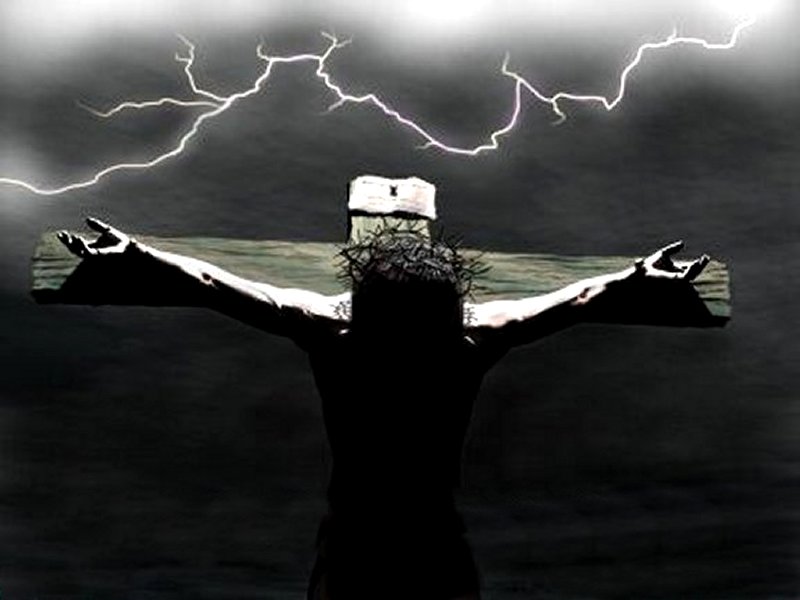
We are now in a position to go a step further still and to
consider how great a range is compassed by the Cross of the Lord Jesus Christ.
In the light of Christian experience and for the purpose of analysis, it may
help us if we recognize four aspects of God's redemptive work. But in doing so
it is essential to keep in mind that the Cross of Christ is one Divine
work -- not many. Once in Judea two thousand years ago the Lord Jesus died
and rose again, and He is now "by the right hand of God exalted"
Acts 2:33
Jesus was taken up to sit at the right side
of God, and he was given the Holy Spirit, just as the Father had promised.
Jesus is also the one who has given the Spirit to us, and that is what you are
now seeing and hearing.
. The work is finished and need never be repeated, nor can it be added
to.
Of the four aspects of the Cross which we shall now mention, we
have already dealt with three in some detail. The last will be considered in the
two succeeding chapters of our study. They may be briefly summarized as
follows:
- The Blood of Christ to deal with sins and guilt.
- The Cross of Christ to deal with sin, the flesh and
the natural man.
- The Life of Christ made available to indwell,
re-create and empower man.
- The Working of Death in the natural man that that
indwelling Life may be progressively manifest.
The first two of these aspects are remedial. They relate to the
undoing of the work of the Devil and the undoing of the sin of man. The last two
are not remedial but positive, and relate more directly to the securing of the
purpose of God. The first two are concerned with recovering what Adam lost by
the Fall; the last two are concerned with bringing us into, and bringing into
us, something that Adam never had. Thus we see that the achievement of the Lord
Jesus in His death and resurrection comprises both a work which provided for the
redemption of man and a work which made possible the realization of the purpose
of God.
We have dealt at some length in earlier chapters with the two
aspects of His death represented by the Blood for sins and guilt and the Cross
for sin and the flesh. In our discussion of the eternal purpose we have also
looked briefly at the third aspect -- that represented by Christ as the grain of
wheat -- and in our last chapter, in our consideration of Christ as our life, we
have seen something of its practical outworking. Before, however, we pass on to
the fourth aspect, which I shall call `bearing the cross', we must say a little
more about this third side, namely, the release of the life of Christ in
resurrection for man's indwelling and empowering for service.
We have spoken already of the purpose of God in creation and have
said that it embraced far more than Adam ever came to enjoy. What was that
purpose? God wanted to have a race of men whose members were gifted with a
spirit whereby communion would be possible with Himself, who is Spirit. That
race, possessing God's own life, was to co-operate in securing His purposed end
by defeating every possible uprising of the enemy and undoing his evil works.
That was the great plan. How will it now be effected? The answer is again to be
found in the death of the Lord Jesus. It is a mighty death. It is something
positive and purposive, going far beyond the recovery of a lost position; for by
it, not only are sin and the old man dealt with and their effects annulled, but
something more, something infinitely greater is introduced.
C. The Love Of Christ
Now we must have before us two passages of the Word, one from
Genesis 2 and
one from Ephesians 5,
which are of great importance in this connection.
"And the Lord God caused a deep sleep to fall upon the man, and
he slept; and he took one of his ribs, which the Lord God had taken from the
man, made he a woman, and brought her unto the man. And the man said, This is
now bone of my bones, and flesh of my flesh: she shall be called Woman (Heb.
ishshah), because she was taken out of Man (Heb. ish)"
Genesis 2:21
So the LORD God made him fall into a
deep sleep, and he took out one of the man's ribs. Then after closing the
man's side,
Genesis 2:22
the LORD made a woman out of the rib.
The LORD God brought her to the man,
Genesis 2:23
and the man exclaimed, "Here is someone
like me! She is part of my body, my own flesh and bones. She came from me, a
man. So I will name her Woman!"
Ephesians 5:25
A husband should love his wife as much
as Christ loved the church and gave his life for it.
Ephesians 5:26
He made the church holy by the power
of his word, and he made it pure by washing it with water.
Ephesians 5:27
Christ did this, so that he would have
a glorious and holy church, without faults or spots or wrinkles or any other
flaws.
In Ephesians 5 we
have the only chapter in the Bible which explains the passage in
Genesis 2.
What we have presented to us in Ephesians is indeed very remarkable, if we
reflect upon it. I refer to what is contained in those words: "Christ... loved
the church". There is something most precious here.
We have been taught to think of ourselves as sinners needing
redemption. For generations that has been instilled into us, and we praise the
Lord for that as our beginning; but it is not what God has in view as His
end. God speaks here rather of "a glorious church, not having spot or
wrinkle or any such thing; but... holy and without blemish". All too often we
have thought of the Church as being merely so many `saved sinners'. It is
that; but we have made the terms almost equal to one another, as though it were
only that, which is not the case. Saved sinners -- with that thought you
have the whole background of sin and the Fall; but in God's sight the Church is
a Divine creation in His Son. The one is largely individual, the other
corporate. With the one the view is negative, belonging to the past; with the
other it is positive, looking forward. The "eternal purpose" is something in the
mind of God from eternity concerning His Son, and it has as its objective that
the Son should have a Body to express His life. Viewed from that standpoint --
from the standpoint of the heart of God -- the Church is something which is
beyond sin and has never been touched by sin.
So we have an aspect of the death of the Lord Jesus in Ephesians
which we do not have so clearly in other places. In Romans things are viewed
from the standpoint of fallen man, and beginning with `Christ died for sinners,
enemies, the ungodly' (Romans 5) we are led
progressively to
Romans 8:35
Can anything separate us from the love of
Jesus Christ? Can trouble, suffering, and hard times, or hunger and nakedness,
or danger and death?
. In Ephesians, on the other hand, the standpoint is that of God
Ephesians 1:4
Before the world was created, God had
Jesus Christ choose us to live with him and become His holy, innocent, and
loving people.
, and the heart of the gospel is:
Ephesians 5:25
A husband should love his wife as much
as Jesus Christ loves the church and gave up His life for it.
. Thus, in Romans it is "we sinned", and the message is of God's love
for sinners (
Romans 5:8
But God showed how much he loved us by
having Jesus Christ die for us, even though we were sinful.
whereas in Ephesians it is "Christ loved", and the love here is the love of
husband for wife. That kind of love has fundamentally nothing to do with sin as
such. What is in view in this passage is not atonement for sin but the creation
of the Church, for which end it is said that He "gave himself".
There is thus an aspect of the death of the Lord Jesus which is
altogether positive and a matter particularly of love to His Church, where the
question of sin and sinners does not directly appear. To bring this fact home
Paul takes that incident in Genesis 2 as
illustration. Now this is one of the marvelous things in the Word, and if our
eyes have been opened to see it we will certainly worship.
From Genesis 3
onwards, from the `coats of skins' to Abel's sacrifice, and on from there
through the whole Old Testament, there are numerous types which set forth the
death of the Lord Jesus as an atonement for sin; yet the apostle does not appeal
here to any of those types of His death, but to this one in
Genesis 2.
Note that; and then recall that it was not until Genesis 3 that
sin came in. There is one type of the death of Christ in the Old Testament which
has nothing to do with sin, for it is not subsequent to the Fall but prior to
it, and that type is here in Genesis 2. Let
us look at it for a moment.
Could we say that Adam was put to sleep because Eve had
committed a serious sin? Is that what we have here? Certainly not, for Eve was
not yet even created. There were as yet no moral issues involved and no problems
at all. No, Adam was put to sleep for the express purpose that something might
be taken out of him to be made into someone else. His sleep was not for her sin
but for her existence. That is what is taught in these verses. This
experience of Adam had as its object the creation of Eve, as something
determined in the Divine counsels. God wanted an ishshah. He put the man
(ish) to sleep, took a rib from his side and made it into ishshah,
a woman, and brought her to the man. That is the picture which God is giving us.
It foreshadows an aspect of the death of the Lord Jesus that is not primarily
for atonement, but answerable to the sleep of Adam in this chapter.
God forbid that I should suggest that the Lord Jesus did not
die for purposes of atonement. Praise God, He did. We must remember that today
we are in fact in Ephesians 5
and not in Genesis 2.
Ephesians was written after the Fall, to men who had suffered from its
effects, and in it we have not only the purpose in Creation but also the scars
of the Fall -- or there would need to be no mention of "spot or wrinkle".
Because we are still on the earth and the Fall is a historic fact, `cleansing'
is needed.
But we must always view redemption as an interruption, an
`emergence' measure, made necessary by a catastrophic break in the straight line
of the purpose of God. Redemption is big enough, wonderful enough, to occupy a
very large place in our vision, but God is saying that we should not make
redemption to be everything, as though man were created to be redeemed.
The Fall is indeed a tragic dip downwards in that line of purpose, and the
atonement a blessed recovery whereby our sins are blotted out and we are
restored; but when it is accomplished there yet remains a work to be done to
bring us into possession of that which Adam never possessed, and to give God
that which His heart desires. For God has never forsaken the purpose which is
represented by that straight line. Adam was never in possession of the life of
God as presented in the tree of life. But because of the one work of the Lord
Jesus in His death and resurrection (and we must emphasize again that it is all
one work) His life was released to become ours by faith, and we have received
more than Adam ever possessed. The very purpose of God is brought within reach
of fulfillment by our receiving Christ as our life.
Adam was put to sleep. We remember that it is said of believers
that they fall asleep, rather than that they die. Why? Because whenever death is
mentioned sin is there in the background. In Genesis 3 sin
entered into the world and death through sin, but Adam's sleep preceded that. So
the type of the Lord Jesus here is not like other types on the Old Testament. In
relation to sin and atonement there is a lamb or a bullock slain; but here Adam
was not slain, but only put to sleep to awake again. Thus he
prefigures a death that is not on account of sin, but that has in view increase
in resurrection. Then too we must note that Eve was not created as a separate
entity by a separate creation, parallel to that of Adam. Adam slept, and Eve was
created out of Adam. That is God's method with the Church. God's `second Man'
has awakened from His `sleep' and His Church is created in Him and of Him, to
draw her life from Him and to display that resurrection life.
God has a Son who is known to be the only begotten, and God is
seeking that the only begotten Son should have brethren. From the
position of only begotten He will become the first begotten, and instead of the
Son alone God will have many sons. One grain of wheat has died and many grains
will spring up. The first grain was once the only grain; now it is changed to be
the first grain of many. The Lord Jesus laid down His life, and that life
emerged in many lives. These are the Biblical figures we have used hitherto in
our study to express this truth. Now, in the figure just considered, the
singular takes the place of the plural. The outcome of the Cross is a single
person: a Bride for the Son. Christ loved the Church and gave Himself up for
it.
D. One Living Sacrifice
We have said that there is an aspect of the death of Christ
presented to us in Ephesians 5
which is to some extent different from that which we have been studying in
Romans. Yet in fact this aspect is the very end to which our study of Romans has
been moving, and it is into this that the letter is leading us as we shall now
see, for redemption leads us back into God's original line of purpose.
In Romans 8 Paul speaks to us of
Christ as the firstborn Son among many Spirit-led "sons of God"
Romans 8:14
Only those people who are led by God's
Spirit are his children.
Romans 8:29
and he has always known who his chosen
ones would be. He had decided to let them become like his own Son, so that his
Son would be the first of many children.
Romans 8:30
God then accepted the people he had
already decided to choose, and he has shared his glory with them.
Here justification is seen to lead on to glory, a glory
that is expressed not in one or more individuals but in a plurality: in many who
manifest the image of One. And this object of our redemption is further set
forth, as we have seen, in "the love of Christ" for His own, which is the
subject of
Romans 8:35
Can anything separate us from the love of
Christ? Can trouble, suffering, and hard times, or hunger and nakedness, or
danger and death?
Romans 8:36
It is exactly as the Scriptures say, "For
you we face death all day long. We are like sheep on their way to be
butchered."
Romans 8:37
In everything we have won more than a
victory because of Christ who loves us.
Romans 8:38
I am sure that nothing can separate us
from God's love--not life or death, not angels or spirits, not the present or
the future,
Romans 8:39
and not powers above or powers below.
Nothing in all creation can separate us from God's love for us in Christ Jesus
our Lord!
But what is implicit here in Romans 8
becomes explicit as we move over into Romans 12,
the subject of which is the Body of Christ.
After the first eight chapters of Romans, which we have been
studying, there follows a parenthesis in which God's sovereign dealings with
Israel are taken up and dealt with, before the theme of the first chapters is
resumed. Thus, for our present purpose, the argument of
Romans 12
follows that of Romans 8 and
not of Romans 11. We
might very simply summarize these chapters thus: Our sins are forgiven (Romans 5), we are
dead with Jesus Christ (Romans 6), we are
by nature utterly helpless (Romans 7),
therefore we rely upon the indwelling Holy Spirit (Romans 8). After
this, and as a consequence of it: "We... are one body in Christ" (Romans 12). It is
as though this were the logical outcome of all that has gone before, and the
thing to which it has all been leading.
Romans 12 and the following chapter
contain some very practical instructions for our life and walk. These are
introduced with an emphasis once again on consecration.
Romans 6:13
or let any part of it become a slave of
evil. Give yourselves to God, as people who have been raised from death to
life. Make every part of your body a slave that pleases God.
But here the emphasis is a little different:
Romans 12:1
Dear friends, God is good. So I beg you
to offer your bodies to him as a living sacrifice, pure and pleasing. That's
the most sensible way to serve God.
This new appeal for
consecration is made to us as "brethren", linking us in thought to the "many
brethren" of
Romans 8:29
and he has always known who his chosen
ones would be. He had decided to let them become like his own Son, so that his
Son would be the first of many children.
It is a call to us for a united step of faith, the presenting of our
bodies as one "living sacrifice" unto God.
This is something that goes beyond the merely individual, for it
implies contribution to a whole. The `presenting' is personal but the sacrifice
is corporate; it is one sacrifice. Intelligent service to God is one service. We
need never feel our contribution is not needed, for if it contributes to
the service, God is satisfied. And it is through this kind of service
that we prove
Romans 12:2
Don't be like the people of this world,
but let God change the way you think. Then you will know how to do everything
that is good and pleasing to him.
, or, in other words, realize God's eternal purpose in Christ
Jesus. So Paul's appeal
Romans 12:3
I realize how kind God has been to me,
and so I tell each of you not to think you are better than you really are. Use
good sense and measure yourself by the amount of faith that God has given you.
is in the light of this new Divine fact, that
Romans 12:5
That's how it is with us. There are many
of us, but we each are part of the body of Christ, as well as part of one
another.
and it is on this basis that the practical instructions follow.
The vessel through which the Lord Jesus can reveal Himself in
this generation is not the individual but the Body. "God hath dealt to each man
a measure of faith" (Romans 12:3),
but alone in isolation man can never fulfill God's purpose. It requires a
complete Body to attain to the stature of Christ and to display His glory. Oh
that we might really see this!
So Romans
12:3-6 draws from the figure of the human body the lesson of our
inter-dependence. Individual Christians are not the Body but are members of the
Body, and in a human body "all the members have not the same office". The ear
must not imagine itself to be an eye. No amount of prayer will give sight to the
ear -- but the whole body can see through the eye. So (speaking figuratively) I
may have only the gift of hearing, but I can see through others who have the
gift of sight; or, perhaps I can walk but cannot work, so I receive help from
the hands. An all-too-common attitude to the things of the Lord is that, `What I
know, I know; and what I don't know, I don't know, and can do quite well
without.' But in Christ, the things we do not know others do, and we may know
them and enter into the enjoyment of them through others.
Let me stress that this is not just a comfortable thought. It is
a vital factor in the life of God's people. We cannot get along without one
another. That is why fellowship in prayer is so important. Prayer together
brings in the help of the Body, as must be clear from
Matthew 18:19
I promise that when any two of you on
earth agree about something you are praying for, my Father in heaven will do
it for you.
Matthew 18:20
Whenever two or three of you come
together in my name, I am there with you.
. Trusting the Lord by myself may not be enough. I must trust Him
with others. I must learn to pray "Our Father..." on the basis of oneness
with the Body, for without the help of the Body I cannot get through. In the
sphere of service this is even more apparent. Alone I cannot serve the Lord
effectively, and He will spare no pains to teach me this. He will bring things
to an end, allowing doors to close and leaving me ineffectively knocking my head
against a blank wall until I realize that I need the help of the Body as well as
of the Lord. For the life of Christ is the life of the Body, and His gifts are
given to us for work that builds up the Body.
The Body is not an illustration but a fact. The Bible does not
just say that the Church is like a body, but that it is the Body
of Christ. "We, who are many, are one body in Christ, and severally members one
of another." All the members together are one Body, for all share His
life -- as though He were Himself distributed among His members. I was once with
a group of Chinese believers who found it very hard to understand how the Body
could be one when they were all separate individual men and women who made it
up. One Sunday I was about to break the bread at the Lord's table and I asked
them to look very carefully at the loaf before I broke it. Then, after it had
been distributed and eaten, I pointed out that though it was inside all of them
it was still one loaf -- not many. The loaf was divided, but Christ is not
divided even in the sense in which that loaf was. He is still one Spirit in us,
and we are all one in Him.
This is the very opposite of man's condition by nature. In Adam
I have the life of Adam, but that is essentially individual. There is no union,
no fellowship in sin, but only self-interest and distrust of others. As I go on
with the Lord I soon discover, not only that the problem of sin and of my
natural strength has to be dealt with, but that there is also a further problem
created by my `individual' life, the life that is sufficient in itself and does
not recognize its need for and union in the Body. I may have got over the
problems of sin and the flesh, and yet still be a confirmed individualist. I
want holiness and victory and fruitfulness for myself personally and apart,
albeit from the purest motives. but such an attitude ignores the Body, and so
cannot provide God with satisfaction. he must deal with me therefore in this
matter also, or I shall remain in conflict with His ends. God does not blame me
for being an individual, but for my individualism. His greatest problem
is not the outward divisions and denominations that divide His Church but our
own individualistic hearts.
Yes, the Cross must do its work here, reminding me that in
Christ I have died to that old life of independence which I inherited from Adam,
and that in resurrection I have become not just an individual believer in Christ
but a member of His Body. There is a vast difference between the two. When I see
this, I shall at once have done with independence and shall seek fellowship. The
life of Christ in me will gravitate to the life of Christ in others. I can no
longer take an individual line. Jealousy will go. Competition will go. Private
work will go. My interests, my ambitions, my preferences, all will go. It will
no longer matter which of us does the work. All that will matter will be that
the Body grows.
I said: `When I see this...' That is the great need: to
see the Body of Christ as another great Divine fact; to have it break in
upon our spirits by heavenly revelation that "we, who are many, are one
body in Christ". Only the Holy Spirit can bring this home to us in all its
meaning, but when He does it will revolutionize our life and work.
E. More Than Conquerors Through Jesus Christ
We only see history back to the Fall. God sees it from the
beginning. There was something in God's mind before the Fall, and in the
ages to come that thing is to be fully realized. God knew all about sin and
redemption; yet in His great purpose for the Church set forth in
Genesis 2
there is no view of sin. It is as though (to speak in finite terms) He leaps in
thought right over the whole story of redemption and sees the Church in future
eternity, having a ministry and a (future) history which is altogether apart
from sin and wholly of God. It is the Body of Christ in glory, expressing
nothing of fallen man but only that which is the image of the glorified Son of
man. This is the Church that has satisfied God's heart and has attained
dominion.
In Ephesians 5 we
stand within the history of redemption, and yet through grace we still have this
eternal purpose of God in view as expressed in the statement that He will
`present unto himself a glorious Church'. But now we note that the water of life
and the cleansing Word are needed to prepare the Church (now marred by the Fall)
for presentation to Christ in glory. For now there are defects to be remedied
and wounds to be healed. And yet how precious is the promise and how gracious
are the words used of her: "not having spot" -- the scars of sin, whose very
history is now forgotten; "or wrinkle" -- the marks of age and of time lost, for
all is now made up and all is new; and "without blemish" -- so that Satan or
demons or men can find no ground for blame in her.
This is where we are now. The age is closing, and Satan's power is
greater than ever. Our warfare is with angels and principalities and powers
Romans 8:38
I am sure that nothing can separate us
from God's love--not life or death, not angels or spirits, not the present or
the future,
Ephesians 6:12
We are not fighting against humans. We
are fighting against forces and authorities and against rulers of darkness and
powers in the spiritual world.
who are set to withstand and destroy the work of God in us
by laying many things to the charge of God's elect. Alone we could never be
their match, but what we alone cannot do the Church can. Sin, self-reliance and
individualism were Satan's master-strokes at the heart of God's purpose in man,
and in the Cross God has undone them. As we put our faith in what He has done
Romans 8:33
If God says his chosen ones are
acceptable to him, can anyone bring charges against them?
Romans 8:34
Or can anyone condemn them? No indeed!
Christ died and was raised to life, and now he is at God's right side,
speaking to him for us.
-- we present a front against which the very gates of Hades
shall not prevail. We, His Church, are
Romans 8:37
In everything we have won more than a
victory because of Christ who loves us.
God has made full provision for our redemption in the Cross of
Christ, but He has not stopped there. In that Cross He has also made secure
beyond possibility of failure that eternal plan which Paul speaks of as having
been from all the ages "hid in God who created all things". That plan He has now
proclaimed "to the intent that now unto the principalities and the powers in the
heavenly places might be made known through the church the manifold wisdom of
God, according to the eternal purpose which he purposed in Christ Jesus our
Lord"
Ephesians 3:9
God, who created everything, wanted me
to help everyone understand the mysterious plan that had always been hidden in
his mind.
Ephesians 3:10
Then God would use the church to show
the powers and authorities in the spiritual world that he has many different
kinds of wisdom.
Ephesians 3:11
God did this according to his eternal
plan. And he was able to do what he had planned because of all that Christ
Jesus our Lord had done.
We have said that the work of the Cross has two consequences which
bear directly upon the realizing of that purpose in us. On the one hand it has
issued in the release of His life that it may find expression in us through the
indwelling Spirit. On the other hand it has made possible what we speak of as
`bearing the cross'; that is, our co-operation in the daily in working of His
death whereby way is made in us for the manifestation of that new life, through
the bringing of the `natural man' progressively into his right place of
subjection to the Holy Spirit. Clearly these are the positive and the negative
sides of one thing. Equally clearly we are now touching more particularly on the
matter of progress in a life lived for God. Hitherto in dealing with the
Christian life we have placed our main emphasis upon the crisis by which it is
entered. Now our concern is more definitely with the walk of the disciple,
having especially in view his training as a servant of God. It is of him that
the Lord Jesus said:
Luke 14:27
You cannot be my disciple unless you carry
your own cross and follow me.
So we come to a consideration of the natural man and the `bearing
of the cross'. To understand this we must, at the risk of being tedious, go back
once more to Genesis and consider what it was that God sought to have in man at
the beginning and how His purpose was frustrated. In this way we shall be able
to grasp the principles by which we can come again to live in line with that
purpose.
A. The True Nature Of The Fall
If we have even a little revelation of the plan of God we shall
always think much of the word `man'. We shall say with the Psalmist, "What is
man, that thou art mindful of him?" The Bible makes it clear that what God
desires above all things is a man -- a man who will be after His own heart.
So God created a man. In
Genesis 2:7
The LORD God took a handful of soil and
made a man. God breathed life into the man, and the man started breathing.
we learn that Adam was created a living soul, with a spirit inside
to commune with God and with a body outside to have contact with the
material world. (Such New Testament verses as
1Thessallonians 5:23
I pray that God, who gives
peace, will make you completely holy. And may your spirit, soul, and body be
kept healthy and faultless until our Lord Jesus Christ returns.
and
Hebrews 4:12
What God has said isn't only alive and
active! It is sharper than any double-edged sword. His word can cut through
our spirits and souls and through our joints and marrow, until it discovers
the desires and thoughts of our hearts.
confirm this threefold character of man's being.) With his spirit Adam
was in touch with the spiritual world of God; with his body he was in touch with
the physical world of material things. He gathered up these two sides of God's
creative act into himself to become a personality, an entity living in the
world, moving by itself and having powers of free choice. Viewed thus as
a whole, he was found to be a self-conscious and self-expressing being, "a
living soul".
We saw earlier that Adam was created perfect -- by which we mean
that he was without imperfections because by God -- but that he was not yet
perfected. He needed a finishing touch somewhere. God had not yet done all that
He intended to do in Adam. There was more in view, but it was as yet in
abeyance. God was moving towards the fulfillment of His purpose in creating man,
a purpose which went beyond man himself, for it had in view the securing to God
of all His rights in the universe through man's instrumental in this? Only by a
co-operation that sprang from living union with God. God was seeking to have not
merely a race of men of one blood upon the earth, but a race which had, in
addition, His life resident within its members. Such a race will eventually
compass the downfall of Satan and bring to fulfillment all that God has set His
heart upon. It is that that was in view with the creation of man.
Then again, we saw that Adam was created neutral. He had a spirit
which enabled him to hold communion with God; but as man he was not yet, so to
speak, finally orientated; he had powers of choice and he could, if he liked,
turn the opposite way. God's goal in man was `son ship', or, in other words, the
expression of His life in human beings. That Divine life was represented in the
garden by the tree of life, bearing a fruit that could be accepted, received,
taken in. If Adam, created neutral, were voluntarily to turn that way and,
choosing dependence upon God, were to receive of the tree of life (representing
God's own life), God would then have that life in union with men; He would have
realized `son ship'. But if instead Adam should turn to the tree of the knowledge
of good and evil, he would as a result be `free' to develop himself on his own
lines apart from God. Because, however, this latter choice involved complicity
with Satan, Adam would thereby put beyond his reach the attaining of his
God-appointed goal.
B. The Root Question: The Human Soul
Now we know the course that Adam chose. Standing between the two
trees, he yielded to Satan and took of the fruit of the tree of knowledge. This
determined the lines of his development. From then on he could command a
knowledge; he `knew'. But -- and here we come to the point -- the fruit of the
tree of knowledge made the first man over-developed in his soul. The
emotion was touched, because the fruit was pleasant to the eyes, making him
`desire'; the mind with its reasoning power was developed, for he was `made
wise'; and the will was strengthened, so that in future he could always decide
which way he would go. The whole fruit ministered to the expansion and full
development of the soul, so that not only was the man a living soul, but from
henceforth man will live by the soul. It is not merely that man has a
soul, but that from that day on the soul, with its independent powers of free
choice, takes the place of the spirit as the animating power of man.
We have to distinguish here between two things, for the
difference is most important. God does not mind -- in fact He intends -- that we
should have a soul such as He gave to Adam. But what God has set Himself to do
is to reverse something. There is something in man today which is not just the
fact of having a soul, but which constitutes a living by the soul. It was this
that Satan brought about in the Fall. He trapped man into taking a course by
which he could develop his soul so as to derive his very life from it.
We must however be careful. To remedy this does not mean that we
are going to cross out the soul altogether. You cannot do that. When today the
Cross is really working in us, we do not become inert, insensate, characterless.
No, we still possess a soul, and whenever we receive something from God the soul
will still be used in relation to it, as an instrument, a faculty, in a true
subjection to Him. But the point is, Are we keeping within God's appointed limit
-- within the bounds set by Him in the Garden at the beginning -- with regard to
the soul, or are we getting outside those bounds?
What God is now doing is the pruning work of the vinedresser. In
our souls there is an uncontrolled development, an untimely growth, that has to
be checked and dealt with. God must cut that off. So now there are two things
before us to which our eyes must be opened. On the one hand God is seeking to
bring us to the place where we live by the life of His Son. On the other hand He
is doing a direct work in our hearts to undo that other natural resource that is
the result of the fruit of knowledge. Every day we are learning these two
lessons: a rising up of the life of this One, and a checking and a handing over
to death of that other soul-life. These two processes go on all the time, for
God is seeking the fully developed life of His Son in us in order to manifest
Himself, and to that end He is bringing us back, as to our soul, to Adam's
starting-point. So Paul says:
II Corinthians 4:10-11
We face death every day
because of Jesus Christ. Our bodies show what His death was like, so that His
life can also be seen in us.
What does this mean? It simply means that I will not take any
action without relying on God. I will find no sufficiency in myself. I will not
take any step just because I have the power to do so. Even though I have that
inherited power within me, I will not use it; I will put no reliance in myself.
By taking the fruit, Adam became possessed of an inherent power to act, but a
power which played right into Satan's hands. You lose that power to act when you
come to know the Lord. The Lord cuts it off and you find you can no longer act
on your own initiative. You have to live by the life of Another; you have to
draw everything from Him.
Oh, friends, I think we all know ourselves in measure, but many
a time we do not truly tremble at ourselves. We may, in a manner of courtesy to
God, say: `If the Lord does not want it, I cannot do it', but in reality our
subconscious thought is that really we can do it quite well ourselves, even if
God does not ask us to do it nor empower us for it. Too often we have been
caused to act, to think, to decide, to have power, apart from Him. Many of us
Christians today are men with over-developed souls. We have grown too big in
ourselves. We have become `big-souled'. When we are in that condition, the life
of the Son of God in us is confined and almost crowded out of action.
C. Natural Energy In The Work Of God
The power, the energy of the soul is present with us all. Those
who have been taught by the Lord repudiate that principle as a life principle;
they refuse to live by it; they will not let it reign, nor allow it to be the
power-spring of the work of God. But those who have not been taught of God rely
upon it; they utilize it; they think it is the power.
Let us take first an obvious illustration of this. Far too many
of us in the past have reasoned as follows. Here is a delightfully good-natured
man, with a clear brain, splendid managing powers and sound judgment. In our
hearts we say, `If that man could be a Christian, what an asset he would be to
the Church! If only he were the Lord's, what a lot it would mean to His
cause!'
But think for a moment. Where did that man's good nature come
from? Whence are those splendid managing powers and that good judgment? Not form
new birth, for he is not yet born again. We know we have all been born of the
flesh; therefore we need a new birth. But the Lord Jesus had something to say
about this in
John 3:6
Humans give life to their children. Yet only
God's Spirit can change you into a child of God.
Everything which comes not by new
birth but by natural birth is flesh and will only bring glory to man, not God.
That statement is not very palatable, but it is true.
We have spoken of soul-power or natural energy. What is this
natural energy? It is simply what I can do, what I am of myself,
what I have inherited of natural gifts and resources. We are none of us
without the power of the soul, and our first need is to recognize it for what it
is.
Take for example the human mind. I may have by nature a keen
mind. Before my new birth I had it naturally, as something developed from my
natural birth. But the trouble arises here. I become converted, I am born anew,
a deep work is effected in my spirit, and essential union with God that has been
set up in my spirit, but at the same time I carry over with me something which I
derive from my natural birth. Now what am I going to do about it?
The natural tendency is this. Formerly I used to use my mind to
pore over history, over business, over chemistry, over questions of the world,
or literature, or poetry. I used my keen mind to get the best out of those
studies. But now my desire has been changed, so henceforth I employ the same
mind in the things of God. I have therefore changed my subject of interest,
but I have not changed my method of working. That is the whole point. My
interests have been utterly changed (praise God for that!), but now I utilize
the same power to study Corinthians and Ephesians that I used before to pursue
history and geography. But that power is not of God; and God will not allow
that. The trouble with so many of us is that we have changed the channel into
which our energies are directed, but we have not changed the source of those
energies.
You will find there are many such things which we carry over
into the service of God. Consider the matter of eloquence. There are some men
who are born orators; they can present a case very convincingly indeed. Then
they become converted, and, without asking ourselves where they really stand in
relation to spiritual things, we put them on the platform and make preachers of
them. We encourage them to use their natural powers for preaching, and again it
is a change of subject but the same power. We forget that, in the matter of our
resource for handling the things of God, it is a question not of comparative
value but of origin -- of where the resource springs from. It is not so
much a matter of what we are doing, but of what powers we are employing to do
it. We think too little of the source of our energy and too much of the end to
which it is directed, forgetting that with God the end never justifies the
means.
The following hypothetical case will help us to test the truth
of our argument. Mr. A. is a very good speaker: he can talk fluently and most
convincingly on any subject, but in practical things he is a very bad manager.
Mr. B., on the other hand, is a poor speaker: he cannot express himself clearly
but wanders all round his subject, never coming to a point; yet on the other
hand he is a splendid manager, most competent in all matters of business. Both
these men get converted, and both become earnest Christians. Let us suppose now
that I call on them both and ask them to speak at a convention, and that both
accept.
Now what will happen? I have asked the self-same thing of both
men, but who do you think will pray the harder? Certainly Mr. B. Why? Because he
is no speaker. In the matter of eloquence he has no resources of his own to
depend upon. He will pray: `Lord, if you do not give me power for this, I cannot
do it'. Of course Mr. A. will pray too, but maybe not in the same way as Mr. B.
because he has something of natural resource upon which to rely.
Now let us suppose that, instead of asking them to speak, I
ask them both to take charge of the practical side of affairs at the convention.
What will happen? The position will be exactly reversed. Now it will be Mr. A.'s
turn to pray hard, for he knows full well that he has no organizing ability. Mr.
B. of course will pray too, but perhaps without quite the same urgency, for
though he knows his need of the Lord he is not nearly so conscious of his need
in business matters as is Mr. A.
Do you see the difference between natural and spiritual gifts?
Anything we can do without prayer and without an utter dependence upon God must
come from that spring of natural life, and is suspect. We must see this
clearly. Of course it is not true that those only are suited for a particular
work who lack the natural gift for it. The point is that, whether naturally
gifted or not, they must know the touch of the Cross in death upon all that is
of nature, and their complete dependence upon the God of resurrection. All too
readily do we envy our neighbor who has some outstanding natural gift, and fail
to realize that our own possession of it, apart from such a working of the
Cross, may easily prove a barrier to the very thing that God is seeking to
manifest in us.
Shortly after my conversion I went out preaching in the
villages. I had had a good education and was well versed in the Scriptures, so I
considered myself thoroughly capable of instructing the village folk, among whom
were quite a number of illiterate women. But after several visits I discovered
that, despite their illiteracy, those women hand an intimate knowledge of the
Lord. I knew the Book they haltingly read; they knew the One of whom the Book
spoke. I had much in the flesh; they had much in the Spirit. How many Christian
teachers today are teaching others as I was then, very largely in the strength
of their carnal equipment!
Once I met a young brother -- young, that is to say, in years,
but who had learned a good deal of the Lord. The Lord had brought him through
much tribulation to gain that knowledge of Himself. As I was talking to him I
said, `Brother, what has the Lord really been teaching you these days?' He said,
`Only one thing: that I can do nothing apart from him.' `Do you really mean', I
said, `that you can do nothing?' `Well, no', he replied. `I can do many
things! In fact that has been just my trouble. Oh, you know, I have always been
so confident in myself. I know I am well able to do lots of things.' So I asked,
`What then do you mean when you say you can do nothing apart from Him?' He
answered, `The Lord has shown me that I can do anything, but that
He has said, "Apart from me ye can do nothing". So it comes to this, that
everything I have done and can do apart from Him is nothing!'
We have to come to that valuation. I do not mean to say we
cannot do a lot of things, for we can. We can take meetings, and build churches,
we can go to the ends of the earth and found missions, and we can seem to bear
fruit; but remember that the Lord's word is:
Matthew 15:13
Jesus answered, "Every plant that my
Father in heaven did not plant will be pulled up by the roots.
God is the only legitimate Originator in the universe
Genesis1:1
In the beginning God created the heavens
and the earth.
.
Anything that you plan and set on foot has its origin in the flesh, and
it will never reach the realm of the Spirit however earnestly you seek God's
blessing on it. It may last for years, and then you may think you will adjust
here and improve there and maybe bring it on a better plane, but it cannot be
done.
Origin determines destination, and what was "of the flesh"
originally will never be made spiritual by any amount of `improvement'. That
which is born of the flesh is flesh, and it will never be otherwise. Anything
for which we are sufficient in ourselves is `nothing' in God's estimate, and we
have to accept His estimate and write it down as nothing. "The flesh profits
nothing." It is only what comes from above that will abide.
We cannot see this simply by being told it. God must teach us
what is meant, by putting His finger on something which He sees and saying:
`This is natural; this has its source in the old creation; this cannot abide.'
Until He does so, we may agree in principle but we can never really see
it. We may assent to, and even enjoy, the teaching, but we shall never truly
loathe ourselves.
But there will come a day when God opens our eyes. Facing a
particular issue we shall have to say, as by revelation: `It is unclean, it is
impure; Lord, I see it!' The word `purity' is a blessed word. I always associate
it with the Spirit. Purity means something altogether of the Spirit. Impurity
means mixture. When God opens our eyes to see that the natural life is something
He can never use in His work, then we find we do not enjoy the doctrine
any longer. Rather we loathe ourselves for the impurity that is in us; but when
that point is reached, God begins His work of deliverance. We are going on
shortly to look at the provision He has made for that deliverance, but we must
stay for a little longer with this matter of revelation.
D. The Light Of God And Knowledge
Of course, if one does not set out to serve the Lord
whole-heartedly, one does not feel the necessity for light. It is only when one
has been apprehended by God, and seeks to go forward with Him, that one finds
how necessary light is. There is a fundamental need of light in order for us to
know the mind of God; to know what is of the spirit and what is of the soul; to
know what is Divine and what is merely of man; to discern what is truly heavenly
and what is only earthly; to understand the difference between things which are
spiritual and things which are carnal; to know whether God is really leading us
or whether we are walking by our feelings, senses or imaginations. It is when we
have reached a position where we would like to follow God fully that we find
light to be the most necessary thing in the Christian life.
In my conversations with younger brothers and sisters one
question comes up again and again. It is: How can I know that I am walking in
the Spirit? How do I distinguish which prompting within me is from the Holy
Spirit and which is from myself? It seems that all are alike in this; but some
have gone further. They are trying to look within, to differentiate, to
discriminate to analyze, and in doing so are bringing themselves into deeper
bondage. Now this is a situation which is really dangerous to Christian life,
for inward knowledge will never be reached along the barren path of
self-analysis.
We are never told in the Word of God to examine our inward
condition. That way ends only to
uncertainty, vacillation and despair. Of course we have to have self-knowledge.
We have to know what is going on within. We do not want to live in a fool's
paradise; to have gone altogether wrong and yet not know we have gone wrong; to
have a Spartan will and yet think we are pursuing the will of God. But such
self-knowledge does not come by our turning within; by our analyzing our
feelings and motives and everything that is going on inside, and then trying to
pronounce whether we are walking in the flesh or in the Spirit.
There are several passages in the Psalms which illumine this
subject. The first is
Psalm 36:9
The life-giving fountain belongs to you,
and your light gives light to each of us.
. I think that is one of the best verses in the
old Testament. There are two lights there. There is "thy light", and then, when
we have come into that light, we shall "see light".
Now those two lights are different. We might say that the first
is objective and the second subjective. The first light is the light which
belongs to God but is shed upon us; the second is the knowledge imparted by that
light. "In thy light shall we see light": we shall know something; we shall be
clear about something; we shall see. No turning within, no introspective
self-examination will ever bring us to that clear place. No, it is when there is
light coming from God that we see.
I think it is so simple. If we want to satisfy ourselves that
our face is clean, what do we do? Do we feel it carefully all over with our
hands? No, of course not. We find a mirror and we bring it to the light. In that
light everything becomes clear. No sight ever came by feeling or analyzing.
Sight only comes by the light of God coming in; and when once it has come, there
is no loner need to ask if a thing is right or wrong. We know.
You remember again how
Psalm 139:23
Look deep into my heart, God, and find
out everything I am thinking.
. You realize,
do you not, what it means to say `Search me'? It certainly does not mean that I
search myself. `Search me' means `You search me!' That is the way of
illumination. It is for God to come in and search; it is not for me to search.
Of course that will never mean that I may go blindly on, careless of my true
condition. That is not the point. The point is that however much my
self-examination may reveal in me that needs putting right, such searching never
really gets below the surface. My true knowledge of self comes not from my
searching myself but from God searching me.
But, you ask, what does it mean in practice for us to come into
the light? How does it work? How do we see light in His light? Here again
the Psalmist comes to our help.
Psalm 119:130
Understanding your word brings light to
the minds of ordinary people.
. In spiritual things we are all `simple'. We are dependent upon
God to give us understanding, and especially is this so in the matter of our own
true nature. And it is here that the Word of God operates. In the New Testament
the passage which states this most clearly is in the Epistle to the Hebrews:
"The word of God is living, and active, and sharper than any two-edged sword,
and piercing even to the dividing of soul and spirit, of both joints and marrow,
and quick to discern the thoughts and intents of the heart. And there is no
creature that is not manifest in his sight: but all things are naked and laid
open before the eyes of him with whom we have to do"
Hebrews 4:12
What God has said isn't only alive and
active! It is sharper than any double-edged sword. His word can cut through
our spirits and souls and through our joints and marrow, until it discovers
the desires and thoughts of our hearts.
Hebrews 4:13
Nothing is hidden from God! He sees
through everything, and we will have to tell him the truth.
Yes, it is the Word of God, the penetrating Scripture of Truth,
that settles our questions. It is that which discerns our motives and defines
for us their true source in soul or spirit.
With this I think we can pass on from the doctrinal to the
practical side of things. Many of us, I am sure, are living quite honestly
before God. We have been making progress, and we do not know of anything much
wrong with us. Then one day, as we go on, we meet with a fulfillment of that
word: "The entrance of Your words give light". Some servant of God has been
used by Him to confront us with His living Word, and that Word has made an
entrance into us. Or perhaps we ourselves have been waiting before God and,
whether from our memory of Scripture or from the page itself, His Word has come
to us in power. Then it is we see something which we have never seen before. We
are convicted. We know where we are wrong, and we look up and confess: `Lord, I
see it. There is impurity there. There is mixture. How blind I was! Just fancy
that for so many years I have been wrong there and have never known it!' Light
comes in and we see light. The light of God brings us to see the light
concerning ourselves, and it is an abiding principle that every knowledge of
self comes to us in that way.
It may not always be the Scriptures. Some of us have known
saints who really knew the Lord, and through praying with them or talking with
them, in the light of God radiating from them, we have seen something which we
never saw before. I have met one such, who is now with the Lord, and I always
think of her as a `lighted' Christian. If I did but walk into her room, I was
brought immediately to a sense of God. In those days I was very young and had
been converted about two years, and I had lots of plans, lots of beautiful
thoughts, lots of schemes for the Lord to sanction, a hundred and one things
which I thought would be marvelous if they were all brought to fruition. With
all these things I came to her to try to persuade her; to tell her that this or
that was the thing to do.
Before I could open my mouth she would just say a few words in
quite an ordinary way. Light dawned! It simply put me to shame. My `doing' was
all so natural, so full of man. Something happened. I was brought to a place
where I could say: `Lord, my mind is set only in creaturely activities, but here
is someone who is not out for them at all'. She had but one motive, one desire,
and that was for God. Written in the front of her Bible were these words: `Lord,
I want nothing for myself', Yes, she lived for God alone, and where that is the
case you will find that such a one is bathed in light, and that that light
illuminates others. That is real witness. Light has one law: it shines
wherever it is admitted. That is the only requirement. We may shut it out
of ourselves; it fears nothing else. If we throw ourselves open to God, He will
reveal. The trouble comes when we have closed areas, locked and barred places in
our hearts, where we think with pride that we are right. Our defeat lies
then not only in our being wrong but in our not knowing that we are
wrong. Wrong may be a question of natural strength; ignorance of it is a
question of light. You can see the natural strength in some but they cannot see
it themselves. Oh, we need to be sincere and humble, and to open ourselves
before God! Those who are open can see. God is light, and we cannot live
in His light and be without understanding. Let us say again
Psalm 43:3
Send your light and your truth to guide
me. Let them lead me to your house on your sacred mountain.
We praise God that sin is being brought to the notice of
Christians today more than hitherto. In many places the eyes of Christians have
been opened to see that victory over sins, as items, is important in Christian
life, and in consequence many are walking closer to the Lord in seeking
deliverance and victory over them. Praise the Lord for any movement toward
Himself, any movement back to real holiness unto God! But that is not enough.
There is one thing that must be touched, and that is the very life of the man,
not merely his sins. The question of the personality of the man, of his
soul-power, is the heart of the matter. To make the question of sins to be
everything is still to be on the surface. Holiness, if you only regard sins, is
still something on the outside, still superficial. You have not yet got to the
root of the evil.
Adam did not let sin into the world by committing murder. That
came later. Adam let in sin by choosing to have his soul developed to a place
where he cold go on by himself apart from God. When, therefore, God secures a
race of men who will be to His glory, and who will be His instrument to
accomplish His purpose in the universe, they will be a people whose life -- yea,
whose very breath -- is dependent upon Him. He will be the "tree of life" to
them.
What I feel more and more the need of in myself, and what I
feel that we all as the Lord's children need to seek from God, is a real
revelation of ourselves. I repeat that I do not mean we should be for ever
looking in on ourselves and asking: `Now, is this soul or is it spirit?' That
will never get us anywhere; it is darkness. No, Scripture shows us how the
saints were brought to self-knowledge. It was always by light from God, and that
light is God Himself. Isaiah, Ezekiel, Daniel, Peter, Paul, John, all
came to a knowledge of themselves because the Lord flashed Himself upon
them, and that flash brought revelation and conviction.
Isaiah 6:5
Then I cried out, "I'm doomed! Everything
I say is sinful, and so are the words of everyone around me. Yet I have seen
the King, the LORD All-Powerful."
Ezekiel 1:28
as colorful as a rainbow that appears
after a storm. I realized I was seeing the brightness of the LORD 's glory! So
I bowed with my face to the ground, and just then I heard a voice speaking to
me.
Daniel 10:8
Only I saw this great vision. I became
weak and pale,
Luke 22:61-62
The Lord turned and looked at Peter.
And Peter remembered that the Lord had said, "Before a rooster crows tomorrow
morning, you will say three times that you don't know me." Then Peter went out
and cried hard.
Acts 9:3-5
When Saul had almost reached Damascus, a
bright light from heaven suddenly flashed around him. He fell to the ground
and heard a voice that said, "Saul! Saul! Why are you so cruel to me?" "Who
are you?" Saul asked. "I am Jesus," the Lord answered. "I am the one you are
so cruel to.
Revelation 1:17
When I saw him, I fell at his feet
like a dead person. But he put his right hand on me and said: Don't be afraid!
I am the first, the last,
We can never know the hatefulness of sin and the hatefulness of
ourselves unless there is that flash of God upon us. I speak not of a sensation
but of an inward revelation of the Lord Himself through His Word. It does for us
what doctrine alone can never do.
Christ is our light. He is the living Word, and when we read
the Scriptures that life in Him brings revelation.
John 1:3-4
And with the Word, God created all things. Nothing was made without the Word.
Everything that was created received life from Him, and His life gave
light to everyone.
Such illumination may not come to us all at once, but gradually; but
it will be more and more clear and searching, until we see ourselves in the
light of god and all our self-confidence is gone. For light is the purest thing
in the world. It cleanses. It sterilizes. It kills what should not be there. In
its radiance the `dividing asunder of joints and marrow' becomes to us a fact
and no mere teaching. We know fear and trembling as we recognize the corruption
of man's nature, the hatefulness of our own selves, and the real threat to the
work of God of our unrestrained soul-life and energy. As never before, we wee
now how much of us needs God's drastic dealing if He is to use us, and we know
that, apart from Him, as servants of God we are finished.
But here the Cross, in its widest meaning, will come to our
help again, and we shall seek now to examine an aspect of its work which meets
and deals with our problem of the human soul. For only a thorough understanding
of the Cross can bring us to that place of dependence which the Lord Jesus
Himself voluntarily took when He said:
John 5:30
I cannot do anything on my own. The Father
sent me, and He is the one who told me how to judge. I judge with fairness,
because I obey him, and I don't just try to please myself.
In our previous chapter we have touched several times upon the
matter of service for the Lord. As we come now to look at the provision that God
has made to meet the problem created by the soul-life of man, it will be helpful
if we approach that problem by considering first the principles which govern our
work for Him and from which no one who tries to serve Him may deviate. The basis
of our salvation, as we well know, is the fact of our Lord's death and
resurrection; but the conditions of our service are no less definite. Just as
the fact of the death and resurrection of the Lord is the ground of our
acceptance with God, so the principle of death and resurrection is the
basis of our life and service for Him.
A. The Basis Of A True Ministry
No one can be a true servant of God without knowing the
principle of death and the principle of resurrection. Even the Lord Jesus
Himself served on that basis. You will find in Matthew 3
that, before His public ministry ever began, our Lord was baptized. He was
baptized not because He had any sin, or anything which needed cleansing. No, we
know the meaning of baptism: it is a figure of death and resurrection. The
ministry of the Lord did not begin until He was on that ground. After He had
been baptized and had voluntarily taken the ground of death and resurrection,
the Holy Spirit came upon Him, and then He ministered.
What does this teach us? Our Lord was a sinless Man. None but He
has trodden this earth and known no sin. Yet as Man He had a separate
personality from His Father. Now we must tread very carefully when we touch our
Lord; but remember His words: "I seek not mine own will, but the will of him
that sent me". What does this mean? It certainly does not mean that the Lord had
no will of His own. He had a will, as His own words show. As Son of man He had a
will, but He did not do it; He came to do the will of the Father. So this is the
point. That thing in Him which is in distinction from the Father is the human
soul, which He assumed when He was "found in fashion as a man". Being a perfect
Man our Lord had a soul, and of course a body, just as you and I have a soul and
a body, and it was possible for Him to act from the soul -- that is, from
Himself.
You remember that immediately after the Lord's baptism, and
before His public ministry began, Satan came and tempted Him. He tempted Him to
satisfy His essential needs by turning stones to bread; to secure immediate
respect for His ministry by appearing miraculously in the temple court; to
assume without delay the world dominion destined for Him; and you are inclined
to wonder why he tempted Him to do such strange things. He might rather, you
feel, have tempted Him to sin in a more thoroughgoing way. But he did not; he
knew better. He only said: "If thou art the Son of God, command that
these stones become bread". What did it mean? The implication was this: `If You
are the Son of God You must do something to prove it. Here is a challenge. Some
will certainly raise a question as to whether Your claim is real or not. Why do
You not settle the matter finally now by coming out and proving it?'
The whole subtle object of Satan was to get the Lord to act for
Himself -- that is, from the soul -- and, by the stand He took, the Lord Jesus
absolutely repudiated such action. In Adam, man had acted from himself apart
from God; that was the whole tragedy of the garden. Now in a similar situation
the Son of man takes another ground. Later He defines it as His basic
life-principle -- and I like the word in the Greek:
John 5:19
Jesus told the people: I tell you for
certain that the Son cannot do anything on his own. He can do only what he
sees the Father doing, and he does exactly what he sees the Father do.
That total denial of the soul-life was to govern all His
ministry.
So we can safely say that all the work which the Lord Jesus did
on earth, prior to His actual death on the cross, was done with the principle of
death on the cross, and resurrection as basis, even though as an actual event
Calvary still lay in the future. Everything He did was on that ground. But if
this is so -- if the Son of man has to go through death and resurrection (in
figure and in principle) in order to work, can we do otherwise? Surely no
servant of the Lord can serve Him without himself knowing the working of that
principle in his life. It is of course out of the question. The Lord made this
very clear to His disciples when He left them. He had died and He was risen, and
He told them to wait in Jerusalem for the Spirit to come upon them. Now what is
this power of the Holy Spirit, this "power from on high" of which He spoke? It
is nothing less than the virtue of His death, resurrection and ascension. To use
another figure, the Holy Spirit is the Vessel in whom all the values of the
death, resurrection and exaltation of the Lord are deposited, that they may be
brought to us. He is the one who `contains' those values and mediates them to
men. That is the reason why the Spirit could not be given before the Lord had
been glorified. Then only could He rest upon men and women that they might
witness; and without the values of the death and resurrection of Christ no such
witness is possible.
If we turn to the Old Testament we find the same thing is there.
I would refer you to a familiar passage in Numbers
17 . The matter of Aaron's ministry has been contested. There
is a question among the people as to whether Aaron is truly the chosen of God.
They have entertained a suspicion, and have said in effect: `Whether that man is
ordained of God or not, we do not know!' and so God sets out to prove who is His
servant and who is not. How does He do so? Twelve dead rods are put before the
Lord in the sanctuary over against the testimony, and they are there for a
night. Then, in the morning, the Lord indicates His chosen minister by the rod
which buds, blossoms and bears fruit.
We all know the meaning of that. The budding rod speaks of
resurrection. It is death and resurrection that marks God-recognized ministry.
Without that you have nothing. The budding of Aaron's rod proved him to be on a
true basis, and God will only recognize as His ministers those who have come
through death to resurrection ground.
We have seen that the death of the Lord works in different ways
and has different aspects. We know how His death has worked in regard to the
forgiveness of our sins. We all know that our forgiveness is based upon the shed
Blood, and that without the shedding of Blood there is no remission. Then we
have come further and in Romans 6 have
seen how death works to meet the power of sin. We have learned that our old man
has been crucified in order that henceforth we should not serve sin, and we have
praised the Lord that here too His death has worked for our deliverance. Further
on still the question of human self-will arises, and the need for consecration
is apparent; and we find death working that way to bring about in us a
willingness to let go our own wills and obey the Lord. That indeed constitutes a
starting point for our ministry, but still it does not touch the core of the
question. There may still be the lack of knowledge of what is meant by the
soul.
Then another phase is presented to us in Romans 7 where
the question of holiness of life is in view -- a living, personal holiness.
There you find a true man of God trying to please God in righteousness, and he
comes under the law and the law finds him out. He is trying to please God by
using his own carnal power, and the Cross has to bring him to the place where he
says, `I cannot do it. I cannot satisfy God with my powers; I can only
trust the Holy Spirit to do that in me.' I believe some of us have passed
through deep waters to learn this, and to discover the value of the death of the
Lord working in this way.
Now mark you, there is still a great difference between "the
flesh", as spoken of in Romans 7 in
relation to holiness of life, and the working of the natural energies of the
soul-life in the service of the Lord. With all the above being known -- and
known in experience -- there still remains this one sphere more which the death
of the Lord must enter before we are actually of use to Him in service. Even
with all these experiences we are still unsafe for Him to use until this further
thing is effected in us. How many of God's servants are used by Him, as we say
in China, to build twelve feet of wall, only, when they have done so, to undo it
all by themselves pulling down fifteen feet! We are used in a sense, but at the
same time we destroy our own work, and sometimes that of others also, because of
there being somewhere something un-dealt with by the Cross.
Now we have to see how the Lord has set out to deal with the
soul, and then more particularly how this touches the question of our service
for Him.
B. The Subjective Work Of The Cross
We must keep before us now four passages from the Gospels. They
are:
Matthew 10:34-39
Don't think that I came to bring
peace to the earth! I came to bring trouble, not peace. I came to turn sons
against their fathers, daughters against their mothers, and daughters-in-law
against their mothers-in-law. Your worst enemies will be in your own family.
If you love your father or mother or even your sons and daughters more than
me, you are not fit to be my disciples. And unless you are willing to take up
your cross and come with me, you are not fit to be my disciples. If you try to
save your life, you will lose it. But if you give it up for me, you will
surely find it.
Matthew 8:32-34
Jesus told them to go, and they went
out of the men and into the pigs. All at once the pigs rushed down the steep
bank into the lake and drowned. The people taking care of the pigs ran to the
town and told everything, especially what had happened to the two men.
Everyone in town came out to meet Jesus. When they saw him, they begged him to
leave their part of the country.
Luke 17:32-34
Remember what happened to Lot's wife.
People who try to save their lives will lose them, and those who lose their
lives will save them. On that night two people will be sleeping in the same
bed, but only one will be taken. The other will be left.
John 12:24-26
I tell you for certain that a grain of
wheat that falls on the ground will never be more than one grain unless it
dies. But if it dies, it will produce lots of wheat. If you love your life,
you will lose it. If you give it up in this world, you will be given eternal
life. If you serve me, you must go with me. My servants will be with me
wherever I am. If you serve me, my Father will honor you.
These four passages have something in common. In each you have the
Lord Himself speaking to us concerning the soul-activity of man, and in each a
different aspect or manifestation of the soul-life is touched upon. In these
verses He makes it very plain that the soul of man can be dealt with in one way
and in one way only, and that is by our bearing the cross daily and following
Him.
As we have just seen, the soul-life or natural life that is
here in view is something further than what we have in those passages which are
concerned with the old man or the flesh. We have sought to make quite clear
that, in respect of our old man, God emphasizes the thing He has done once
for all in crucifying us with Christ on the Cross. We have seen that three
times in the Epistle to the Galatians the `crucifying' aspect of the Cross is
referred to as a thing accomplished; and
Romans 6:6
We know that the persons we used to be
were nailed to the cross with Jesus Christ. This was done, so that our sinful
bodies would no longer be the slaves to sin.
which, if the
tense of the word means anything, we might well paraphrase: `Our old man has
been finally and for ever crucified'. It is something done, to be apprehended by
Divine revelation and then appropriated by faith.
But there is a further aspect of the Cross, namely that implied
in the expression `bearing his cross daily', which is before us now. The Cross
has borne me; now I must bear it; and this bearing of the Cross is an inward
thing. It is this that we mean when we speak of `the subjective working of the
Cross'. Moreover it is a daily process; it is a step by step following after
Him. It is this which is now brought before us in relation to the soul, and let
us note that the emphasis here is not quite the same as with the old man. We do
not have here the `crucifixion' of the soul itself, in the sense that our
natural gifts and faculties, our personality and our individuality, are to be
put away altogether. Were it so it could hardly be said of us, as it is in
Hebrews 10:39
We are not like those people who turn
back and get destroyed. We will keep on having faith until we are saved.
Compare
1Peter 1:8-9
You have never seen Jesus, and you don't
see him now. But still you love him and have faith in him, and no words can
tell how glad and happy you are to be saved. That's why you have faith.
with
Luke 21:18-19
But don't worry because You will be
saved by being faithful to me.
No, we do not lose our souls in this sense, for to do so would be to
lose our individual existence completely. The soul is still there with its
natural endowments, but the Cross is brought to bear upon it to bring those
natural endowments into death -- to put the mark of His death upon them -- and
thereafter, as God may please, to give them back to us in resurrection.
It is in this sense that Paul, writing to the Philippians,
expresses the desire
Philippians 3:10
All I want is to know Christ and the
power that raised him to life. I want to suffer and die as he did,
The mark of death is upon the soul all the time to bring it to the
place where it is always subordinate to the Spirit and never independently
asserts itself. Only the Cross, working in such a way, could make a man of the
caliber of Paul, and with the natural resources hinted at in
Philippians
3, so distrust his own natural strength that he could write to the
Corinthians:
1Corinthians 2:2-5
In fact, while I was with you, I
made up my mind to speak only about Jesus Christ, who had been nailed to a
cross. At first, I was weak and trembling with fear. When I talked with you or
preached, I didn't try to prove anything by sounding wise. I simply let God's
Spirit show his power. That way you would have faith because of God's power
and not because of human wisdom.
The soul is the seat of the affections, and what a great part
of our decisions and actions is influenced by these! There is nothing
deliberately sinful about them, mind you, but it is simply that there is
something in us which can go out in natural affection to another person and
which as a result can influence wrongly our whole course of action. So in the
first of the four passages before us the Lord has to say:
Matthew 10:37-38
If you love your father or mother or
even your sons and daughters more than me, you are not fit to be my disciples.
And unless you are willing to take up your cross and come with me, you are not
fit to be my disciples.
You note that to follow the Lord in the way of the Cross
is set before us as His normal, His only way for us. What immediately follows?
Matthew 10:39
If you try to save your life, you will
lose it. But if you give it up for me, you will surely find it.
The secret danger lies in that subtle working of the affections
to turn us away from the pathway of God; and the key to the matter is the soul.
The Cross has to deal with that. I have to "lose" my soul in the sense in which
the Lord meant those words, and which we are seeking here to explain.
Some of us know well what it means to lose our soul. We can no
longer fulfill its desire; we cannot give in to it; we cannot gratify it: that
is the `loss' of the soul. We are going through a painful process to discourage
what the soul is asking for. And many a time we have to confess that it is not
any definite sin that is keeping us from following the Lord to the end. We are
held up because of some secret love somewhere, some perfectly natural affection
diverting our course. Yes, affection plays a great part in our lives, and the
Cross has to come in there and do its work.
Then we pass to the reference in Mark 8.
I think that is a most important passage. Our Lord had just taught His disciples
at Caesarea Philippi that He was going to suffer death at the hands of the
elders of the Jews, and then Peter, with all his love for his Master, came up
and rebuked Him and said to Him: `Lord, do not do it; pity Thyself: this shall
never come to Thee!' Out of his love for the Lord he appealed to Him to spare
Himself; and the Lord rebuked Peter, as He would rebuke Satan, for caring for
the things of men and not the things of God. And then to all present the word
was spoken once more:
Mark 8:34-35
Jesus then told the crowd and the
disciples to come closer, and he said: If any of you want to be my followers,
you must forget about yourself. You must take up your cross and follow me. If
you want to save your life, you will destroy it. But if you give up your life
for me and for the good news, you will save it.
The whole question at issue is again that of the soul, and here
it is particularly of the soul's desire for self-preservation. There is that
subtle working of the soul which says, `If I could be allowed to live I would do
anything, be willing for anything; but I must be kept alive!' There you have the
soul almost crying out for help. `Going to the Cross, being crucified -- oh that
is really too much! Have mercy on yourself; pity yourself! Do you mean to say
you are going against yourself and going with God?' Some of us
know well that in order to go on with God we have many a time to go against the
voice of the soul- our own or other people's -- and to let the Cross come in to
silence that appeal for self-preservation.
Am I afraid of the will of God? The dear saint whom I have
already mentioned as having had such an influence upon the course of my life,
many times asked me the question: `Do you like the will of God?' It is a
tremendous question. She did not ask, `Do you do the will of God?' she
always asked, `Do you like the will of God?' That question cuts deeper
than anything else. I remember once she was having a controversy with the Lord
over a certain matter. She knew what the Lord wanted, and in her heart she
wanted it too. But is was difficult, and I heard her pray like this: `Lord, I
confess I don't like it, but please do not give in to me. Just wait, Lord -- and
I will give in to Thee.' She did not want the Lord to yield to her and to
reduce His demands upon her. She wanted nothing but to please Him.
Many a time we have to come to the place where we are willing
to let go things we think to be good and precious -- yes, and even, it may be,
the very things of God themselves -- that His will may be done. Peter's concern
was for his Lord and was dictated by his natural love for Him. We might feel
that Peter had a marvelous love for his Lord, sufficient even for him to dare to
rebuke Him. Only a strong love could bring one to attempt that! Yes, but when
there is purity of spirit without that mixture of soul, you will not be led into
Peter's mistake. You will recognize the will of God and you will find that
that is what your heart delights in alone. You will no longer even shed a
tear in sympathy with the flesh. Yes, the Cross cuts deeply, and we see here
once more how utterly it has to deal with the soul.
Once again the Lord Jesus deals with the matter of the soul in
Luke 17, and now it is in relation to His return.
Speaking of "the day that the Son of man is revealed", He draws a parallel
between that day and "the day that Lot went out from Sodom"
Luke 17:29-30
But on the very day Lot left Sodom,
fiery flames poured down from the sky and killed everyone. The same will
happen on the day when the Son of Man appears.
A little later He speaks of the `rapture' in the twice
repeated words:
Luke 17:34-35
On that night two people will be
sleeping in the same bed, but only one will be taken. The other will be left.
Two women will be together grinding wheat, but only one will be taken. The
other will be left.
But between His reference to the calling of Lot out of
Sodom and this allusion to the rapture, the Lord says these remarkable words:
"In that day, he which shall be on the housetop, and his goods in the house, let
him not go down to take them away: and let him that is in the field likewise not
return back. Remember Lot's wife"
Luke 17:31-32
At that time no one on a rooftop should
go down into the house to get anything. No one in a field should go back to
the house for anything. Remember what happened to Lot's wife.
Remember Lot's wife! Why? because
Luke 17:33
People who try to save their lives will
lose them, and those who lose their lives will save them.
If I mistake not, this is the one passage in the New Testament
that tells of our reaction to the rapture call. We may have thought that when
the Son of man comes we shall be taken up automatically, as it were, because of
what we read in
1Corinthians 15:51-52
I will explain a mystery to
you. Not every one of us will die, but we will all be changed. It will happen
suddenly, quicker than the blink of an eye. At the sound of the last trumpet
the dead will be raised. We will all be changed, so that we will never die
again.
Well, however we reconcile the two
passages, this one in Luke's Gospel should at least make us pause and reflect;
for the emphasis is here very strongly upon one being taken and the other left.
It is a matter of our reaction to the call to go, and on the basis of this a
most urgent appeal is made to us to be ready (compare
Matthew 24:42
So be on your guard! You don't know
when your Lord will come.
There is surely a reason for this. Clearly that call is not
going to produce a miraculous last-minute change in us out of all relation to
our previous walk with the Lord. No, in that moment we shall discover our
heart's real treasure. If it is the Lord Himself, then there will be no backward
look. A backward glance decides everything. It is so easy to become more
attached to the gifts of God than to the Giver -- and even, I should add, to the
work of God than to God Himself.
Let me illustrate. At the present time I am writing a book. I have
finished eight chapters and I have another nine to write, about which I am very
seriously exercised before the Lord. But if the call to `come up hither' should
come and my reaction were to be `What about my book?' the answer might well be,
`All right, stay down and finish it!' That precious thing which we are doing
downstairs `in the house' can be enough to pin us down, a peg that holds us to
earth.
It is all a question of our living by the soul or by the
spirit. Here in this passage in Luke, we have depicted the soul-life in its
engagement with the things of the earth -- and mark you, not sinful things
either. The Lord only mentioned marrying, planting, eating, selling -- all
perfectly legitimate activities with which there is nothing essentially wrong.
But it is occupation with them, so that your heart goes out to them, that is
enough to pin you down. The way out of that danger is by the losing of the soul.
This is beautifully illustrated in the action of Peter when he recognized the
risen Lord Jesus by the lake-side. Though with the others he had returned to his
former employment, there was now no thought of the ship, nor even of the net
full of fishes so miraculously provided. When he heard John's cry of
recognition: "it is the Lord", we read that "he cast himself into the sea".
That is true detachment. The question at issue is always,
Where is my heart? The cross has to work in us a true spiritual detachment from
anything and anyone outside of the Lord Himself.
But, even here, we are as yet only dealing with the more
outward aspects of the soul's activity. The soul giving rein to its affections,
the soul asserting itself and trying to manipulate things, the soul becoming
preoccupied with things, the soul becoming preoccupied with things on the earth:
these are still small things, and do not yet touch the real heart of the matter.
There is something which is deeper yet, and which I will try now to explain.
C. The Cross And Fruitfulness
Let us read again
John 12:24-25
I tell you for certain that a grain of
wheat that falls on the ground will never be more than one grain unless it
dies. But if it dies, it will produce lots of wheat. If you love your life,
you will lose it. If you give it up in this world, you will be given eternal
life.
Here we have the inward working of the Cross of which we have
been speaking -- the losing of the soul -- linked with and likened to that
aspect of the death of the Lord Jesus Himself which we have already seen
depicted in the grain of wheat, namely, His death with a view to increase. The
end in view is fruitfulness. There is a grain of wheat with life in it, but "it
abides alone". It has the power to impart its life to others; but to do so it
must go down into death.
Now we know the way the Lord Jesus took. He passed into death,
and, as we saw earlier, His life emerged in many lives. The Son died, and came
forth as the first of "many sons". He let go His life that we might receive it.
It is in this aspect of His death that we are called to die. It is here that He
makes clear the value of conformity to His death, which is that we lose our own
natural life, our soul, in order that we may become life-imparters, sharing
thereafter with others the new life of God which is in us. This is the secret of
ministry, the path of real fruitfulness to God. As Paul says:
II Corinthians 4:10-12
We face death every day
because of Jesus. Our bodies show what his death was like, so that his life
can also be seen in us. This means that death is working in us, but life is
working in you.
We are coming to our point. There is new life in us, if we
have received Christ. We all have that precious possession, the treasure in the
vessel. Praise the Lord for the reality of His life within us! But why is there
so little expression of that life? Why is there an `abiding alone'? Why is it
not overflowing and imparting life to others? Why is it scarcely making itself
apparent even in our own lives? The reason why there is so little sign of life
where life is present is that the soul in us is enveloping and confining that
life (as the husk envelopes the grain of wheat) so that it cannot find outlet.
We are living in the soul; we are working and serving in our own natural
strength; we are not drawing from God. It is the soul that stands in the
way of the springing up of life. Lose it; for that way lies fullness.
D. A Dark Night and A Resurrection Morning
So we come back to the almond rod, which was brought into the
sanctuary for a night -- a dark night in which there was nothing to be seen --
and then in the morning it budded. There you have set forth the death and
resurrection, the life yielded up and the life fained, and there you have the
ministry attested. But how does this work out in practice? How do I recognize
that God is dealing with me in this way?
First we must be clear about one thing: the soul with its fund
of natural energy and resource will continue with us until our death. Till then
there will be an unending day-by-day need for the Cross to operate in us,
dredging deeply that well-spring of nature. This is the life-long condition of
service that is laid down in the words:
Mark 8:34
Jesus then told the crowd and the disciples
to come closer, and he said: If any of you want to be my followers, you must
forget about yourself. You must take up your cross and follow me.
We never get past that. He who evades it
Mark 10:38
Jesus told them, "You don't really know
what you're asking! Are you able to drink from the cup that I must soon drink
from or be baptized as I must be baptized?"
because he
Luke 14:27
You cannot be my disciple unless you carry
your own cross and come with me.
Death and resurrection must remain an abiding principle of our lives
for the losing of the soul and the uprising of the Spirit.
Yet here too there may be a crisis that, once reached and
passed, can transform our whole life and service for God. It is a wicket gate by
which we may enter upon an entirely new pathway. Such a crisis occurred in the
life of Jacob at Peniel. It was the `natural man' in Jacob that was seeking to
serve God and to attain His end. Jacob knew well that God had said: "The elder
shall serve the younger", but he was trying to compass that end through his own
ingenuity and resource. God had to cripple that strength of nature in Jacob, and
that He did when He touched the sinew of Jacob's thigh. Jacob continued to walk
thereafter, but he continued to be lame. He was a different Jacob, as his change
of name implies. He had his feet and he could use them, but the strength had
been touched, and he limped from an injury from which he would never quite
recover.
God must bring us to a point -- I cannot tell you how it will
be, but He will do it -- where, through a deep and dark experience, our natural
power is touched and fundamentally weakened, so that we no longer dare trust
ourselves. He has had to deal with some of us very harshly, and take us through
difficult and painful ways, in order to get us there. At length there comes a
time when we no longer `like' to do Christian work -- indeed we almost dread to
do things in the Lord's Name. But then at last it is that He can begin to use
us.
I can tell you this, that for a year after I was converted I
had a lust to preach. It was impossible to stay silent. It was as though there
was something moving within me that drove me forward, and I had to keep going.
Preaching had become my very life. The Lord may graciously allow you to go on a
long while like that -- and not only so but with a fair measure of blessing --
until one day that natural force impelling you is touched, and from then on you
no longer do it because you want to do it but because the Lord wants it. Before
that experience you preached for the sake of satisfaction you got from serving
God in that way; and yet sometimes the Lord could not move you to do one thing
that He wanted done. You were living by the natural life, and that life
varies a good deal. It is the slave of your temperament. When emotionally you
are set on His way you go ahead at full speed, but when your emotions are
directed the other way you are reluctant to move at all, even when duty calls.
You are not pliable in the Lord's hands. He has therefore to weaken that
strength of preference, of like and dislike, in you, until you will do a thing
because He wants it and not because you like it. You may enjoy it or you may
not, but you will do it just the same. It is not that you can derive a certain
satisfaction from preaching or from doing this or that work for God, and
therefore you do it. No, you do it now because it is the will of God, and
regardless of whether or not it gives you conscious joy. The true joy you know
in doing His will lies deeper than your variable emotions.
God is bringing you to the place where He has but to express a
wish and you respond instantly. That is the spirit of the Servant
Psalm 40:7-8
And so, I said, "I am here to do what is
written about me in the book, where it says, I enjoy pleasing you. Your Law is
in my heart.' "
but such a spirit does not come naturally to any of us. It
comes only when our soul, the seat of our natural energy and will and
affections, has known the touch of the Cross. Yet such a servant-spirit is what
He seeks and will have in us all. The way to it may be a painful, long-drawn-out
process with some of us, or it may be just one stroke; but God has His ways and
we must have regard to them.
Every true servant of God must know at some time that disabling
from which he can never recover; he can never be quite the same again. There
must be that established in you which means that from henceforth you will
really fear yourself. You will fear to do anything `out from' yourself,
for, like Jacob, you know what kind of sovereign dealing you will incur if you
do it; you know what a bad time you will have in your own heart before the Lord
if you move out on the impulse of your soul. You have known something of the
chastening hand of a loving God upon you, a God who
Hebrews 12:7
Be patient when you are being corrected!
This is how God treats his children. Don't all parents correct their children?
The Spirit Himself bears witness in your spirit to that
relationship, and to the inheritance and glory that are ours
Romans 8:16-17
God's Spirit makes us sure that we are
his children. His Spirit lets us know that together with Jesus Christ we will
be given what God has promised. We will also share in the glory of Jesus
Christ, because we have suffered with him.
; and your response to the `Father of our spirits' is: "Abba,
Father".
But when this is really established in you, you have come to a
new place which we speak of as `resurrection ground'. Death in principle may
have had to be wrought out to a crisis in your natural life, but when it has,
then you find God releases you into resurrection. You discover that what you
have lost is coming back -- though not as before. The principle of life is at
work in you now -- something that empowers and strengthens you, something that
animates you, giving you life. From henceforth what you have lost will be
brought back - but now under discipline, under control.
Let me make this quite clear again. If we want to be spiritual
people, there is no need for us to amputate our hands or feet; we can still have
our body. In the same way we can have our soul, with the full use of its
faculties; and yet the soul is not now our life-spring. We are no longer living
in it, we are no longer drawing from it and living by it; we use it. When the
body becomes our life we live like beasts. When the soul becomes our life we
live as rebels and fugitives from God -- gifted, cultured, educated, no doubt,
but alienated from the life of God. But when we come to live our life in the
Spirit and by the Spirit, though we still use our soul faculties just as we do
our physical faculties, they are now the servants of the Spirit; and when
we have reached that point God can really use us.
But the difficulty with many of us is that dark night. The
Lord graciously laid me aside once in my life for a number of months and put me,
spiritually, into utter darkness. It was almost as though He had forsaken me --
almost as though nothing was going on and I had really come to the end of
everything. And then by degrees He brought things back again. The temptation is
always to try to help God by taking things back ourselves; but remember, there
must be a full night in the sanctuary -- a full night in darkness. It cannot be
hurried; He knows what He is doing.
We would like to have death and resurrection put together
within one hour of each other. We cannot face the thought that God will keep us
aside for so long a time; we cannot bear to wait. And I cannot tell you how long
He will take, but in principle I think it is quite safe to say this, that there
will be a definite period when He will keep you there. It will seem as though
nothing is happening; everything you valued is slipping from your grasp. There
confronts you a blank wall with no door in it. Seemingly everyone else is being
blessed and used, while you yourself have been passed by and are losing out. Lie
quiet. All is in darkness, but it is only for a night. It must indeed be a full
night, but that is all. Afterwards you will find that everything is given back
to you in glorious resurrection; and nothing can measure the difference between
what was before and what now is!
I was sitting one day at supper with a young brother to whom
the Lord had been speaking on this very question of our natural energy. He said
to me, `It is a blessed thing when you know the Lord has met you and touched you
in that fundamental way, and that disabling touch has been received.' There was
a plate of biscuits between us on the table, and I picked one up and broke it in
half as though to eat it. Then, fitting the two pieces together again carefully,
I said, `It looks all right, but it is never quite the same again, is it? When
once your back is broken, you will yield ever after to the slightest touch from
God.'
That is it. The Lord knows what He is doing with His own, and
He has left no aspect of our need unmet in His Cross, that the glory of the Son
may be manifested in the sons. Disciples who have gone this way can, I believe,
truly echo the words of the apostle Paul, who could claim to serve God:
Romans 1:9
God has seen how I never stop praying for you, while I serve him with all my
heart and tell the
Good News about his Son.
They have learned, as he had, the secret of such a
ministry:
Philippians 3:3
But we are the ones who are truly
circumcised, because we worship by the power of God's Spirit and take pride in
Christ Jesus. We don't brag about what we have done,
Few can have led a more active life than Paul's. To the Romans
he puts it on record:
Romans 15:19
Indeed, I will tell how Jesus Christ
worked miracles and wonders by the power of the Holy Spirit. I have preached
the good news about Him all the way from Jerusalem to Illyricum.
and that he is ready now to go on to Rome (1:10) and
thence, if possible, to Spain (15:24,28). Yet in all this service, embracing as
it does the whole Mediterranean world, his heart is set on one object only --
the uplifting of the One who has made it all possible.
Romans 15:17
Because of Christ Jesus, I can take
pride in my service for God.
Romans 15:18
In fact, all I will talk about is how
Jesus Christ let me speak and work, so that the Gentiles would obey him.
That is spiritual service.
May God make each one of us, as truly as he was, "a
bondservant of Jesus Christ".
For our final chapter we will take as our starting-point an
incident in the Gospels that occurs under the very shadow of the Cross -- an
incident that, in its details, is at once historic and prophetic.
Mark 14:3
Jesus was eating in Bethany at the home of
Simon, who once had leprosy, when a woman came in with a very expensive bottle
of sweet-smelling perfume. After breaking it open, she poured the perfume on
Jesus' head.
Mark 14:4
This made some of the guests angry, and
they complained, "Why such a waste?
Mark 14:5
We could have sold this perfume for more
than three hundred silver coins and given the money to the poor!" So they
started saying cruel things to the woman.
Mark 14:6
But Jesus said: Leave her alone! Why are
you bothering her? She has done a beautiful thing for me.
Mark 14:7
You will always have the poor with you. And
whenever you want to, you can give to them. But you won't always have me here
with you.
Mark 14:8
She has done all she could by pouring
perfume on my body to prepare it for burial.
Mark 14:9
You may be sure that wherever the good news
is told all over the world, people will remember what she has done. And they
will tell others.
Thus the Lord ordained that the story of Mary anointing Him with
that costly ointment should always accompany the story of the Gospel; that what
Mary has done should always be coupled with what the Lord has done. That is His
own statement. What does He intend that we should understand by it?
I think we all know the story of Mary's action well. From the
details given in John 12, where the incident
follows not long after her brother's restoration to life, we may gather that the
family was not a specially wealthy one. The sisters had to work in the house
themselves, for we are told that at this feast
John 12:2
A meal had been prepared for Jesus. Martha
was doing the serving, and Lazarus himself was there.
and compare
Luke 10:40
Martha was worried about all that had to
be done. Finally, she went to Jesus and said, "Lord, doesn't it bother you
that my sister has left me to do all the work by myself? Tell her to come and
help me!"
No doubt every penny mattered
to them. Yet one of those sisters, Mary, having among her treasures an alabaster
cruse containing `three hundred pence' worth of ointment, expended the whole
thing on the Lord. Human reasoning said this was really too much; it was giving
the Lord more than His due. That is why Judas took the lead, and the other
disciples supported him, in voicing a general complaint that Mary's action was a
wasteful one.
A. Waste
Mark 14:4
This made some of the guests angry, and
they complained, "Why such a waste?
Mark 14:5
We could have sold this perfume for more
than three hundred silver coins and given the money to the poor!" So they
started saying cruel things to the woman.
These words bring us to what I believe the Lord would have us
consider finally together, namely, that which is signified by the little word
"waste".
What is waste? Waste means, among other things, giving more
than is necessary. If a shilling will do and you give a point, it is a waste. If
two ounces will do and you give a kilogram, it is a waste. If three days will
suffice to finish a task well enough and you lavish five days or a week on it,
it is a waste. Waste means that you give something too much for something too
little. If someone is receiving more than he is considered to be worth, then
that is waste.
But remember, we are dealing here with something which the Lord
said had to go out with the Gospel, wherever that Gospel should be carried. Why?
Because He intends that the preaching of the Gospel should issue in something
along the very lines of the action of Mary here, namely, that people should come
to Him and waste themselves on Him. This is the result that He is seeking.
We must look at this question of wasting on the Lord from two
angles: that of Judas:
John 12:4
A disciple named Judas Iscariot was there.
He was the one who was going to betray Jesus, and he asked,
John 12:5
"Why wasn't this perfume sold for three
hundred silver coins and the money given to the poor?"
John 12:6
Judas did not really care about the poor.
He asked this because he carried the moneybag and sometimes would steal from
it.
and that of the other disciples
Romans 7:25
Thank God! Jesus Christ will rescue me.
So with my mind I serve the Law of God, although my selfish desires make me
serve the law of sin.
and for our present purpose we will run together the parallel
accounts.
All the twelve thought is a waste. To Judas of course, who had
never called Jesus `Lord', everything that was poured out upon Him was waste.
Not only was ointment waste; even water would have been waste. Here Judas stands
for the world. In the world's estimation the service of the Lord, and our giving
ourselves to Him for such service, is sheer waste. He has never been loved,
never had a place in the hearts of the world, so any giving to Him is a waste.
Many say: `Such-and-such a man could make good in the world if only he were not
a Christian!' Because a man has some natural talent or other asset in the
world's eyes, they count such people are really too good for the Lord. `What
waste of a useful life!' they say.
Let me give a personal instance. In 1929 I returned from
Shanghai to my home town of Foochow. One day I was walking along the street with
a stick, very weak and in broken health, and I met one of my old college
professors. He took me into a teashop where we sat down. He looked at me from
head to foot and from foot to head, and then he said: `Now look here; during
your college days we thought a good deal of you and we had hopes that you would
achieve something great. Do you mean to tell me that this is what you
are?' Looking at me with penetrating eyes, he asked that very pointed
question. I must confess that, on hearing it, my first desire was to break down
and weep. My career, my health, everything had gone, and here was my old
professor who taught me law in the school, asking me: `Are you still in this
condition, with no success, no progress, nothing to show?'
But the very next moment -- and I have to admit that in all my
life it was the first time -- I really knew what it meant to have the "spirit of
glory" resting upon me. The thought of being able to pour our my life for my
Lord flooded my soul with glory. Nothing short of the Spirit of glory was on me
then. I could look up and without a reservation say: `Lord, I praise Thee! This
is the best thing possible; it is the right course that I have chosen!' To my
professor it seemed a total waste to serve the Lord; but that is what the Gospel
is for -- to bring us to a true estimate of His worth.
Judas felt it a waste. `We could manage better with the money
by using it in some other way. There are plenty of poor people. Why not rather
give it for charity, do some social service for their uplift, help the poor in
some practical way? Why pour it out at the feet of Jesus?'
John 12:4
A disciple named Judas Iscariot was there.
He was the one who was going to betray Jesus, and he asked,
John 12:5
"Why wasn't this perfume sold for three
hundred silver coins and the money given to the poor?"
John 12:6
Judas did not really care about the poor.
He asked this because he carried the moneybag and sometimes would steal from
it.
That is always the way the world reasons. `Can you not do something
better with yourself than this? It is going a bit too far to give yourself
altogether to the Lord!'
But if the Lord is worthy, then how can it be a waste? He is
worthy to be so served. He is worthy for me to be His prisoner. He is worthy for
me just to live for Him. He is worthy! What the world says about this
does not matter. The Lord says: `Do not trouble her'. So let us not be troubled.
Men may say what they like, but we can stand on this ground, that the Lord said:
`It is a good work. Every true work is not done on the poor; every true work is
done to Me'. When once our eyes have been opened to the real worth of our Lord
Jesus, nothing is too good for Him.
But I do not want to dwell too much on Judas. Let us go on to
see what was the attitude of the other disciples, because their reaction affects
us even more than does his. We do not greatly mind what the world is saying; we
can stand that, but we do very much mind what other Christians are saying who
ought to understand. And yet we find that they said the same thing as Judas; and
they not only said it but they were very upset, very indignant about it.
Matthew 26:8
But when his disciples saw this, they
became angry and complained, "Why such a waste?
Matthew 26:9
We could have sold this perfume for a
lot of money and given it to the poor."
Of course we know that the attitude of mind is all too common
among Christians which says, `Get all you can for as little as possible'. That
however is not what is in view here, but something deeper. Let me illustrate.
Has someone been telling you that you are wasting your life be sitting still and
not doing much? They say, `Here are people who ought to get out into this or
that kind of work. They could be used to help this or that group of people. Why
are they not more active?' -- and in saying so, their whole idea is use.
Everything ought to be used to the full in ways they understand.
There are those who have been very concerned with some dear
servants of the Lord on this very ground, that they are apparently not
doing enough. They could do so much more, they think, if they could
secure an entry somewhere and enjoy a greater acceptance and prominence in
certain circles. They could then be used in a far greater way. I have spoken
already of a sister whom I knew for a long time and who, I think, is the one by
whom I have been helped most. She was used of the Lord in a very real way during
those years when I was associated with her, though to some of us at the time
this was not so apparent. The one concern in my heart was this: `She is not
used!' Constantly I said to myself, `Why does she not get out and take some
meetings, go somewhere, do something? It is a waste for her to be living in that
small village with nothing happening!' Sometimes, when I went to see her, I
almost shouted at her. I said, `No one knows the Lord as you do. You know the
Book in a most living way. Do you not see the need around? Why don't you
do something? It is a waste of time, a waste of energy, a waste of money,
a waste of everything, just sitting here and doing nothing!'
But no, brethren, that is not the first thing with the Lord.
He wants you and me to be used, certainly. God forbid that I should preach
inactivity or seek to justify a complacent attitude to the world's need. As
Jesus Himself says here, "the gospel shall be preached throughout the whole
world". But the question is one of emphasis. Looking back today, I realize how
greatly the Lord was in fact using that dear sister to speak to a number of us
who, as young men, were at that time in His training school for this very work
of the Gospel. I cannot thank God enough for her.
What, then, is the secret? Clearly it is this, that in
approving Mary's action at Bethany, the Lord Jesus was laying down one thing as
a basis of all service: that you pour out all you have, your very self, unto
Him; and if that should be all He allows you to do, that is enough. It is
not first of all a question of whether `the poor' have been helped or not. The
first question is: Has the Lord been satisfied?
There is many a meeting we might address, many a convention at
which we might minister, many a Gospel campaign in which we might have a share.
It is not that we are unable to do it. We could labor and be used to the full;
but the Lord is not so concerned about our ceaseless occupation in work for Him.
That is not His first object. The service of the Lord is not to be measured by
tangible results. No, my friends, the Lord's first concern is with our position
at His feet and our anointing of His head. Whatever we have as an `alabaster
box': the most precious thing, the thing dearest in the world to us -- yes, let
me say it, the outflow from us of a life that is produced by the very Cross
itself -- we give that all up to the Lord. To some, even of those who
should understand, it seems a waste; but that is what He seeks above all. Often
enough the giving to Him will be in tireless service, but He reserves to Himself
the right to suspend the service for a time in order to discover to us whether
it is that or Himself that holds us.
B. Ministering To His Pleasure
Mark 14:9
You may be sure that wherever the Good News
is told all over the world, people will remember what she has done. And they
will tell others.
Why did the Lord say this? Because the Gospel is meant to
produce this. It is what the Gospel is for. The Gospel is not just to satisfy
sinners. Praise the Lord, sinners will be satisfied! but their satisfaction is,
we may say, a blessed by-product of the Gospel and not its primary aim. The
Gospel is preached in the first place so that the Lord may be
satisfied.
I am afraid we lay too much emphasis on the good of sinners
and we have not sufficiently appreciated what the Lord has in view as His goal.
We have been thinking how the sinner will fare if there is no Gospel, but that
is not the main consideration. Yes, Praise God! the sinner has his part. God
meets his need and showers him with blessings; but that is not the most
important thing. The first thing is this, that everything should be to the
satisfaction of the Son of God. It is only when He is satisfied that we shall be
satisfied and the sinner will be satisfied. I have never met a soul who has set
out to satisfy the Lord and has not been satisfied himself. It is impossible.
Our satisfaction comes unfailingly when we satisfy Him first.
But we have to remember this, that He will never be satisfied
without our `wasting' ourselves upon Him. Have you ever given too much to the
Lord? May I tell you something? One lesson some of us have come to learn is
this, that in Divine service the principle of waste is the principle of power.
The principle which determines usefulness is the very principle of scattering.
Real usefulness in the hand of God is measured in terms of `waste'. The more you
think you can do, and the more you employ your gifts up to the very limit
(and some even go over the limit!) in order to do it, the more you find that you
are applying the principle of the world and not of the Lord. God's ways with us
are all designed to establish in us this other principle, namely, that our work
for Him springs out of our ministering to Him. I do not mean that
we are going to do nothing; but the first thing for us must be the Lord Himself,
not His work.
But we must come down to very practical issues. You say: `I
have given up a position; I have given up a ministry; I have foregone certain
attractive possibilities of a bright future, in order to go on with the Lord in
this way. Now I try to serve Him. Sometimes it seems that the Lord hears me, and
sometimes He keeps me waiting for a definite answer. Sometimes He uses me, but
sometimes it seems that He passes my by. Then, when this is so, I compare myself
with that other fellow who is in a certain big system. He too had a bright
future, but he has never given it up. He continues on and he serves the Lord. He
sees souls saved and the Lord blesses his ministry. He is successful -- I do not
mean materially, but spiritually -- and I sometimes think he looks more like a
Christian than I do, so happy, so satisfied. After all, what do I get out of
this? He has a good time; I have all the bad time. He has never gone this way,
and yet he has much that Christians today regard as spiritual prosperity, while
I have all sorts of complications coming to me. What is the meaning of it all?
Am I wasting my life? Have I really given too much?'
So there is your problem. You feel that were you to follow in
that other brother's steps -- were you, shall we say, to consecrate yourself
enough for the blessing but not enough for the trouble, enough for the Lord to
use you but not enough for Him to shut you up -- all would be perfectly all
right. But would it? You know perfectly well that it would not.
Takes your eyes off that other man! Look at your Lord, and ask
yourself again what it is that He values most highly. The principle of
waste is the principle that He would have govern us. `She is doing this for
Me.' Real satisfaction is brought to the heart of the Son of God only when
we are really, as people would think, `wasting' ourselves upon Him. It seems as
though we are giving too much and getting nothing -- and that is the
secret of pleasing God.
Oh, friends, what are we after? Are we after `use' as those
disciples were? They wanted to make every penny of those three hundred pence go
to its full length. The whole question was one of obvious `usefulness' to God in
terms that could be measured and put on record. The Lord waits to hear us say:
`Lord, I do not mind about that. If I can only please Thee, it is enough'.
C. Anointing Jesus Beforehand
Mark 14:6
But Jesus said: Leave her alone! Why are
you bothering her? She has done a beautiful thing for me.
Mark 14:7
You will always have the poor with you. And
whenever you want to, you can give to them. But you won't always have me here
with you.
Mark 14:8
She has done all she could by pouring
perfume on my body to prepare it for burial.
In these verses the Lord Jesus introduces a time-factor with
the word `beforehand', and this is something of which we can have a new
application today, for it is as important to us now as it was to her then. We
all know that in the age to come we shall be called to a greater work -- not to
inactivity.
Matthew 25:21
"Well done" his master replied. "You
are a good and faithful servant. I left you in charge of only a little, but
now I will put you in charge of much more. Come and share in my happiness!"
and compare
Matthew 24:47
You may be sure that a servant who is
always faithful will be put in charge of everything the master owns.
and
Luke 19:17
"That's fine, my good servant!" the king
said. "Since you have shown that you can be trusted with a small amount, you
will be given ten cities to rule."
Yes, there will be a greater work; for the work of God's house will
go on, just as in the story the care of the poor went on. The poor would always
be with them, but they could not always have Him. There was something,
represented by this pouring out of the ointment, which Mary had to do
beforehand or she would have no later opportunity. I believe that in that
day we shall all love Him as we have never done now, but yet that it will be
most blessed for those who have poured out their all upon the Lord today. When
we see Him face to face I trust that we shall all break and pour out everything
for Him. But today -- what are we doing today?
Several days after Mary broke the alabaster box and poured
the ointment on Jesus' head, there were some women who went early in the morning
to anoint the body of the Lord. Did they do it? Did they succeed in their
purpose on that first day of the week? No, there was only one soul who succeeded
in anointing the Lord, and it was Mary, who anointed Him before hand. The others
never did it, for He had risen. Now I suggest that in just such a way the matter
of time may be important to us also, and that the whole question for us is :
What am I doing to the Lord today?
Have our eyes been opened to see the preciousness of the One
whom we are serving? Have we come to see that nothing less than the dearest, the
costliest, the most precious, is fit for Him? Have we come to see that working
for the poor, working for the benefit of the world, working for the souls of men
and for the eternal good of the sinner -- all these so necessary and valuable
things -- are right only if they are in their place? In themselves, as things
apart, they are as nothing compared with work that is done to the Lord.
The Lord has to open our eyes to His worth. If there is in
the world some precious art treasure, and I pay the high price asked for it, be
it one thousand, ten thousand, or even a million pounds, dare anyone say it is a
waste? The idea of waste only comes into our Christianity when we underestimate
the worth of our Lord. The whole question is: How precious is He to us now? If
we do not think much of Him, then of course to give Him anything at all, however
small, will seem to us a wicked waste. But when He is really precious to our
soul, nothing will be too good, nothing too costly for Him; everything we have,
our dearest, our most priceless treasure, we shall pour out upon Him, and we
shall not count it a shame to have done so.
Of Mary the Lord said: "She hath done what she could". What
does that mean? It means that she had given up her all. She had kept nothing in
reserve for a future day. She had lavished on Him all she had; and yet on the
resurrection morning she had no reason to regret her extravagance. And the Lord
will not be satisfied with anything less from us than that we too should have
done `what we could'. By this, remember, I do not mean the expenditure of our
effort and energy in trying to do something for Him, for that is not the point
here. What the Lord Jesus looks for in us is a life laid at His feet -- and that
in view of His death and burial and of a future day. His burial was already in
view that day in the home in Bethany. Today it is His crowning that is in view
-- when He shall be acclaimed in glory as the Anointed One, the Christ of God.
Yes, then we shall pour out our all upon Him! But it is a precious thing --
indeed it is a far more precious thing to Him -- that we should anoint Him now,
not with any material oil but with something costly, something from our
hearts.
That which is merely external and superficial has no place
here. It has already been dealt with by the Cross, and we have given our consent
to God's judgment upon it and learnt to know in experience its cutting off. What
God is demanding of us now is represented by that flask of alabaster: something
mined from the depths, something turned and chased and wrought upon, something
that, because it is so truly of the Lord, we cherish as Mary cherished that
flask -- and we would not, we dare not break it. It comes now from the heart,
from the very depth of our being; and we come to the Lord with that, and we
break it and pour it out and say: `Lord, here it is. It is all Yours, because
You are worthy!' -- and the Lord has got what He desired. May He receive such an
anointing from us today.
D. A Sweet Fragrance
John 12:3
Mary took a very expensive bottle of
perfume and poured it on Jesus' feet. She wiped them with her hair, and the
sweet smell of the perfume filled the house.
By the breaking of that flask and the anointing of the Lord Jesus,
the house was pervaded with the sweetest fragrance. Everyone could smell it and
none could be unaware of it. What is the significance of this?
Whenever you meet someone who has really suffered -- someone
who has gone through experiences with the Lord that have brought limitation, and
who, instead of trying to break free in order to be `used', has been willing to
be imprisoned by Him and has thus learned to find satisfaction in the Lord and
nowhere else -- then immediately you become aware of something. Immediately your
spiritual senses detect a sweet savor of Jesus Christ. Something has been crushed,
something has been broken in that life, and so you smell the odor. The odor that
filled the house that day in Bethany still fills the Church today; Mary's
fragrance never passes. It needed but one stroke to break the flask for the
Lord, but that breaking and the fragrance of that anointing abides.
We are speaking here of what we are; not of what we do or what
we preach. Perhaps you may have been asking the Lord for a long time that He
will be pleased to use you in such a way as to impart impressions of Himself to
others. That prayer is not exactly for the gift of preaching or teaching. It is
rather that you might be able, in your touch with others, to impart God, the
presence of God, the sense of God. Dear friends, you cannot produce such
impressions of God upon others without the breaking of everything, even your
most precious possessions, at the feet of the Lord Jesus.
But if once that point is reached, you may or may not seem to
be much used in an outward way, but God will begin to use you to create a hunger
in others. People will scent Christ in you. The least saint in the Body will
detect that. He will sense that here is one who has gone with the Lord, one who
has suffered, one who has not moved freely, independently, but who has known
what it is to let go everything to Him. That kind of life creates impressions,
and impressions create hunger, and hunger provokes men to go on seeking until
they are brought by Divine revelation into fullness of life in Christ.
God does not set us here first of all to preach or to do work
for Him. The first thing for which He sets us here is to create in others a
hunger for Himself. That is, after all, what prepares the soil for the
preaching.
If you set a delicious cake in front of two men who have just
had a heavy meal, what will be their reaction? They will talk about it, admire
its appearance, discuss the recipe, argue about the cost -- do everything in
fact but eat it! But if they are truly hungry it will not be very long before
that cake is gone. And so it is with the things of the Spirit. No true work will
ever begin in a life without first of all a sense of need being created. But how
can this be done? We cannot inject spiritual appetite by force into others; we
cannot compel people to be hungry. Hunger has to be created, and it can be
created in others only by those who carry with them the impressions of God.
I always like to think of the words of that "great woman" of
Shunem. Speaking of the prophet, whom she had observed but whom she did not know
well, she said:
II Kings 4:9
Some time later the woman said to her
husband, "I'm sure the man who comes here so often is a prophet of God.
It was not what Elisha said or did that conveyed that impression, but
what he was. By his merely passing by she could detect something; she could
see. What are people sensing about us? We may leave many kinds of
impressions: we may leave the impression that we are clever, that we are gifted,
that we are this or that or the other. But no: the impression left by
Elisha was an impression of God Himself.
This matter of our impact upon others turns upon one thing,
and that is the working of the Cross in us with regard to the pleasure of the
heart of God. It demands that I seek His pleasure, that I seek to satisfy Him
only, and that I do not mind how much it costs me to do so. The sister of whom I
have spoken came once into a situation that was very difficult for her: I mean,
it was costing her everything. I was with her at the time, and together we knelt
down and prayed with wet eyes. Looking up she said: `Lord, I am willing to break
my heart in order that I may satisfy Thy heart!' To talk thus of heart-break
might with many of us be merely romantic sentiment, but in the particular
situation in which she was, it meant to her just that.
There must be something -- a willingness to yield, a breaking
and a pouring out of everything to Him -- which gives release to that fragrance
of Christ and produces in other lives an awareness of need, drawing them out and
on to know the Lord. This is what I feel to be the heart of everything. The
Gospel has as its one object the producing in us sinners of a condition that
will satisfy the heart of our God. In order that He may have that, we come to
Him with all we have, all we are -- yes, even the most cherished things in our
spiritual experience -- and we make known to Him: `Lord, I am willing to let go
all of this for You: not just for Your work, not for Your children, not for
anything else, but for Yourself!'
Oh, to be wasted! It is a blessed thing to be wasted for the
Lord. So many who have been prominent in the Christian world know nothing of
this. Many of us have been used to the full -- have been used, I would say, too
much -- but we do not know what it means to be wasted on God. We like to be
always `on the go': the Lord would sometimes prefer to have us in prison. We
think in terms of apostolic journeys: God dares to put his greatest ambassadors
in chains.
II Corinthians 2:14
I am grateful that God always
makes it possible for Jesus Christ to lead us to victory. God also helps us
spread the knowledge about Jesus Christ everywhere, and this knowledge is like
the smell of perfume.
John 12:3
Mary took a very expensive bottle of
perfume and poured it on Jesus' feet. She wiped them with her hair, and the
sweet smell of the perfume filled the house.
II Corinthians 5:9
But whether we are at home with the
Lord or away from Him, we still try our best to please Him.
